Yoli stops calling the Winnipeg hospital to ask for Elf
All My Puny SorrowsYolandi’s repeated calls to the Winnipeg hospital make her grief for Elfrieda Von Riesen audible as a question she cannot stop asking: can she speak to her sister? The hospital says Elfrieda is not a patient and offers no information about her whereabouts. Much later, Lottie discovers the calls have become part of Yolandi’s solitary drinking and mourning. Her intervention helps Yolandi stop, but does not make the loss simple or resolved.
The hospital’s answer
Yolandi first calls the hospital in Winnipeg and asks to speak to Elfrieda by name. When staff tell her Elfrieda is not a patient there, Yolandi insists that she had been hospitalized and that the last she had heard, she was not expected to leave soon. The hospital says it has no information. Yolandi, frustrated by what she regards as evasive formalities, tells them she is tired of their fripperies and hangs up. The exchange gives no news of Elfrieda; instead, it leaves Yolandi confronting the gap between what she knows of her sister’s recent crisis and what the institution will confirm.
That unanswered call acquires a different meaning when Lottie later identifies it as a recurring habit. Yolandi has been dialing the hospital regularly, asking for Elfrieda even though she knows the answer will be that her sister is not there. The calls are not simply attempts to obtain an update: they have become a ritual that lets her address Elfrieda’s absence through the place where she last expected to find her.
A private ritual exposed
Lottie pieces the pattern together by checking the phone bills and noticing repeated calls to Manitoba numbers. She has not heard what Yolandi says to the hospital; her discovery comes from the record of the calls themselves. She also works out the routine surrounding them: Yolandi buys alcohol in the early evening, drinks alone at home, listens to Neil Young songs that remind her of Elfrieda, and works herself into grief and rage before calling. When the hospital says Elfrieda is not there, Yolandi acts incredulous, turning the predictable answer into part of the ritual.
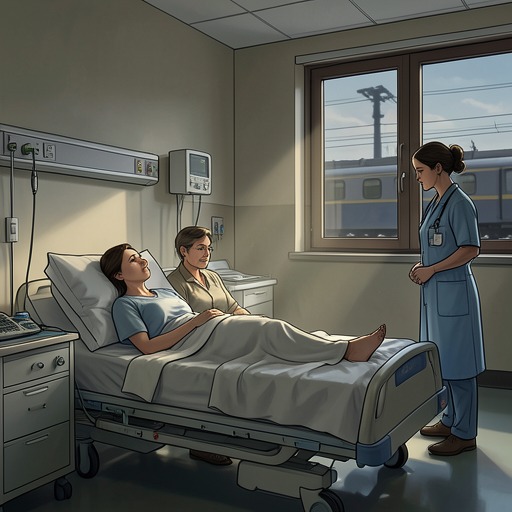
Lottie confronts her during one of her own hospital emergencies. Holding Yolandi’s hand tightly, she tells her she needs to stop getting drunk and phoning the Winnipeg hospital. The timing reverses the expected direction of care: although Lottie is the one in the hospital, connected to cables and power cords, she has recognized that her daughter is in danger of being consumed by a pattern of solitary grief. Yolandi feels ashamed, weak, and foolish. She cries, nods, apologizes, and says she will stop. Lottie’s knowledge is intimate but incomplete: she has inferred the calls from the bills, not heard their contents, and asks whether Yolandi is trying to haunt the hospital. Yolandi cannot explain what she is doing beyond saying that she does not know.
Lottie’s answer to grief
Rather than leave Yolandi alone with that shame, Lottie pulls her into a large bear hug from her hospital bed and rocks her. Yolandi bends over her mother, sobbing, and imagines the embrace as coming from the people she has lost: Elfrieda, her father, Leni, and Dan. Lottie speaks to her about love, kindness, optimism, strength, and their family. Her comfort does not provide information about Elfrieda or undo Yolandi’s grief; it makes room for Yolandi to be held while she is overwhelmed by it.
Lottie also offers a way of thinking about what cannot be neatly explained. She tells Yolandi that a person can fight hard and still acknowledge defeat, and that some things in life can be left unresolved rather than forced into a definition. For Yolandi, a writer who wants feelings to have words attached to them, that counsel is difficult. The conversation places the hospital calls within a larger struggle: the wish to name and reach the lost, against the painful recognition that neither certainty nor language can bring them back.
Stopping without forgetting
Yolandi later writes to Elfrieda that she has stopped pranking the hospital. In that account, she connects Lottie’s advice to an old moment between the sisters: when Yolandi went to school with her mother’s pantyhose pulled over her face, Elfrieda quietly told her to attempt to be cool. Yolandi still recalls that admonition, and now understands her mother’s intervention in its light. The remembered joke gives the stopping a sisterly echo, without pretending that Yolandi’s grief has ended.
The admission appears in a letter addressed to Elfrieda, so the action is reported to the absent person whose absence prompted it. Yolandi can tell her sister the calls have ceased, but the letter also preserves the longing that made them happen. The change is practical and definite—she no longer phones the hospital to ask for Elfrieda—while the emotional ending remains open. The calls stop because Lottie sees what they have become and reaches for her daughter; the love and loss that gathered around them remain part of Yolandi’s continuing account of her family.