Cherry Blossom Branches
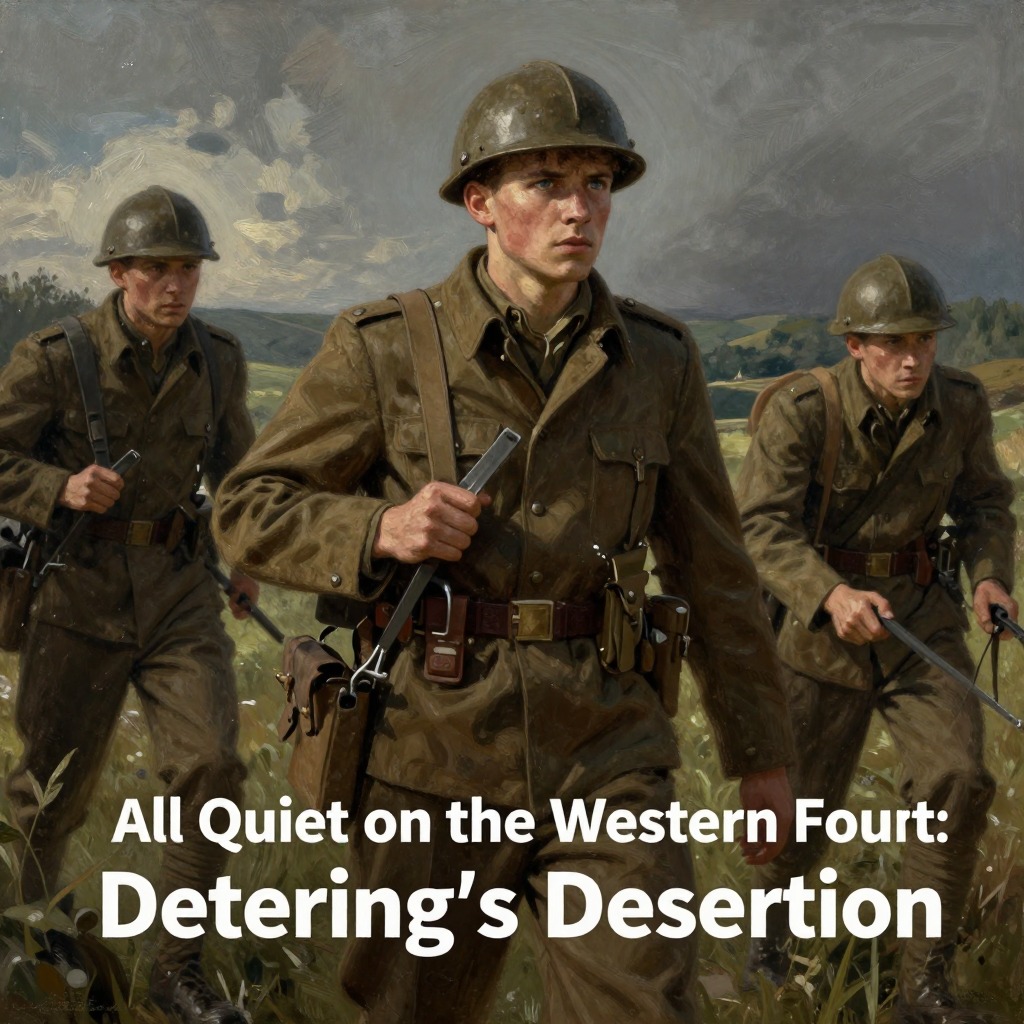
All Quiet on the Western FrontThe cherry blossom branches appear in All Quiet on the Western Front as a deceptively simple natural object that triggers one of the most telling episodes of psychological collapse in the narrative. They belong to Detering, a peasant soldier who has until then kept himself to himself, and they mark the precise moment when the accumulated weight of the war breaks through a man's defenses, turning a momentary vision of home into an act of desperate, doomed flight.
Appearance and Immediate Effect
The cherry tree is first seen by the company as they return from the front line at dawn. It stands at a turning of the road near their billets, a mass of white blossom without leaves, marvellous in the morning twilight. The sight is so striking that it seizes Detering's attention completely. That evening he is missing, and when he finally returns he carries a couple of branches of cherry blossom in his hand. His comrades make fun of him, asking whether he is going to a wedding, but Detering gives no answer and lies down on his bed. During the night Paul Bäumer hears him making a noise, as if packing, and senses something is wrong. When questioned, Detering evades, saying merely that he cannot sleep. Pressed about the cherry branches, he replies, "Surely I can pick cherry blossom if I want to!" and then adds, with a faraway look, "I have a big orchard with cherry trees at home. When they are in blossom, from the hay loft they look like one single sheet, so white. It is just the time." Paul tries to steer him toward reason, suggesting he might get leave soon or even be sent back as a farmer, but Detering nods without conviction, already lost in another world.
The Desperate Flight
The cherry blossom branches are not merely a souvenir; they become the emblem of everything Detering has left behind. The narrator notes that when peasants like Detering are excited, they have a curious expression, "a mixture of cow and yearning god, half stupid and half rapt." Paul, alert to the danger, stays awake through the first night, but Detering gives no further sign. On the second morning, however, he is gone. Paul notices but says nothing, hoping to give him time to get through—various soldiers have already escaped into Holland. But at roll call Detering is missed. A week later the company hears that he has been caught by the field gendarmes, the despised military police. He had headed toward Germany, a hopeless direction, and did everything else just as idiotically. The narrator reflects that his flight was only homesickness and a momentary aberration, but a court-martial a hundred miles behind the front line knows nothing of that. Nothing more is heard of Detering.
Thematic Significance
The cherry blossom branches crystallize a central tension in the novel: the irreconcilable distance between the soldier's inner life and the demands of the war. Detering is not a coward or a mutineer; he is a man who has endured years of horror by keeping his thoughts fixed on his farm, his wife, and the natural cycles of planting and harvest. The cherry tree in blossom—a sight that in peacetime would be merely beautiful—becomes unbearable because it reminds him too vividly of a world that still exists but is now unreachable. The branches are the object through which the war's destruction of the private self becomes visible. Unlike the more dramatic deaths of comrades, Detering's fate is swallowed by the impersonal machinery of military justice, leaving no trace but the memory of a man who could no longer bear the gap between the white blossoms of home and the grey mud of the front.