Cologne
All Quiet on the Western FrontCologne is the German city to which the hospital train carries Paul Bäumer and Albert Kropp after they are wounded, and where they are treated in a Catholic hospital. It marks the farthest point of Paul's journey home from the front and becomes the setting for his most concentrated exposure to the institutional machinery of military medicine, the suffering of mass casualties, and the moral absurdities of rear-echelon life.
Arrival and the Hospital Train
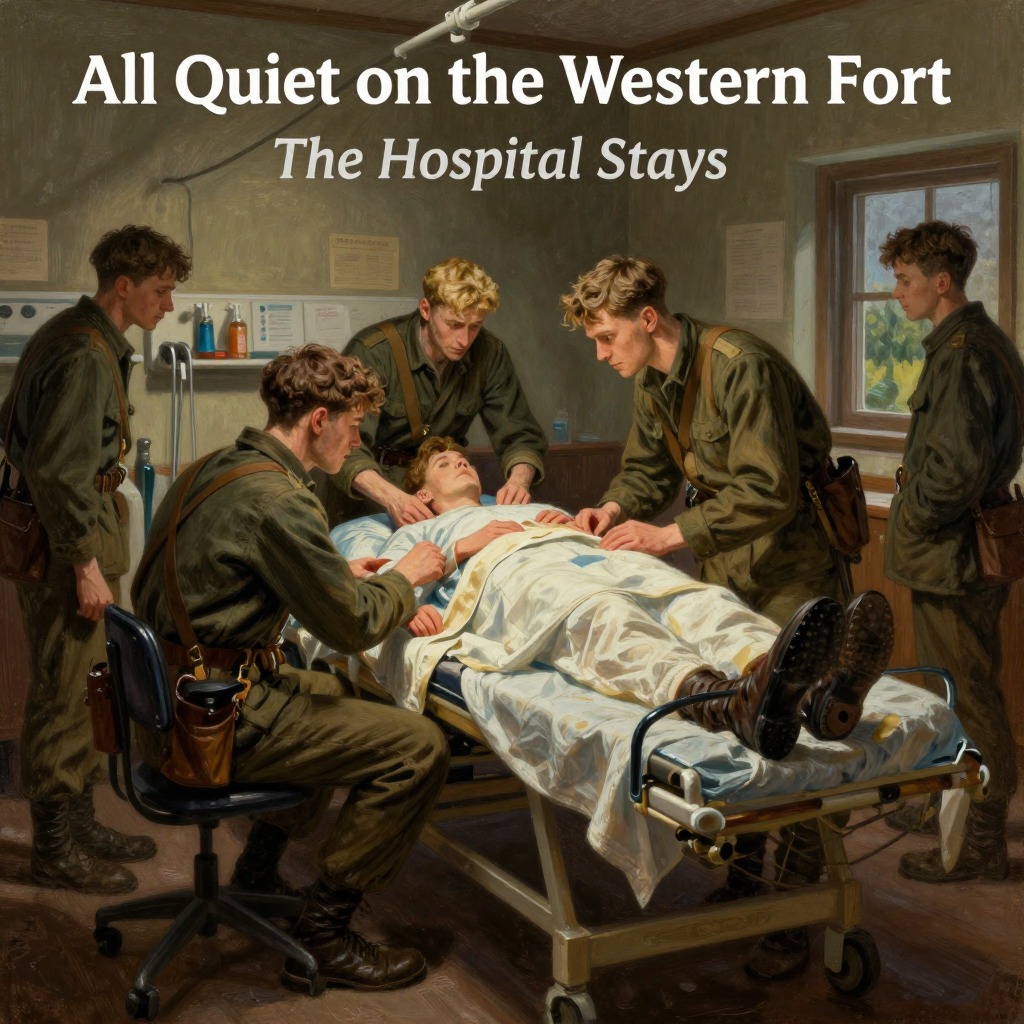
Paul and Albert are put off the train together at Cologne because Paul has faked a fever—he held his breath and pressed his face red, then used a match to drive the thermometer to 101.6°—so that he would not be separated from his friend. The sister had told Paul that Albert was to be dropped at the next station because of his fever, and Paul, unwilling to lose the last of his close comrades, manipulated his own temperature reading to stay with him. They are admitted to a Catholic Hospital, which Paul notes is considered a piece of luck because Catholic infirmaries are known for good treatment and good food. The hospital has been filled up from their train, and there are many bed cases among them.
The Ward and the Morning Devotions
Paul and Albert share a room with six other men. The first morning, the sisters leave the door open for what they call Morning Devotion, and the intoning of the litany wakes the wounded. Paul, furious, counts to five and then hurls a bottle through the door into the corridor, smashing it to pieces. The praying stops. A swarm of sisters appears and reproaches them in concert, but the men yell "Shut the door!" and the little sister who came first chirps "Heathen" as she shuts it. The hospital inspector arrives at noon and threatens them with clink, but a man named Josef Hamacher—who has a "shooting licence," a certificate of periodic non-responsibility from a head wound—claims he threw the bottle, knowing no one will dare punish him. Paul and the others are overjoyed; with Hamacher in their midst they can now risk anything.
The Dying Room and the Surgeons
Hamacher explains the hospital's geography: a little room at the corner of the building, called the Dying Room, where those about to die are put so that the sisters have less work afterward and so that no one in the ward dies in sympathy. Franz Wachter, a curly-haired man with a severe lung wound, is taken there despite his protests. He tries to roll off the trolley, crying "I won't go to the Dying Room," but they wheel him out anyway. Peter, another patient, is also taken to the Dying Room but later returns, pale, thin, upright, and triumphant, pushed by Sister Libertine—the first time Hamacher has ever known such a thing. Paul is operated on and vomits for two days; his bones will not grow together. The chief surgeon, a specialist in flat feet, operates on two young soldiers despite Hamacher's warning that the procedure gives them club feet instead. Paul sees the full range of war wounds: abdominal and spine cases, head wounds, double amputations, jaw wounds, gas cases, nose, ear, and neck wounds, blind and lung wounds, pelvis wounds, wounds in joints, kidneys, testicles, intestines. Two men die of tetanus, their skin turning pale and limbs stiffening. Paul reflects that this is only one hospital, one single station, while there are hundreds of thousands in Germany, France, and Russia, and that a hospital alone shows what war is.
Albert's Amputation and Paul's Departure
Albert's leg is amputated from the thigh. He hardly speaks anymore and says he will shoot himself the first time he can get hold of his revolver again. His stump heals well, and in a few weeks he is to go to an institute for artificial limbs. Paul gets convalescent leave and returns home to his mother, who is feeble and does not want to let him go. Parting from Albert is very hard, but Paul notes that a man gets used to that sort of thing in the army. He returns once more to the line, and Cologne recedes into the past as the war grinds on toward its final months.