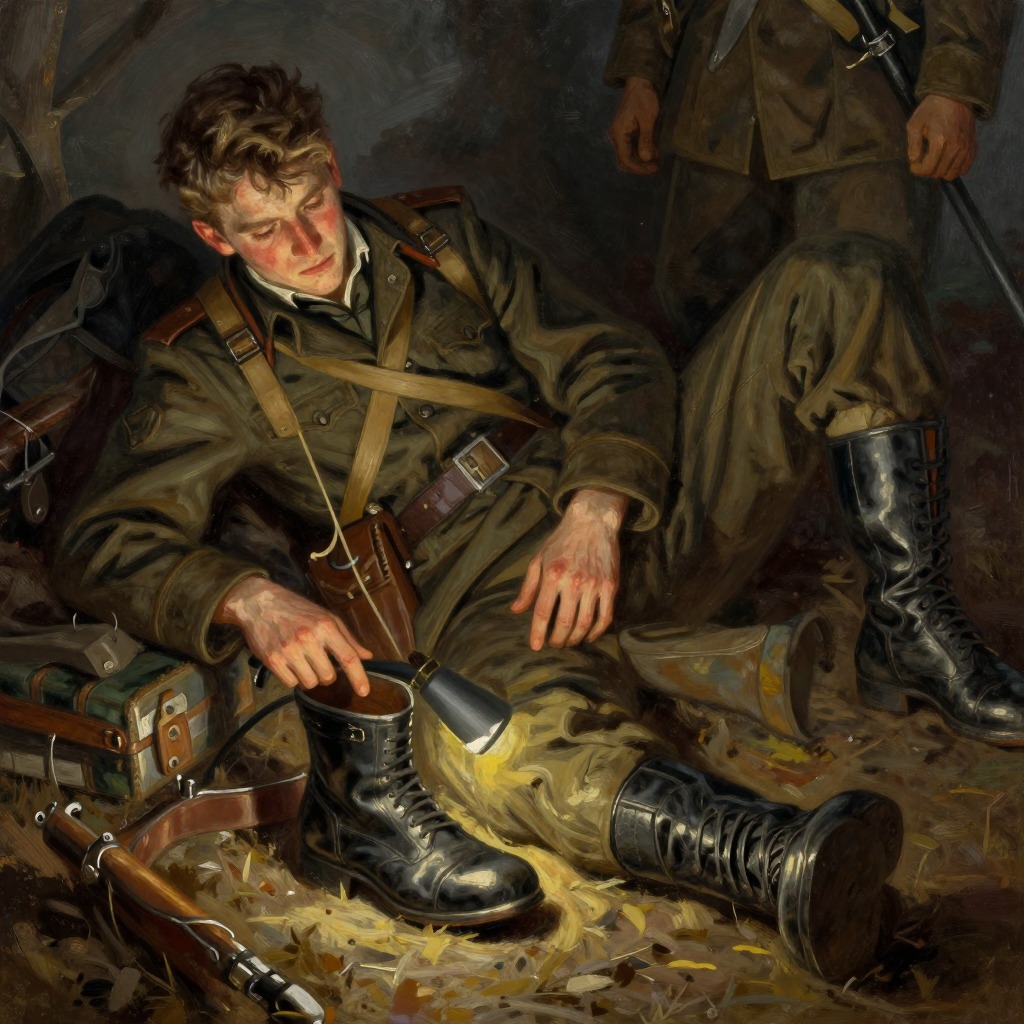
Death of Müller
All Quiet on the Western FrontMüller, the pragmatic and academically minded member of Paul Bäumer's school-friend circle, meets his end in the summer of 1918 during the final, desperate phase of the war. He is shot point-blank in the stomach with a Verey light, a flare pistol, and dies in half an hour, fully conscious and in terrible pain. His death is one of the last among the seven classmates who volunteered together, leaving Paul as the sole survivor of their group.
Identity and Background
Müller is introduced as one of the four nineteen-year-old volunteers from the same school class, alongside Paul, Albert Kropp, and Leer. He is distinguished by his practical, almost calculating nature: he still carries his school textbooks with him, dreams of examinations, and during bombardments mutters propositions in physics. His most defining trait is his unsentimental clarity about survival. When Franz Kemmerich lies dying in the hospital, Müller is the one who immediately covets Kemmerich's fine English lace-up boots, reasoning that Kemmerich will have no use for them and that they would fit him perfectly. He is not callous—Paul notes that Müller is "really quite as sympathetic as another who could not bear to think of such a thing for grief"—but he "merely sees things clearly." This same clarity leads him to press Kemmerich for the boots even as the dying man clings to them, and later to offer Paul a piece of saveloy after receiving them.
Life and Plot Trajectory
Throughout the novel, Müller remains a steady, inquisitive presence. He is the one who persistently asks his comrades what they would do if peace came, probing the existential void that the war has opened in them. He questions Kropp, Haie Westhus, Tjaden, and Detering, acting as a kind of relentless inquisitor of the future. He is also the one who, when the company is reduced from one hundred and fifty men to thirty-two, counts the survivors and notes the absurdity of their school knowledge: "What's the use? We'll have to go back and sit on the forms again." His practicality extends to the material: he is delighted when he finally gets to wear Kemmerich's boots, which fit him well, and he is the one who, during the trench assault, captures a thin loaf of white French bread, sticking it in his belt like a spade.
Key Actions and Objectives
Müller's actions are consistently driven by a clear-eyed assessment of necessity. He is the one who, when the company's cook Ginger refuses to issue rations meant for one hundred and fifty men to the eighty survivors, growls "We'll soon show you." He is also the one who, during the graveyard bombardment, uses his glasses to try to locate the wounded horses. His most significant act, however, is the inheritance and transmission of the boots. When he dies, he bequeaths his pocket-book to Paul and the boots—the same boots he had inherited from Kemmerich—to Paul, who later promises them to Tjaden. This chain of inheritance, from Kemmerich to Müller to Paul to Tjaden, becomes a stark symbol of the war's relentless consumption of lives, where even the most prized possessions are passed on only because their owners die.
Relationships and Conflict
Müller's relationships are defined by his unsentimental loyalty. He is a core member of the group that includes Paul, Kropp, Katczinsky, Tjaden, Haie Westhus, and Detering. He shares in their collective experiences—the goose raid, the trench assaults, the rest periods—and is accepted despite his bluntness. His conflict is not with other characters but with the war itself, which he confronts with a rational, almost academic detachment. He is the one who, when the company sees a stack of brand-new yellow coffins before an offensive, says flatly, "That's a good preparation for the offensive." His death, by a Verey light, is a grotesque irony: a signal flare, meant for illumination, becomes the instrument of his killing.
Change and Ending
Müller's death is narrated with brutal brevity. "Müller is dead. Someone shot him point-blank in the stomach with a Verey light. He lived for half an hour, quite conscious, and in terrible pain." Before he dies, he hands over his pocket-book to Paul and bequeaths him the boots. Paul wears them, noting they fit him quite well, and promises them to Tjaden after him. Müller is buried, but Paul knows he "is not likely to remain long undisturbed" as the lines are falling back. His death, like Kemmerich's and Haie Westhus's before him, is a step in the systematic erasure of Paul's generation. By the end, Paul is the last of the seven classmates.
Narrative Role and Evaluation
Müller functions as the rational, pragmatic counterpoint to the more emotional or impulsive members of the group. His persistent questioning about the future underscores the theme that the war has destroyed any possibility of a normal life for his generation. His inheritance of the boots from Kemmerich and their subsequent bequest to Paul creates a powerful motif of material continuity amid human loss. His death, by a weapon as absurd as a flare pistol, highlights the random, senseless nature of the war's violence. He is not a hero in any conventional sense, but a representative of the ordinary soldier—intelligent, practical, and ultimately disposable.