Detering
All Quiet on the Western FrontDetering is a peasant soldier in the Second Company, a man defined by his unbreakable bond to his farmyard, his wife, and the rhythms of rural life. He is sparing with words, but when he speaks it is of the land: he thinks of nothing but his farm and his wife, and every day he reads the newspapers to see whether it is raining in his little corner of Oldenburg. His identity is rooted in the soil, and the war is for him not an adventure or a duty but an interruption of the only life that matters.
Life and Character
Detering is introduced among the core group of friends who gather at the cookhouse after the company's heavy losses, but he stands apart from the others in his quiet, inward-looking nature. While Tjaden schemes for extra rations and Müller calculates the value of Kemmerich's boots, Detering remains absorbed by thoughts of home. When Müller, acting like an inquisitor, asks each man what he would do if peace came, Detering looks at the sky and says only: "I would go straight on with the harvesting." Then he gets up and walks off. His wife has to look after the farm alone; they have already taken away two more of his horses. The hay has not yet been brought in. This single-minded devotion to his land and his animals is the core of his character, and it makes him the most vulnerable of the group to the war's assault on the ordinary.
The Horses and the Breaking Point
Detering's first visible fracture comes during the bombardment when wounded horses begin to scream. The cries are unendurable—"the moaning of the world, the martyred creation, wild with anguish." Detering, a farmer who is very fond of horses, stands up and raves: "God! For God's sake! Shoot them." He yells out again, "Shoot them! Shoot them, can't you? damn you again!" When Kat quietly says they must look after the men first, Detering raises his gun and aims at the suffering animals, but Kat knocks the rifle aside. Detering trembles and throws his rifle on the ground. Later, as the wounded beasts are finally shot, he walks up and down cursing, and his voice, agitated and almost dignified, declares: "I tell you it is the vilest baseness to use horses in the war." This moment reveals that his moral universe, built on the humane treatment of animals and the sanctity of the farm, cannot accommodate the war's cruelty.
The Cherry Tree and Desertion
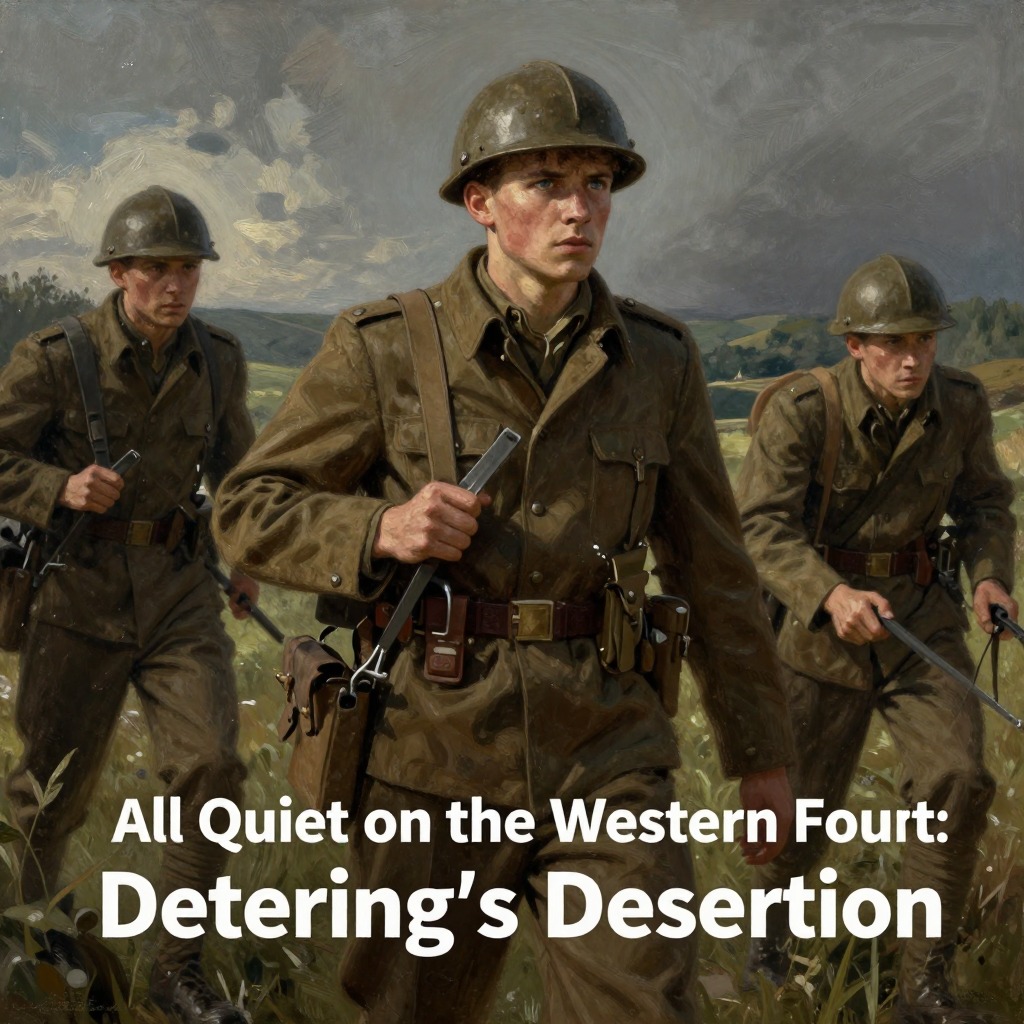
Months later, when the company is returning from the front line, Detering sees a cherry tree in a garden. It has no leaves but is one white mass of blossom. That evening he is not to be seen; he returns with a couple of branches of cherry blossom in his hand. When the others make fun of him, he lies down on his bed without answering. During the night Paul hears him packing. Paul warns him not to do anything foolish, but Detering evades the question, then confesses: "I have a big orchard with cherry trees at home. When they are in blossom, from the hay loft they look like one single sheet, so white. It is just the time." Paul tries to reassure him that he may get leave or be sent back as a farmer, but Detering is far away, his expression a mixture of cow and yearning god, half stupid and half rapt. The next morning he is gone. He heads toward Germany, a hopeless route, and is caught by the field gendarmes—the despised military police. The court-martial, a hundred miles behind the front, knows nothing of homesickness or momentary aberration. Nothing more is heard of Detering.
Thematic Significance
Detering's fate illustrates the impossibility of the peasant soldier's world surviving the war. His desertion is not cowardice but a desperate attempt to return to the only reality he recognizes: the land, the harvest, the cherry orchard. The war, which has already taken his horses and his peace of mind, finally takes him as well, not through a bullet but through the machinery of military justice. His story is one of the quiet, cumulative destructions that the novel chronicles—a man broken not by a single wound but by the slow erosion of everything that made his life worth living. He is one of the generation that, even if they escaped the shells, were destroyed by the war.