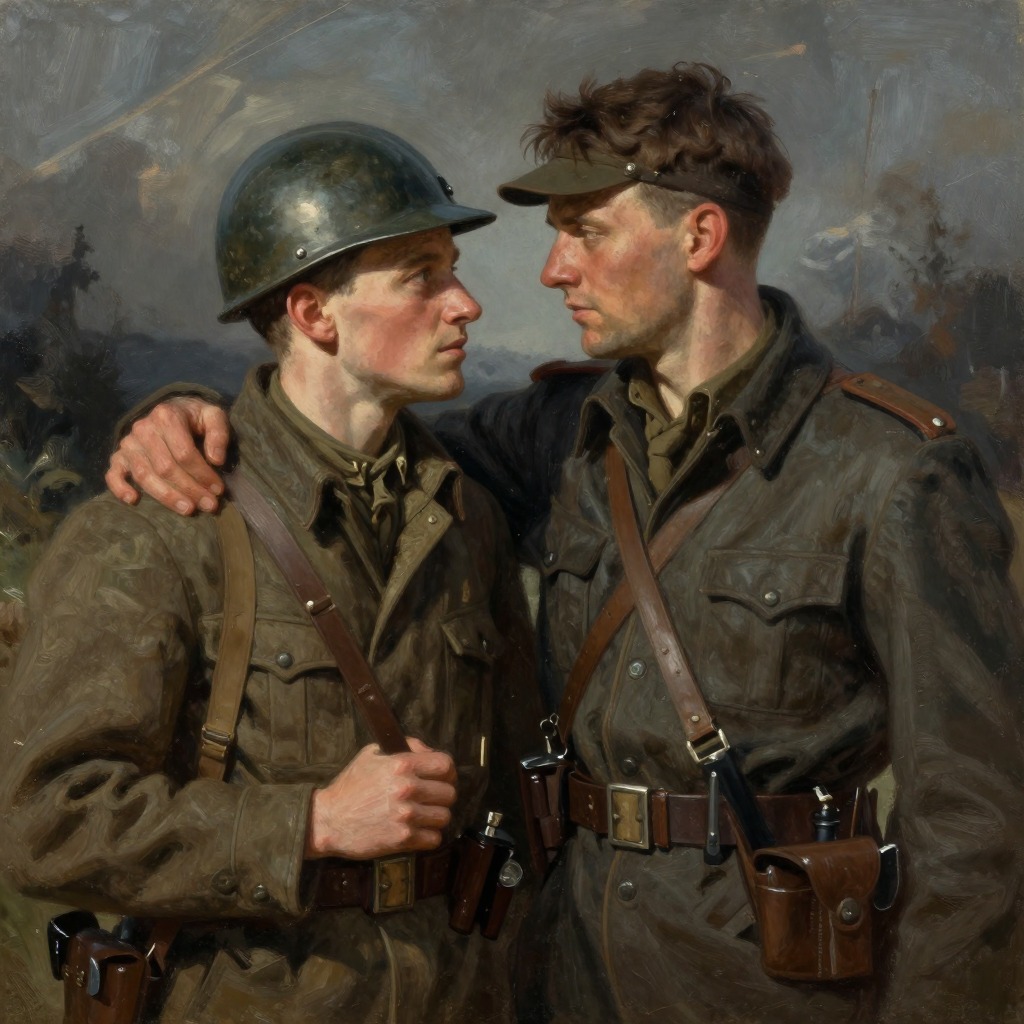
Friendship between Paul Bäumer and Stanislaus Katczinsky
All Quiet on the Western FrontThe friendship between Paul Bäumer and Stanislaus Katczinsky is the deepest and most defining bond in All Quiet on the Western Front, a relationship that transcends age, background, and rank to become the emotional anchor of Paul's war experience. Kat, a shrewd, forty-year-old cobbler with a sixth sense for survival, becomes Paul's mentor, protector, and closest comrade, and their connection embodies the novel's central theme of comradeship as the only sustaining force against the annihilation of war.
Origins and Early Bond
Paul first introduces Kat as the leader of their group, a man with "a face of the soil, blue eyes, bent shoulders, and a remarkable nose for dirty weather, good food, and soft jobs." From the earliest days in the field, Kat's practical cunning sets him apart. When the company receives a windfall of double rations due to a miscalculation, it is Kat who confronts the sergeant-cook Ginger, demanding the food that belongs to the eighty survivors. His authority is natural, not official. Paul quickly learns to rely on Kat's instincts. Kat can find anything: a stove and wood in a cold factory, hay and straw for bedding, and above all, food. His masterpiece was four boxes of lobsters, though Paul admits they would rather have had a good beef steak. Paul observes that if Kat were planted in the middle of the desert, in half an hour he would have gathered together a supper of roast meat, dates, and wine. This uncanny ability to conjure provisions out of nothing makes Kat indispensable, and Paul's admiration is evident.
Shared Exploits and Rituals of Survival
The bond between Paul and Kat is forged in shared acts of survival and defiance. The most memorable of these is the goose-stealing episode. Kat marks the spot of a shed belonging to regimental headquarters, and Paul agrees to get the goose. Kat hoists him over the wall and keeps watch below. Paul's attempt goes wrong when a bull dog pins him down, but he manages to shoot it and toss the goose over the wall. They run off together, and later, in a small deserted lean-to, they roast the goose. Paul describes the scene: "We sit opposite one another, Kat and I, two soldiers in shabby coats, cooking a goose in the middle of the night. We don't talk much, but I believe we have a more complete communion with one another than even lovers have." He reflects that formerly they would not have had a single thought in common, but now they sit with a goose between them and feel in unison, so intimate that they do not even speak. This ritual of shared food and silent companionship becomes a template for their relationship. They also share the thrashing of Himmelstoss, the hated drill-sergeant. Paul is part of the group that ambushes Himmelstoss, and though Haie Westhus delivers the blows, the act is a collective one that binds them all, with Kat as the moral center of the group.
Mutual Protection and Dependence
Kat repeatedly saves Paul's life. During the graveyard bombardment, when gas shells fall, Paul is disoriented. Kat, already masked, grabs him and yells "Gas--Gaas--Gaaas--Pass it on." Paul grabs his own mask and helps a recruit, but it is Kat's alertness that saves them both. Later, when Paul is trapped in a shell-hole after killing the French printer Gérard Duval, it is Kat and Albert Kropp who come out with a stretcher to look for him. Paul calls out, and Kat's answering voice is the most comforting thing he knows. Paul reflects that these voices are more than motherliness and more than fear; they are the strongest, most comforting thing there is anywhere: the voices of his comrades. The dependence is mutual. When Kat is wounded in the shin during the summer of 1918, Paul carries him on his back to the dressing station, refusing to leave him. He says, "When Kat is taken away I will not have one friend left." He writes Kat's address in his pocket book and feels forlorn already, even though Kat still sits beside him. He even considers shooting himself in the foot to be able to go with him. But when they reach the dressing station, Paul discovers that Kat has been killed by a tiny splinter in the head. The orderly asks if they are related. Paul thinks, "No, we are not related. No, we are not related." The denial underscores that their bond is deeper than blood.
Thematic Significance
The friendship between Paul and Kat is the novel's most powerful illustration of comradeship as a survival mechanism. Kat represents the older generation of soldiers who have a background—a wife, a trade, a life before the war—that Paul and his classmates lack. Yet Kat chooses to share his wisdom and his provisions with the younger men. Paul says, "We couldn't do without Katczinsky; he has a sixth sense." Kat's practical philosophy—"Give 'em all the same grub and all the same pay / And the war would be over and done in a day"—grounds Paul's own disillusionment. When Paul returns from leave, he feels alienated from his family and his past, but back with Kat and Albert, he feels he belongs. Kat's death marks the final severing of Paul's last meaningful human connection. After Kat dies, Paul is the last of the seven from his class. The friendship is not sentimentalized; it is hard-won, practical, and unsentimental, yet it carries the full weight of what it means to love and lose in a world where death is the only certainty.