Goose-Stealing Episode
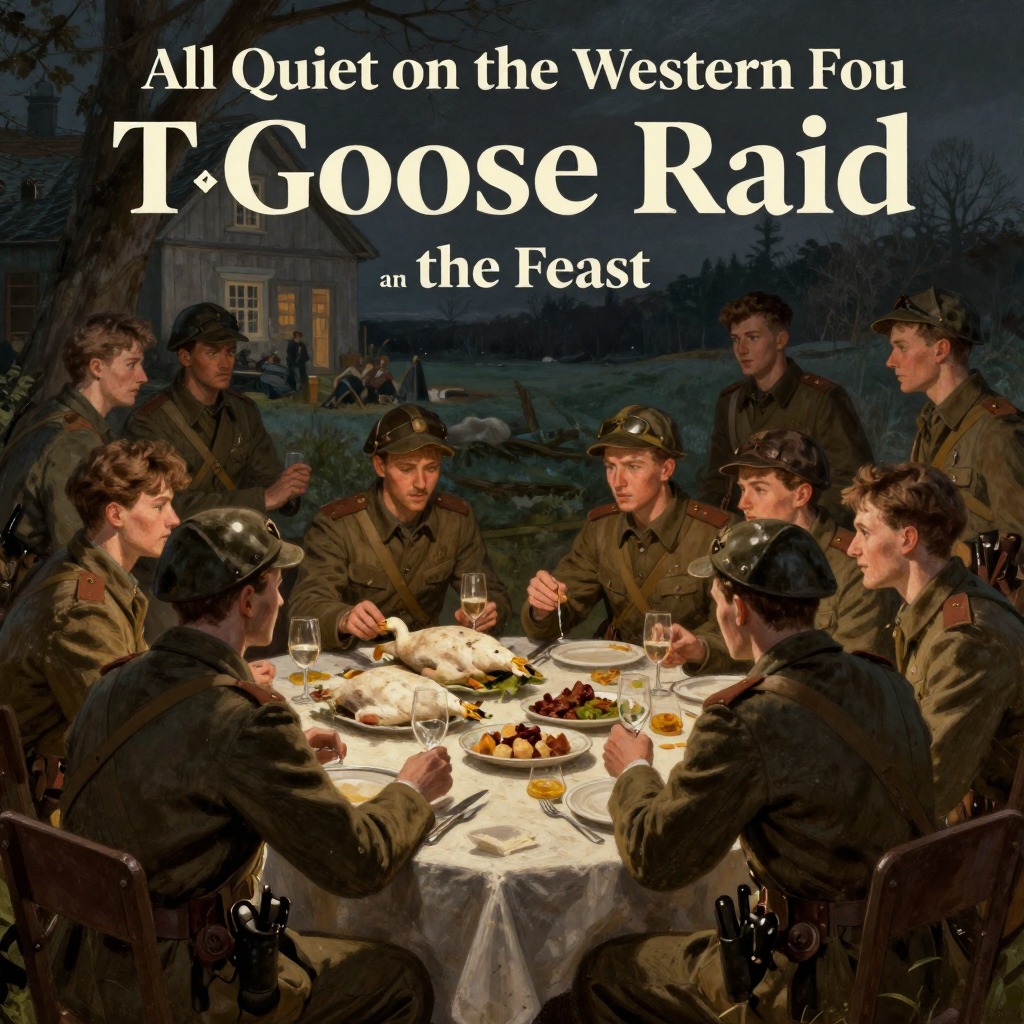
All Quiet on the Western FrontThe Goose-Stealing Episode is one of the most memorable and symbolically rich sequences in All Quiet on the Western Front, a nocturnal raid that transforms a simple act of theft into a profound ritual of comradeship and survival. In the midst of a war that systematically strips men of their humanity, Paul Bäumer and Stanislaus Katczinsky steal two geese from a regimental headquarters, roast them in a hidden lean-to, and share the feast with their imprisoned comrades, Albert Kropp and Tjaden. The episode is a microcosm of the soldiers' resourcefulness, their desperate hunger for normalcy, and the deep, wordless bond that sustains them in the face of annihilation.
Background and Motivation
The episode occurs during a period of rest behind the lines, after the company has endured heavy shelling and the loss of many men. The soldiers are billeted in huts, and the rumour has just materialised that Himmelstoss, their hated former drill-sergeant, has arrived at the front. Tjaden and Kropp have been sentenced to open arrest in a converted fowl-house for insubordination against Himmelstoss, and the group is playing skat far into the night. It is in this context of enforced idleness and simmering resentment that Katczinsky, the group's shrewd and resourceful leader, proposes the raid. He has already marked the exact spot: a shed belonging to a regimental headquarters, where two geese are kept. The ride to the location costs them two cigarettes, a small price for the promise of a proper meal.
The Raid and Its Perils
The theft itself is a tense and near-comic struggle. Katczinsky hoists Paul over the wall, and Paul creeps to the shed, lifts the peg, and opens the door. He distinguishes two white patches—two geese. Realising that if he grabs one the other will cackle, he decides to take both. He jumps, catches hold of one and then the second, and bashes their heads against the wall to stun them. But the geese fight back with surprising ferocity, kicking and cackling. In the dark, their white patches become terrifying, and Paul feels as though he is holding captive balloons. The row attracts a bull dog, which pins him to the floor. Paul lies still, tucking his chin into his collar, and inches his hand toward his small revolver. When he finally fires, the dog leaps howling to one side, and Paul seizes one goose, tosses it over the wall, and climbs up just as the dog springs at him again. He drops down on the other side, and Kat is already there with the goose under his arm. They run until they can take a breather.
The Roasting and the Communion
The goose is dead, and they intend to roast it at once so that nobody will be any wiser. They crawl into a small, deserted lean-to that they use for such purposes, with a single window space heavily curtained. They kindle a fire, and Kat plucks and cleans the goose, carefully setting the feathers aside to make two cushions inscribed "Sleep soft under shell-fire." The sound of gunfire from the front penetrates the refuge, and the glow of the fire lights up their faces as shadows dance on the wall. They sit opposite one another, two soldiers in shabby coats, cooking a goose in the middle of the night. They do not talk much, but Paul reflects that they have a more complete communion with one another than even lovers have. They are two minute sparks of life on the edge of the circle of death, and the hour is flecked over with the lights and shadows of their feelings cast by a quiet fire. The roasting takes a long time, and they take turns basting the goose while the other sleeps. In a half-sleep, Paul watches Kat dip and raise the ladle, and he loves him—his shoulders, his angular, stooping figure. When the goose is done, they eat slowly and with gusto, using their collapsible forks and pocket-knives, dipping army bread in the gravy. They are brothers, pressing on one another the choicest pieces.
Sharing the Feast
After the meal, Paul suggests taking some to Kropp and Tjaden, who are still in the fowl-house under arrest. Kat agrees, and they carve off a portion and wrap it carefully in newspaper. They decide to take it all, and they go off to waken the prisoners. Kropp and Tjaden take them for magicians, then get busy with their teeth. Tjaden holds a wing in his mouth with both hands like a mouth-organ, gnaws, drinks the gravy from the pot, and smacks his lips, saying, "May I never forget you!" The episode ends with Paul walking back to his hut under the lofty sky with the stars and the oncoming dawn, a soldier with big boots and a full belly, but by his side, stooping and angular, goes Kat, his comrade.
Consequences and Thematic Significance
The Goose-Stealing Episode is a powerful illustration of the soldiers' resourcefulness and their ability to carve out moments of joy and humanity in the midst of war. It is also a profound meditation on comradeship. The act of stealing, roasting, and sharing the goose is a ritual that binds the men together, creating a sense of intimacy and trust that transcends words. The episode contrasts sharply with the surrounding violence and deprivation, offering a rare glimpse of warmth, abundance, and communal pleasure. It also highlights Katczinsky's almost supernatural ability to procure food and comfort, a skill that makes him indispensable to the group. The memory of this night—the taste of the goose, the glow of the fire, the presence of Kat—becomes a touchstone for Paul, a symbol of the life and connection that the war is constantly trying to destroy.