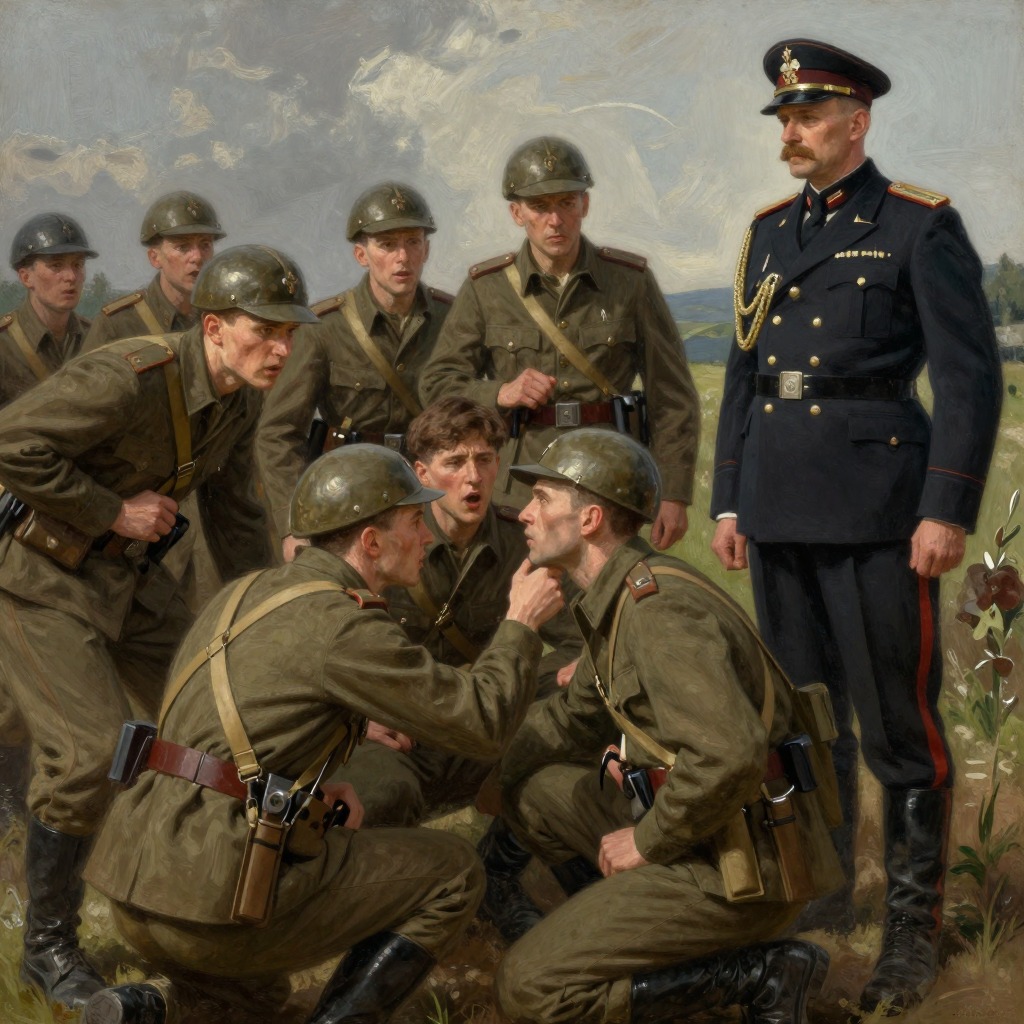
Kaiser Wilhelm II
All Quiet on the Western FrontKaiser Wilhelm II, the German Emperor, appears only once in person in All Quiet on the Western Front, yet his brief inspection of the troops crystallizes the vast distance between the monarch who embodies the nation and the soldiers who are sacrificed for it. His visit provokes a rare moment of political speculation among the men, revealing both their ignorance of how wars are begun and their bitter intuition that the conflict serves interests far above their own. The Kaiser functions less as a character than as a symbol of an authority so remote that it becomes almost absurd, a figure whose power is both absolute and incomprehensible to the men who must stand stiffly before him.
The Inspection and Its Aftermath
The Kaiser arrives after a week of intense polishing and drill that exasperates the soldiers more than frontline duty. The men are inspected at every turn, issued new uniforms that will be taken back immediately after the parade, and subjected to the kind of parade-ground fuss they thought they had left behind. When the Kaiser finally appears, Paul Bäumer is disappointed: judging from his pictures, Paul had imagined him bigger and more powerfully built, with a thundering voice. Instead, the Kaiser stalks along the line distributing Iron Crosses and speaking to this man and that, a figure whose physical ordinariness clashes with the elaborate ceremony surrounding him. After the inspection, the men discuss what they have seen. Tjaden, the simple-minded locksmith, asks with genuine astonishment whether even Hindenburg has to stand stiffly before the Kaiser, and then wonders whether a king would have to stand stiffly before an emperor. None of the men is quite sure, but they suppose that both are so exalted that standing strictly to attention is probably not insisted on. Tjaden's most profound question—whether an emperor has to go to the latrine the same as he does—reveals how utterly alien the concept of supreme authority is to men who have been stripped of all pretense and dignity.
The Question of War and Responsibility
The Kaiser's visit sparks a deeper conversation about the origins of the war. Albert Kropp asks whether there would have been a war if the Kaiser had said No. Paul interjects that the Kaiser was against it from the first, but when Kropp presses further—suggesting that if twenty or thirty people in the world had said No, the war might have been avoided—Paul agrees but adds bitterly that they damned well said Yes. The conversation meanders through the contradictions of patriotism: the French professors and parsons and newspapers say they are right, the German ones say the same, and yet the war continues. Katczinsky, the shrewd veteran, cuts through the abstraction: there must be some people to whom the war is useful. Tjaden, who has never felt offended by any country, concludes that he has no business there at all. The discussion reveals that the men, who are doing the actual fighting, have no stake in the political rationalizations that sent them to war. Katczinsky observes that every full-grown emperor requires at least one war to become famous, and Detering adds that generals become famous through war. The Kaiser, in this light, is not a father figure protecting his people but a ruler whose historical reputation depends on the slaughter of his own subjects.
The Kaiser as a Symbol of Lost Authority
The Kaiser's appearance in the novel is deliberately anticlimactic. He is not a tyrant or a villain but a figure whose power is so abstract that the soldiers cannot even imagine its reality. Tjaden's comic bewilderment—"So that is the All-Highest! And everyone, bar nobody, has to stand up stiff in front of him!"—captures the absurdity of a system in which a single man's whim can set millions of men in motion, yet that man remains unknowable, untouchable, and ultimately irrelevant to the men who die. The Kaiser's visit does not inspire loyalty or patriotism; it provokes a series of questions that the men cannot answer and that the war itself will render moot. By the time Paul Bäumer falls in October 1918, on a day so quiet that the army report confined itself to the single sentence "All quiet on the Western Front," the Kaiser has long since vanished from the narrative, a distant figure whose war has consumed an entire generation and left nothing but silence.