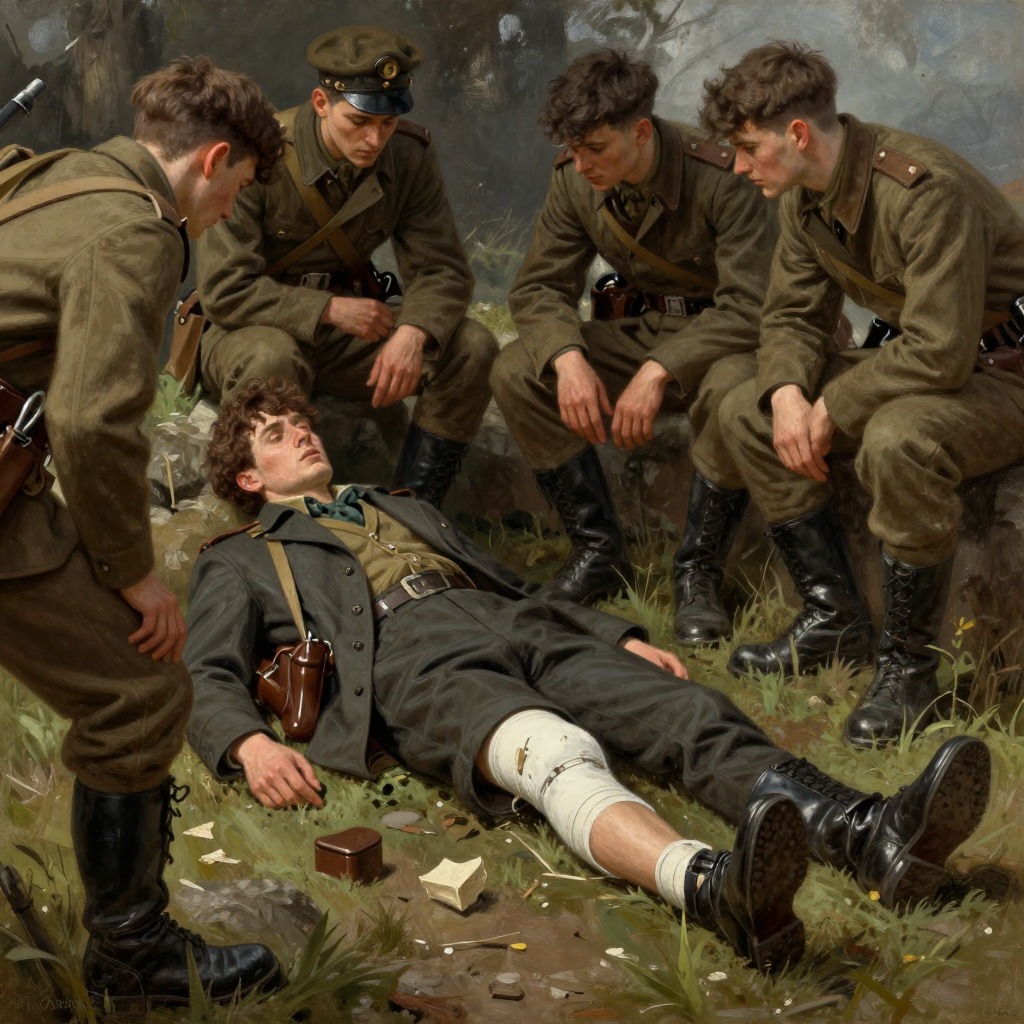
Kemmerich's Death
All Quiet on the Western FrontFranz Kemmerich, a former classmate of Paul Bäumer and the other young volunteers from Kantorek's schoolroom, dies in the St. Joseph's Hospital from a thigh wound that has already cost him his leg. His death is the first sustained encounter the reader has with the process of dying on the Western Front, and it establishes the emotional and moral economy that governs the soldiers' lives: the simultaneous presence of grief, pity, and a hard-headed practicality about scarce resources.
Identity and Background
Kemmerich is introduced as one of the four who joined up from the same class as volunteers, alongside Paul Bäumer, Albert Kropp, and Müller. He is remembered as having a face like a child, frail bones that gave him flat feet after only four weeks of pack-carrying, and a gentle, almost girlish quality—his skin was very white, his hair flew in his face like silk when he did the giant's turn on the horizontal bar, and Kantorek was proud of him. He was the only one who could perform that gymnastic feat. At school he wore a brown coat with a belt and shiny sleeves, and Paul had copied his essays. His mother, a plump matron, wept uncontrollably at the station and repeatedly implored Paul to look after her son.
The Hospital Scene and the Amputation
When Paul, Müller, and Kropp visit him, the dressing station reeks of carbolic, pus, and sweat—a smell that makes even the hardened soldiers feel faint. Kemmerich lies in a large room, his leg under a wire basket that arches the bed covering. The orderlies have already told the visitors that the leg is amputated, but Kemmerich himself does not yet know. He complains of a pain in his foot. His face is yellow and wan, marked by the strained lines the soldiers have seen hundreds of times—lines that are not so much marks as the evidence that death is already working through from within, pressing out the boundaries of the body. His voice sounds like ashes. While he was unconscious, someone stole his watch. Müller, crude and tactless, shakes his head and says he always warned that nobody should carry such a good watch. The boots are the real object of attention: fine English boots of soft yellow leather that lace to the knee, things to be coveted. Müller matches their soles against his own clumsy boots and asks if Kemmerich will be taking them with him. All three have the same thought: even if he should recover, he could use only one boot. Müller suggests an exchange, but Kemmerich refuses; they are his most prized possessions. Paul treads on Müller's foot, and reluctantly the boots are put back under the bed.
The Vigil and the Death
Paul returns alone to sit by Kemmerich's bed. The doctor passes without once looking at him. Kemmerich raises himself on his elbows and says, "They have amputated my leg." Paul tries to comfort him with talk of artificial limbs and home, but Kemmerich whispers, "I don't think so." He speaks of having wanted to become a head-forester. Then he offers his lace-up boots to Müller. Paul watches the physical process of dying: the lips fall away, the mouth becomes larger, the teeth stick out like chalk, the flesh melts, the forehead bulges, the cheekbones protrude, the eyes sink in. He thinks of how Kemmerich looked when they bathed—slight and frail as a child—and the thought rises: "The whole world ought to pass by this bed and say: 'That is Franz Kemmerich, nineteen and a half years old, he doesn't want to die. Let him not die!'" The atmosphere of carbolic and gangrene clogs the lungs like a thick gruel. Kemmerich whispers about his watch, asking Paul to send it home. Paul does not reply; it is no use. He tries to talk to him as though that could save him, describing the convalescent home at Klosterberg, the fields, the poplars by the Klosterbach where they used to catch sticklebacks. Kemmerich cries. Paul puts his arm around his shoulder and puts his face against his. An hour passes. Kemmerich says nothing of his mother or his brothers and sisters; he is entirely alone now with his little life of nineteen years, and cries because it leaves him. Paul reflects that this is the most disturbing and hardest parting he has ever seen, worse than Tiedjen, who called for his mother and held off the doctor with a dagger until he collapsed.
The Aftermath and the Boots
Kemmerich begins to gurgle. Paul rushes out and seizes a white apron, demanding the doctor. The doctor frees himself and asks an orderly which bed it is. Told "Bed 26, amputated thigh," he sniffs and says, "How should I know anything about it, I've amputated five legs to-day," and hurries off to the operating room. The orderly tells Paul that one operation after another has been going on since five o'clock that morning, and that there have already been sixteen deaths—Kemmerich will be the seventeenth. Paul becomes faint, unable to do any more. When they return to the bed, Kemmerich is dead. The face is still wet from the tears; the eyes are half open and yellow like old horn buttons. The orderly pokes Paul and asks if he is taking the things. He collects Kemmerich's identification disc and paybook. Behind him, they are already hauling Franz onto a waterproof sheet. Outside, the darkness and the wind feel like a deliverance. Paul breathes deeply, and thoughts of girls, flowery meadows, and white clouds come into his head. He runs. Müller is waiting in front of the hut. Paul gives him the boots. Müller tries them on; they fit well. He offers Paul a piece of saveloy, and with it hot tea and rum.
Thematic Significance
Kemmerich's death establishes the pattern that will repeat throughout the novel: a young man dies, and his possessions—especially his boots—are immediately reallocated to the living. The boots pass from Kemmerich to Müller, and later from Müller to Paul, and Paul has promised them to Tjaden after him. This circulation of gear is not callousness but a survival mechanism in a world where good boots are scarce and the dead have no further use for them. The scene also introduces the brutal efficiency of the medical system, where a surgeon who has amputated five legs in a day has no time to attend to a dying boy, and where the bed is needed for the next casualty before the body is cold. Paul's promise to write to Kemmerich's mother—and his later, more painful visit to her during his leave—becomes a recurring obligation that ties the front to the home front. The death is the first crack in the "Iron Youth" rhetoric, the first proof that the generation of Kantorek's pupils is being destroyed, not forged, by the war.