Marja
All Quiet on the Western FrontMarja is the wife of Lewandowski, a Polish soldier who has lain ten months in the Catholic Hospital with a severe abdominal wound. She appears in the novel only once, but her visit transforms the ward into a space of shared humanity and practical tenderness, cutting through the institutional routines of pain and death.
Appearance and Arrival
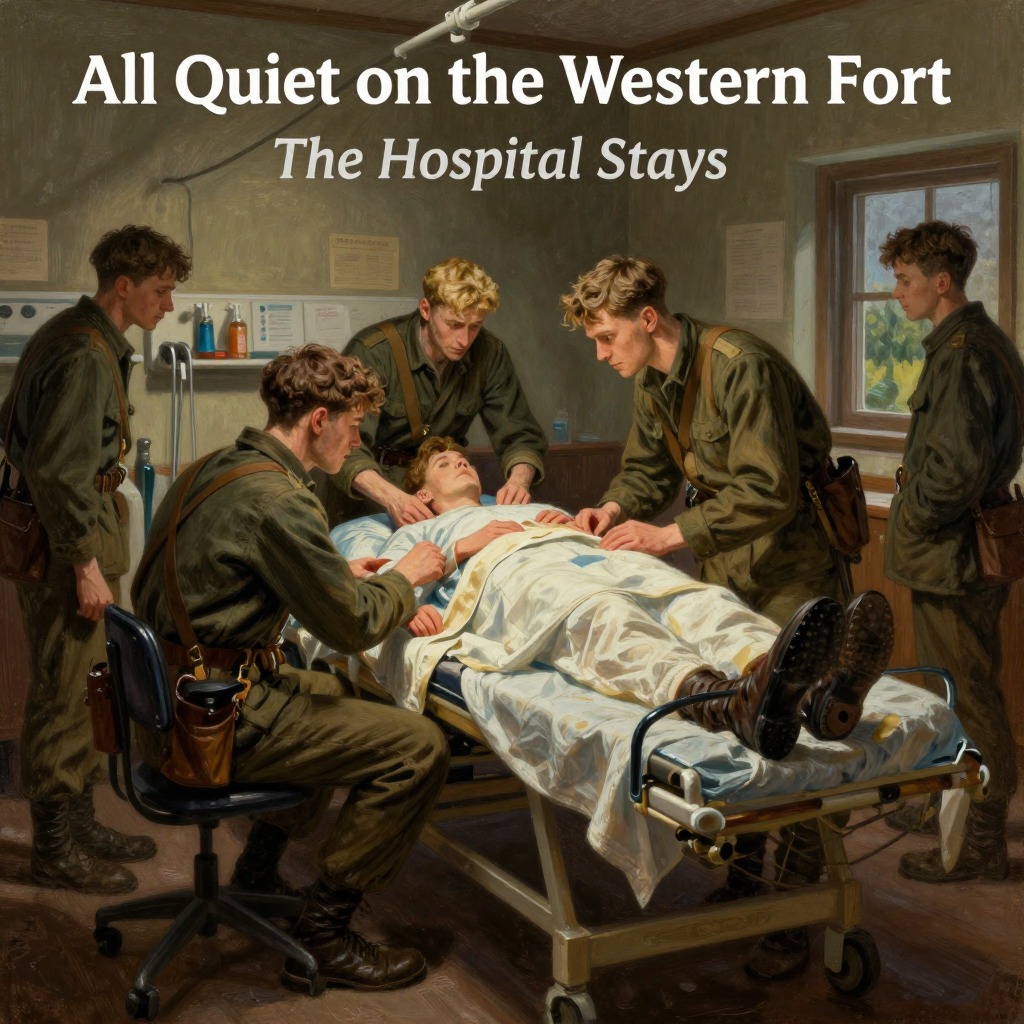
Marja is described as a tousled little woman with anxious, quick eyes like a bird, wearing a sort of black crinkly mantilla with ribbons. She arrives with the child she has given birth to during the two years since she last saw her husband. She stands shyly in the doorway, murmuring softly, and is terrified at first by the presence of six men in the room. Lewandowski reassures her, telling her they will not hurt her, and she goes around proffering each of them her hand. She then produces the child, which has soiled its napkin, and from a large handbag embroidered with beads she takes out a clean one and makes the child fresh and presentable. This practical act dispels her first embarrassment, and the two begin to talk.
The Ward's Conspiracy
Lewandowski is in great excitement and has lost his appetite, even giving away red cabbage and sausage. He has developed a fever and has to go back to bed. He had hoped to get permission to go out when his wife came, for he wants something else besides seeing her. The men of the ward have discussed it with him at great length; in the army there are no secrets about such things. Those who are already able to go out have told him of good spots in the town, parks and squares, where he would not be disturbed. But now Lewandowski lies in bed with his troubles. The men console him and promise to get over the difficulty somehow. When the time is favourable—the doctor's visit is over and no sister is in sight—one of them goes out to prospect and returns nodding. Two men stand at the door to forestall the sisters and keep them occupied if they chance to come along, agreeing to stand guard for a quarter of an hour. Lewandowski can only lie on his side, so one of them props a couple of pillows against his side. Albert Kropp gets the child to hold. The men all turn round a bit, the black mantilla disappears under the bedclothes, they make a great clatter and play skat noisily. After a while the child begins to squall, although Albert, in desperation, rocks it to and fro. There is a bit of creaking and rustling, and as they look up casually they see that the child has the bottle in its mouth and is back again with its mother. The business is over.
Aftermath and Significance
The men now feel themselves like one big family. The woman is happy, and Lewandowski lies there sweating and beaming. He unpacks the embroidered handbag, and some good sausages come to light. He takes up the knife with a flourish and saws the meat into slices. With a handsome gesture he waves toward the men, and the little woman goes from one to another, smiling and handing round the sausage. She now looks quite handsome. They call her Mother, she is pleased, and shakes up their pillows for them. Marja's visit is a brief eruption of ordinary life into the hospital's world of bandages, amputations, and the Dying Room. She is not a developed character but a catalyst: her presence forces the wounded men to act as guardians of a fragile, illicit intimacy, and her acceptance of their help—and her gift of sausage—creates a moment of communal warmth that stands in stark contrast to the surrounding horror. The scene underscores the novel's theme that, in the face of death, the simplest human connections become the most profound acts of resistance.