Roast Goose
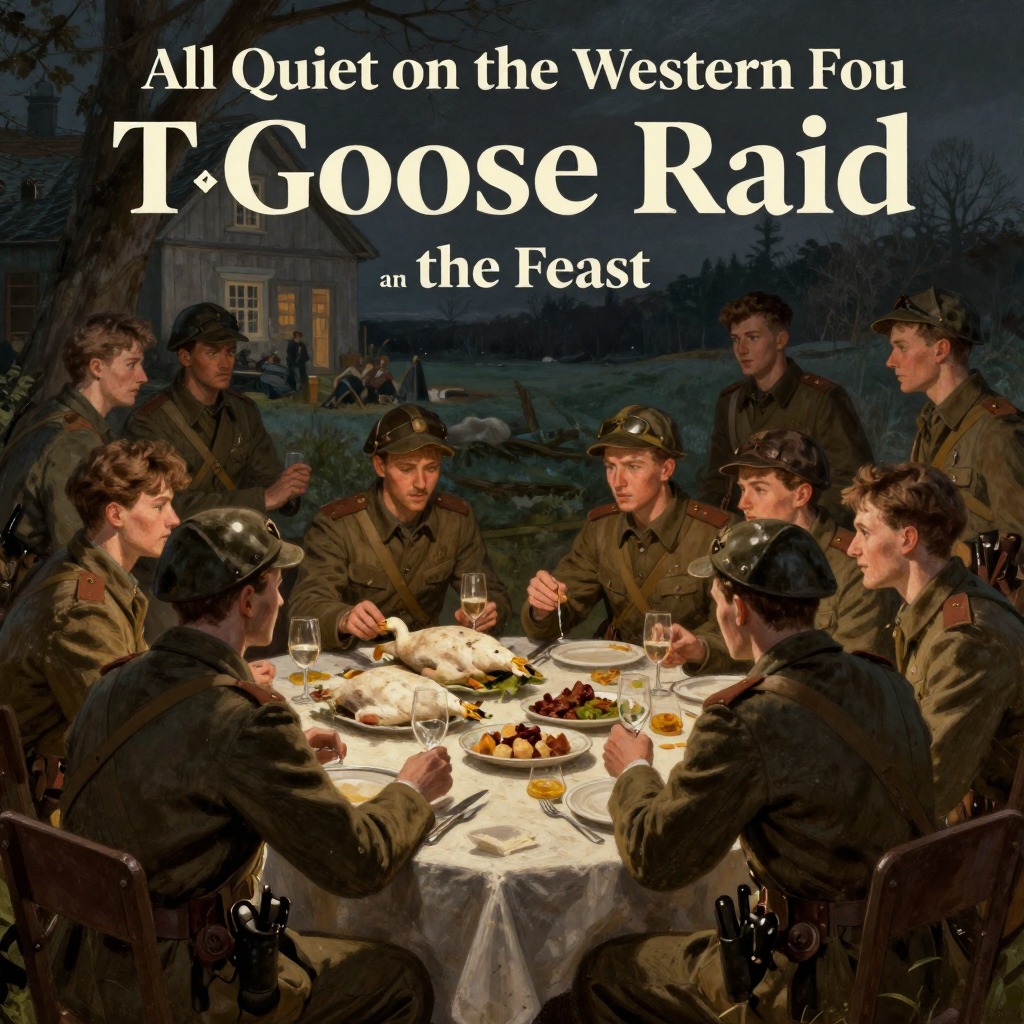
All Quiet on the Western FrontThe Roast Goose is the prize of a daring nighttime theft carried out by Paul Bäumer and Stanislaus Katczinsky behind the lines, and its preparation and consumption become one of the most intimate and symbolically charged episodes in the novel. More than a meal, the goose represents the resourcefulness, mutual care, and fleeting tenderness that bind the two soldiers together in a world otherwise defined by mechanized death and deprivation.
The Theft and Its Risks
The idea originates with Katczinsky, who asks Bäumer, "What do you say to some roast goose?" and Bäumer agrees. Katczinsky has already marked the exact spot: a shed belonging to a regimental headquarters. The two ride partway on a munition wagon, paying two cigarettes for the lift. Katczinsky hoists Bäumer over a wall, then keeps watch below while Bäumer creeps toward the outhouse. Inside, he distinguishes two white patches—two geese. He realizes that if he grabs one, the other will cackle, so he decides to take both, hoping speed will succeed. He catches hold of one and then the second, bashing their heads against the wall to stun them, but he lacks enough weight. The beasts cackle and strike out with feet and wings; Bäumer fights desperately, staggering about in the dark. He describes the white patches as terrifying, and his arms feel as though they have grown wings; he is almost afraid of going up into the sky, as if holding a couple of captive balloons in his fists. One goose gets its breath and goes off like an alarm clock. Before Bäumer can do anything, something comes in from outside: a blow, and he lies outstretched on the floor, hearing awful growls. A bulldog makes a snap at his throat. Bäumer lies still, tucking his chin into his collar. After what feels like an eternity, the dog withdraws its head and sits beside him, but growls at the least movement. Inch by inch, Bäumer moves his hand toward his small revolver. When he finally has it, his hand trembles. He presses it against the ground, tells himself to jerk the revolver up, fire before the dog can grab, and jump up. He takes a deep breath, holds it, whips up the revolver, and fires. The dog leaps howling to one side. Bäumer makes for the door, falls head over heels over one of the scuttering geese, seizes it again, and with a swing tosses it over the wall. He clambers up just as the dog, as lively as ever, springs at him. He lets himself drop. Ten paces away stands Katczinsky with the goose under his arm, and they run.
Preparation and the Shared Meal
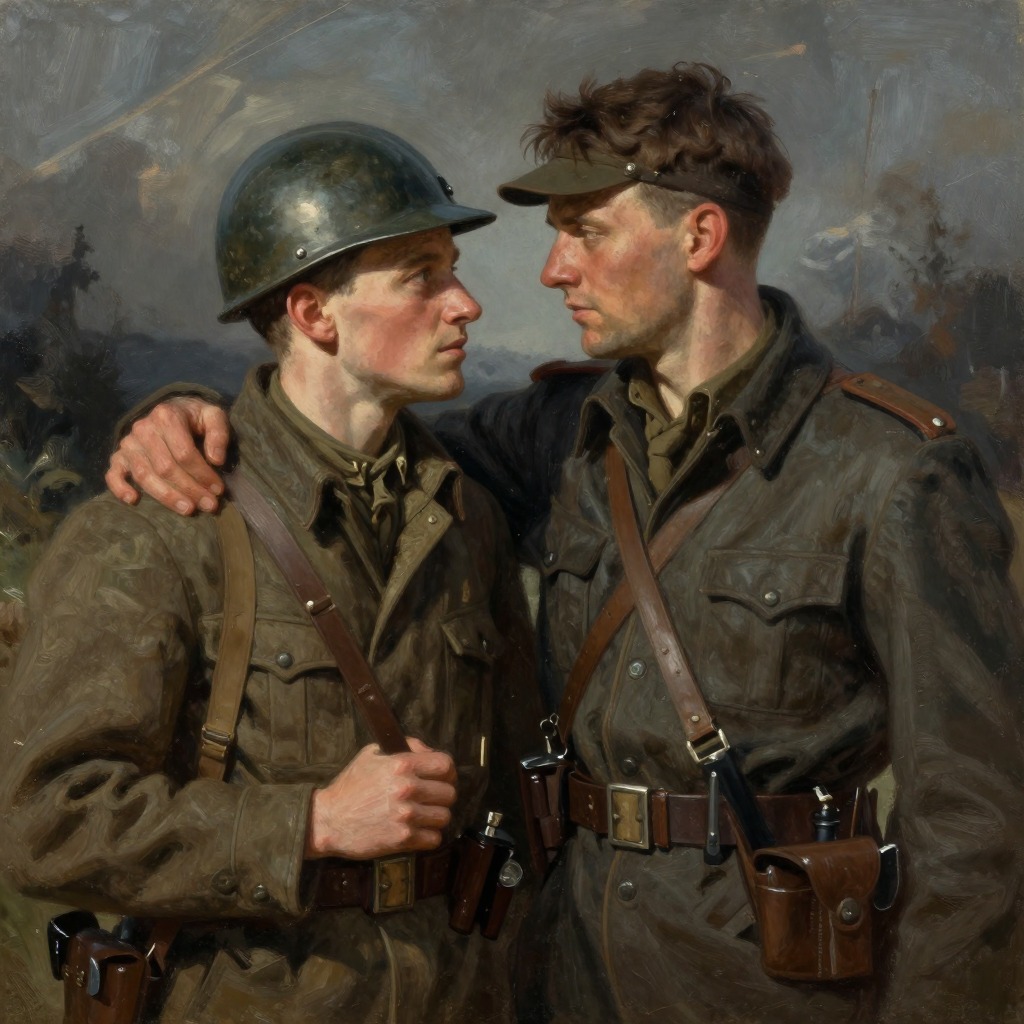
Once safe, Katczinsky quickly kills the goose. They intend to roast it at once so that nobody will be any wiser. Bäumer fetches a dixie and wood from the hut, and they crawl into a small, deserted lean-to they use for such purposes. The single window space is heavily curtained. There is a sort of hearth—an iron plate set on some bricks—and they kindle a fire. Katczinsky plucks and cleans the goose, carefully putting the feathers to one side; they plan to make two cushions out of them with the inscription "Sleep soft under shell-fire." The sound of gunfire from the front penetrates into their refuge; the glow of the fire lights up their faces, shadows dance on the wall. Sometimes a heavy crash makes the lean-to shiver. Aeroplane bombs fall nearby. Once they hear a stifled cry—a hut must have been hit. But no light that could be observed shows from them. They sit opposite one another, two soldiers in shabby coats, cooking a goose in the middle of the night. They do not talk much, but Bäumer reflects that they have a more complete communion with one another than even lovers have. He sees them as two minute sparks of life, with the night and the circle of death outside. The grease drips from their hands; in their hearts they are close to one another. The hour is like the room: flecked over with the lights and shadows of their feelings cast by a quiet fire. It takes a long time to roast a goose, even when it is young and fat, so they take turns: one bastes it while the other lies down and sleeps. A grand smell gradually fills the hut. In a half-sleep, Bäumer watches Katczinsky dip and raise the ladle. He loves him—his shoulders, his angular, stooping figure—and at the same time sees behind him woods and stars. When the goose is done, Katczinsky says simply, "It's done." They take out their collapsible forks and pocket-knives, each cutting off a leg, and eat with army bread dipped in gravy. They eat slowly and with gusto. Bäumer asks, "How does it taste, Kat?" and Katczinsky answers, "Good! And yours?" Bäumer replies, "Good, Kat." They are brothers, pressing on one another the choicest pieces. Afterwards, Bäumer smokes a cigarette and Katczinsky a cigar. There is still a lot left.
Sharing with the Prisoners
Bäumer suggests taking some to Albert Kropp and Tjaden, who are in the clink (open arrest). Katczinsky agrees. They carve off a portion and wrap it carefully in newspaper. The rest they think of taking over to the hut, but Katczinsky laughs and simply says, "Tjaden," and Bäumer agrees they will have to take it all. They go off to the fowl-house where Kropp and Tjaden are confined. Kropp and Tjaden take them for magicians. Then they get busy with their teeth. Tjaden holds a wing in his mouth with both hands like a mouth-organ and gnaws. He drinks the gravy from the pot and smacks his lips, saying, "May I never forget you!"
Thematic Significance
The Roast Goose episode crystallizes the novel's central themes of comradeship and the soldiers' desperate, resourceful assertion of life in the face of death. The elaborate theft, the careful preparation, the shared meal, and the act of bringing portions to imprisoned friends all demonstrate that even in a world of shellfire, lice, and starvation, the men create rituals of care and solidarity. The goose is not merely food; it is a token of trust, a product of Katczinsky's uncanny ability to provide, and a vehicle for a communion that Bäumer explicitly ranks above romantic love. The episode also highlights the soldiers' pragmatic morality: stealing from a regimental headquarters is not a crime but a survival skill, and the risk of a dog attack or a shell is accepted as a normal cost of a good meal. The goose, in its brief existence as a living creature and then as a shared feast, becomes a symbol of the fragile, stolen warmth that makes the war endurable.