Russian Prison Camp
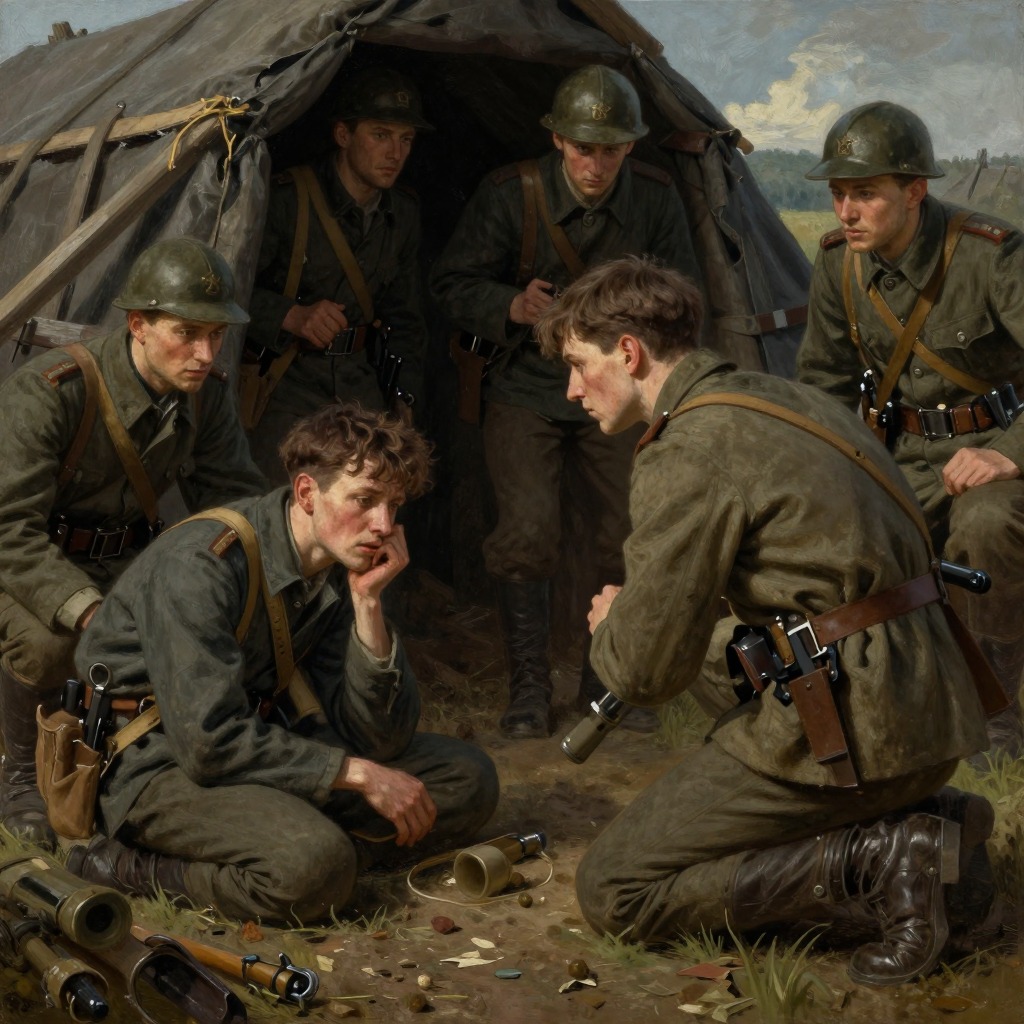
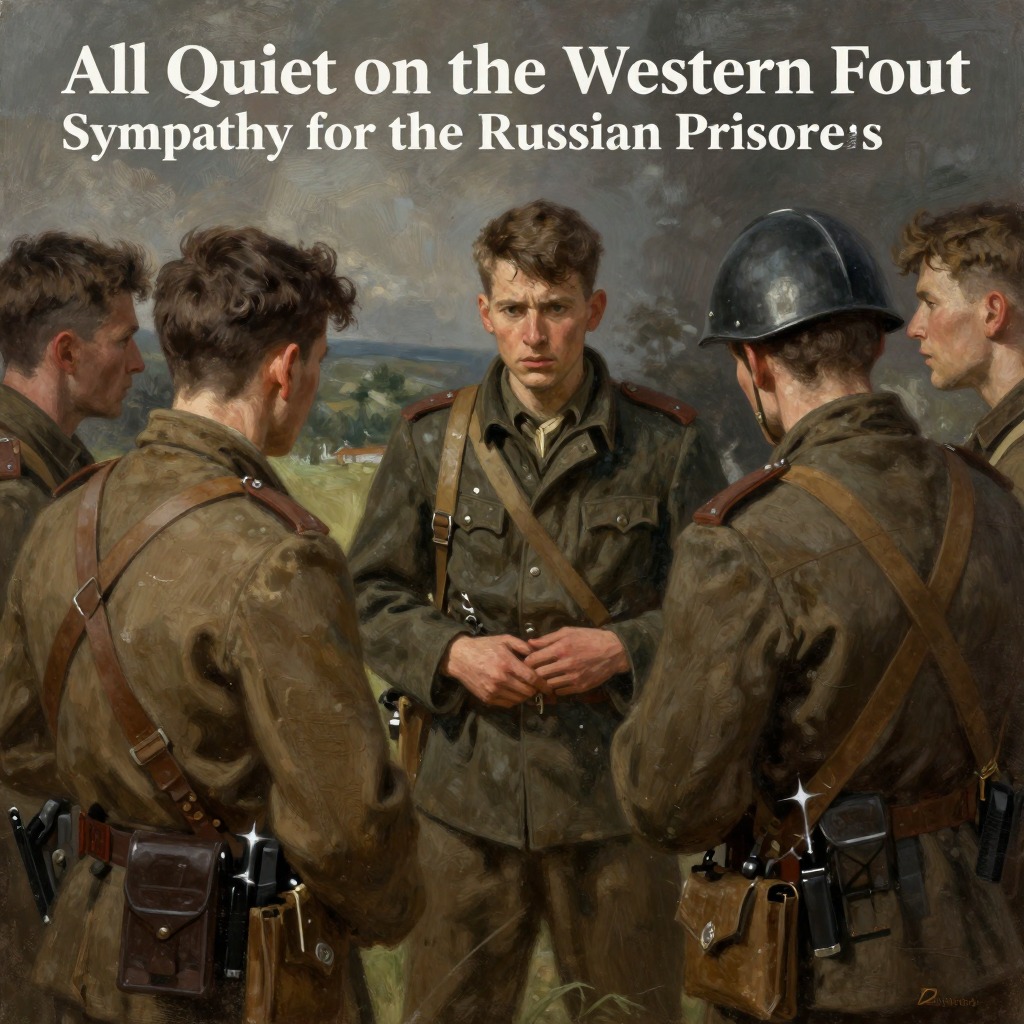
All Quiet on the Western FrontThe Russian Prison Camp, separated from the German training camp on the moors by only a wire fence, stands as one of the most harrowing spaces in the novel—a place where the abstract category of "enemy" dissolves into the concrete reality of starving, desperate men. The camp is not a site of active combat but of slow, passive destruction: dysentery, malnutrition, and apathy claim lives almost daily, and the prisoners, many of them big, bearded men who resemble "meek, scolded, St. Bernard dogs," move with a listlessness that speaks of utter physical and spiritual exhaustion. For Paul Bäumer, the camp becomes a mirror in which the war's true nature—its waste, its lies, its leveling of all human distinction—is reflected with unbearable clarity.
Conditions and Daily Life
The prisoners live on the verge of starvation. Their diet consists of the same meager turnip-based slop issued to the German soldiers, but even that is insufficient. The garbage tins outside the German camp become their primary objective: they pick through the stinking refuse for turnip peelings, mouldy bread crusts, and any other muck the ladle could not reach. Paul observes them with a mixture of pity and horror, noting how they "slink about our camp and pick over the garbage tins" with a greed born of absolute need. Their bodies bear the marks of prolonged malnutrition: they are feeble, their backs and necks bent, their knees sagging, their heads drooping as they stretch out their hands to beg in the few words of German they know. Dysentery is rampant, and many furtively display the blood-stained tails of their shirts. The camp's atmosphere is one of profound apathy; the prisoners, once given to intrigues and fights, have become so weak that most no longer even masturbate. Almost every day, one of them dies, and the burials are quick, perfunctory affairs, accompanied only by a chorale sung in parts that sounds to Paul like an organ far away on the moor.
Trade and Exchange
In the evenings, the prisoners cross to the German camp to trade whatever possessions they still have for bread. Their most valuable items are their boots—made of wonderfully soft leather, like suede—which can fetch two or three loaves of army bread or a loaf and a small, tough ham sausage. But as the war drags on, most have long since parted with their belongings, and now they offer only little carvings and objects made from shell fragments and copper driving bands. The German peasants among the soldiers are hard and cunning in these transactions, holding a piece of bread or sausage right under a prisoner's nose until his eyes bulge with greed, then slowly and deliberately cutting off a slice for themselves while the prisoner watches. Paul finds this spectacle distressing, and it deepens his sense of the gulf between men who, under different circumstances, might have been neighbors.
Paul's Encounters and Reflections
Paul is often on guard duty at the fence, and these hours become occasions for some of the novel's most searching meditations. He sees the prisoners' forms moving in the darkness "like sick storks, like great birds," their faces pressed against the wire, their fingers hooked through the mesh. They rarely speak, and when they do, it is only a few words. Paul senses that they are "more human and more brotherly towards one another" than the Germans are, perhaps because they feel themselves more unfortunate. A word of command, he realizes, has made these silent figures enemies; another word could transform them into friends. He is frightened by the implications of this thought and deliberately sets it aside, storing it away until the war is ended, recognizing it as the seed of a future task: to make life after the war worthy of the hideous years. In a small gesture of solidarity, he breaks his cigarettes in half and gives them to the prisoners, and the red points of light glowing in the darkness comfort him, reminding him of "little windows in dark village cottages."
The Musician and the Violin
Among the prisoners is a musician who once played violin in Berlin. When he learns that Paul can play the piano, he fetches his instrument and performs for the men. He plays mostly folk songs, and the other prisoners hum along, their voices rising from the ground like "a country of dark hills that sing far down under the ground." The violin itself stands above them, "like a slender girl," clear and alone. In the night, the sound is so thin it seems frozen, and Paul finds that it makes a man grow sad. The music, like the camp itself, bridges the divide between enemy and fellow human being, but only to deepen the sense of shared tragedy.
Thematic Significance
The Russian Prison Camp functions as a microcosm of the war's ultimate absurdity: men who have no personal quarrel with one another are set against each other by distant authorities, reduced to a struggle for survival that strips away all pretense of culture or civilization. The prisoners' suffering is not the result of active cruelty but of a system that treats human beings as expendable resources. For Paul, the camp crystallizes the realization that the war is not a noble contest but a crime in which all are complicit and all are victims. The camp's proximity to the German training camp—separated by only a wire fence—underscores the thinness of the boundary between "us" and "them," a boundary that Paul's reflections repeatedly threaten to dissolve.