Second Company
All Quiet on the Western FrontThe Second Company is the German infantry unit to which Paul Bäumer, Albert Kropp, Müller, Leer, Tjaden, Haie Westhus, Detering, and Stanislaus Katczinsky belong. It is the novel's central collective protagonist, the body through which the narrative tracks the systematic destruction of a generation. The company's repeated cycles of reinforcement, attrition, and reduction give the war its statistical, impersonal horror, while the dwindling number of familiar faces among its ranks measures the personal cost of each engagement.
Identity and Composition
The Second Company is a front-line unit of the German Army on the Western Front. At full strength it numbers 150 men, as the quartermaster's requisition for that many rations shows. The company is commanded by Lieutenant Bertinck, a former non-commissioned officer promoted from the ranks, whom the men respect as a decent and capable leader. The company includes a mix of older reservists like Katczinsky, a forty-year-old cobbler with a genius for scrounging, and young volunteers like Paul and his classmates, who joined up together from the same school class. The company's sergeant-cook, Ginger, is a grudging figure who resists issuing surplus rations and keeps his kitchen too far from the line, forcing the men's soup-carriers to travel farther under fire than those of other companies.
Attrition and Reduction
The company's numbers fall with brutal regularity. After a fourteen-day stint in a quiet sector, an unexpected barrage of English heavy shells reduces the company from 150 to 80 men. The survivors return to find a double ration of food and tobacco waiting for them, a windfall that provokes a confrontation with Ginger, who insists he can only issue rations for 80. Lieutenant Bertinck resolves the dispute by ordering the full issue served. Later, after a prolonged period of attack and counter-attack, the company is relieved and mustered: of the original 150, only 32 men answer the roll call. The narrator notes that the summer of 1918 is the most bloody and terrible, and that the company, like the whole German Army, is falling back with no hope of mounting another offensive. By the end, Paul is the last of the seven classmates who joined together; the others—Kemmerich, Müller, Haie Westhus, Leer, and Katczinsky—are all dead.
Key Actions and Combat
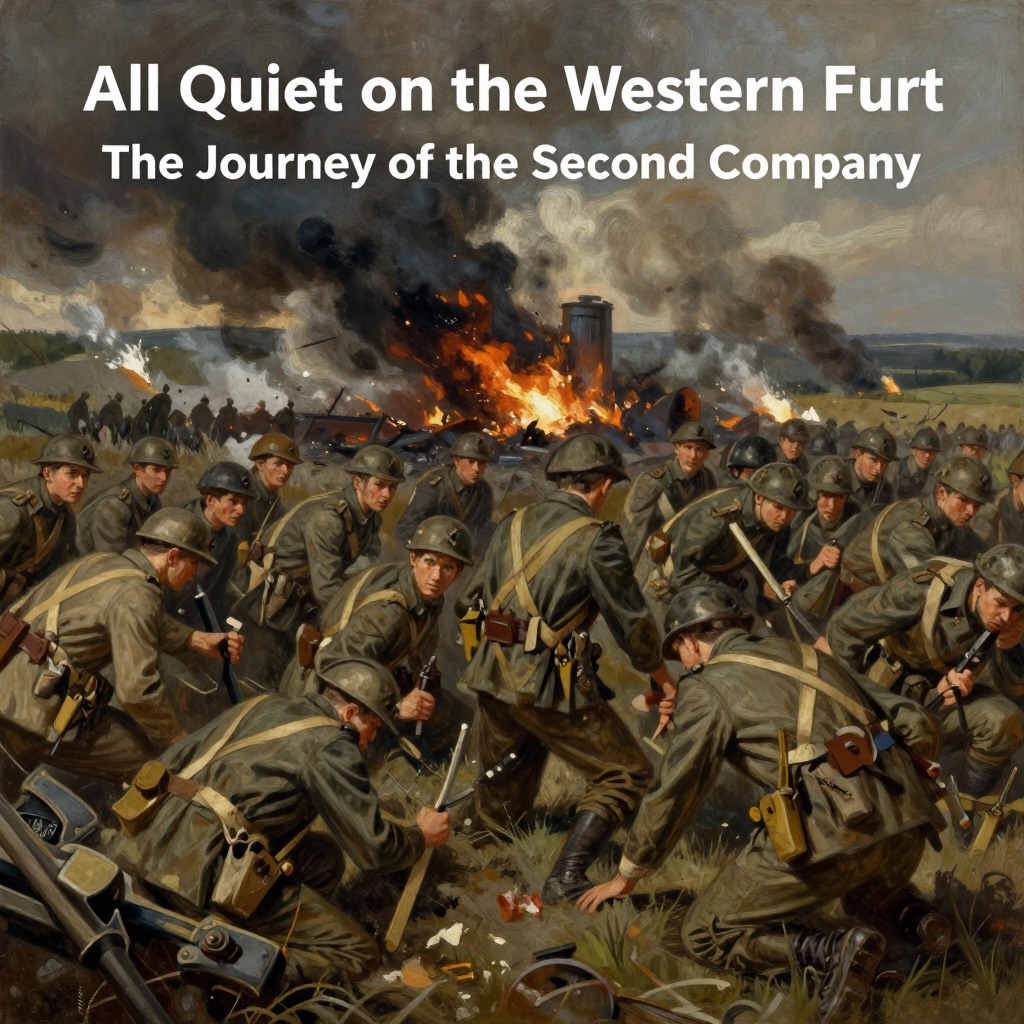
The Second Company participates in wiring fatigues, patrols, trench raids, and full-scale assaults. During one attack, the company captures a French trench and seizes tins of corned beef, white bread, and cognac, provisions far superior to their own turnip jam and thin soup. In another action, the company is surrounded in a crater and nearly overrun until Berger fetches a second machine gun and a counter-attack frees them. Lieutenant Bertinck is killed while taking aim at a flame-thrower team; his shot hits the rear man, causing the flame to spout back and burn the operator. Leer dies in the same action from a hip wound. The company also suffers from gas attacks, trench mortars, and the relentless pressure of superior Allied numbers and equipment.
Discipline and Internal Conflict
The company is not immune to the absurdities of military discipline. After a rest period, Himmelstoss, the former drill-sergeant who tormented the men during training, arrives at the front. Tjaden insults him to his face, calling him a "dirty hound," and is sentenced to three days' open arrest. Kropp, who supports Tjaden, receives one day. Lieutenant Bertinck, understanding the context, lectures Himmelstoss that the front is not a parade-ground. The company also witnesses the reversal of power when Mittelstaedt, a former student, becomes the superior of his old schoolmaster Kantorek, now a territorial, and subjects him to humiliating drill.
The End of the Company
By autumn 1918, the company has been reduced to a remnant. Paul, the last of his class, is given fourteen days' rest after swallowing gas. He sits in a garden and waits for the armistice that everyone talks about. He reflects that the generation that grew up before the war will return to its old occupations and forget, while the generation after will push them aside. He is killed in October 1918, on a day so quiet that the army report says only: "All quiet on the Western Front." The company, as a fighting unit, has effectively ceased to exist.