Shooting licence
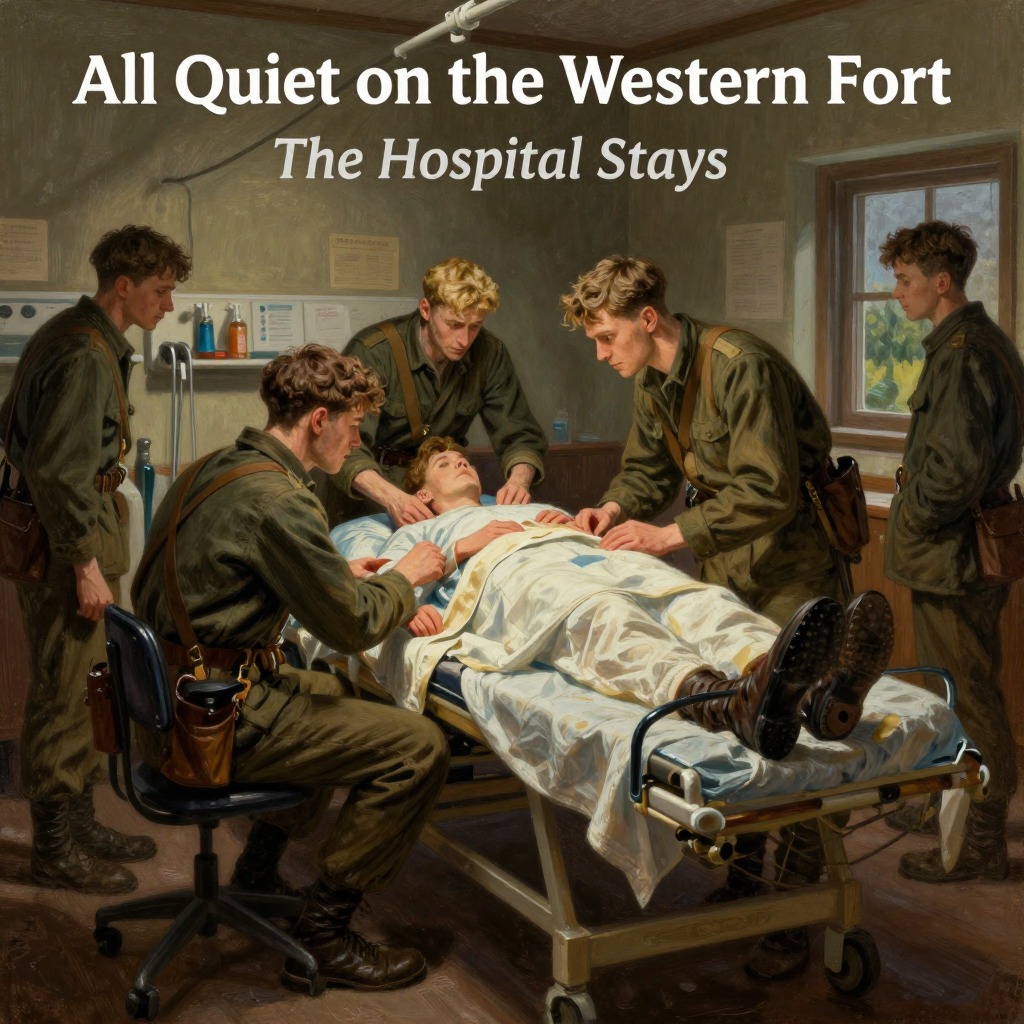
All Quiet on the Western FrontIn the Catholic Hospital where Paul Bäumer and Albert Kropp are recovering from their wounds, a peculiar form of privilege emerges that has nothing to do with rank or decoration. It is called a "shooting licence" — a medical certificate attesting that its bearer is periodically not responsible for his actions. The man who possesses it, Reinforcement-Reservist Josef Hamacher, received the document after a crack on the head, and he uses it with the cheerful confidence of someone who has discovered the war's one invulnerable loophole.
Origin and Nature of the Licence
The shooting licence is born from a head wound that left Hamacher with a formal diagnosis of intermittent insanity. As he explains to the other patients, the certificate means that "no one dares to annoy me" and that "nobody does anything to me." The document is not a weapon but a shield: it does not grant the right to shoot, but rather the freedom from consequence that comes when the army has officially labelled a man mad. Hamacher's tone is matter-of-fact, even proud, as he describes how the diagnosis has given him "a grand time" ever since. The other men in the ward understand immediately: whoever has a shooting licence can do just whatever he pleases.
The Bottle-Throwing Incident
The licence's power is demonstrated almost at once. When the sisters insist on leaving the door open for morning prayers, the patients grow furious at being woken. Paul Bäumer threatens to count to three and "let something fly" if the chanting does not stop. Another man joins the threat. When the prayers continue, a bottle is hurled through the door into the corridor, smashing into a thousand pieces. The praying stops, and a swarm of sisters appears. Later the hospital inspector arrives, threatening clink and worse. Before Paul can decide whether to confess, Hamacher sits up and declares, "I did." He explains that he was annoyed by being wakened unnecessarily and lost his senses so that he did not know what he was doing — a perfect performance of the periodic irresponsibility his licence guarantees. The inspector departs, and Hamacher grins. "That doesn't matter. I have a shooting licence." The ward is overjoyed: with Hamacher in their midst, they can now risk anything.
Function as a Ward's Protection
Hamacher's licence becomes a collective resource. When the night sister fails to respond to Franz Wachter's haemorrhage, and the bell is rung until numb, someone suggests smashing another bottle. Hamacher points out that she would not hear that any more than the bell, but the readiness to use his immunity is always present. The licence does not merely protect Hamacher; it protects the entire room, because any act of rebellion can be claimed by the man who is officially not responsible. The other patients understand this instantly and rely on it. The shooting licence transforms a clinical diagnosis into a form of social power, turning the ward's most vulnerable member — a man with a head wound — into its most formidable defender.
Thematic Significance
The shooting licence is a dark joke at the heart of the novel's hospital sequence, but it carries a serious implication. In a system that reduces soldiers to interchangeable bodies, where a man can be declared fit for front-line duty by a doctor who never looks up from his list, the only escape from punishment is to be certified as insane. The licence is a parody of the army's own logic: if the war requires men to be treated as machines, then the man who is officially broken is the only one who can act freely. Hamacher's cheerful exploitation of his diagnosis exposes the absurdity of a system that punishes rational resistance but grants impunity to the certified madman. The shooting licence is not a medical document; it is a survival strategy, a piece of paper that turns the war's own categories against itself.