Stanislaus Katczinsky
All Quiet on the Western FrontStanislaus Katczinsky, called Kat by everyone, is the forty-year-old leader of Paul Bäumer's group, a cobbler by trade whose shrewdness, cunning, and hard-bitten practicality make him indispensable to the survival of his younger comrades. With a face of the soil, blue eyes, bent shoulders, and a remarkable nose for dirty weather, good food, and soft jobs, he embodies the seasoned front-line soldier who has learned to navigate the war's chaos through instinct and experience. Kat is the smartest man Paul knows, possessing a sixth sense that allows him to find anything—food, straw, wood, even four boxes of lobsters—as if he conjured it out of the air. His presence is a constant source of comfort and stability; Paul reflects that if Kat were planted in the middle of the desert, in half an hour he would have gathered a supper of roast meat, dates, and wine.
Role as Provider and Tactician
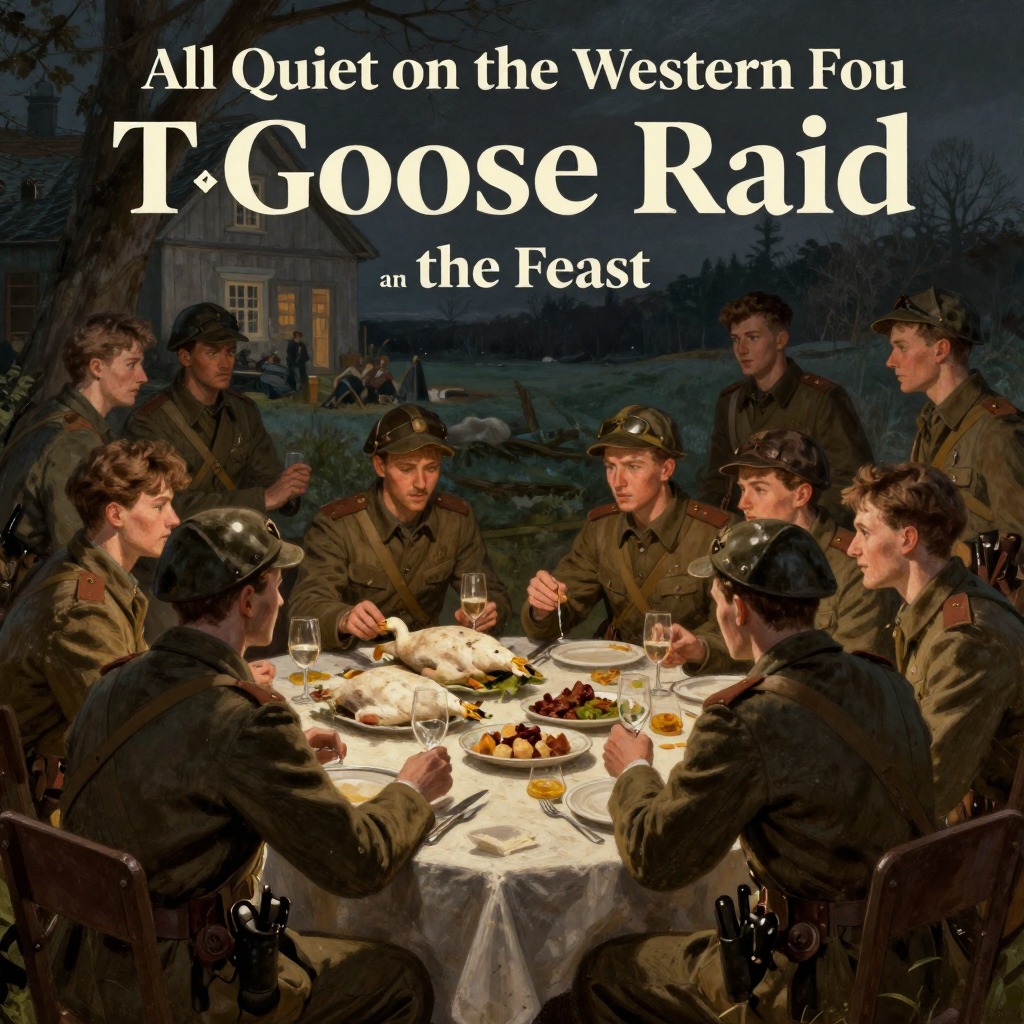
Kat's resourcefulness is legendary within the company. When the squad is quartered in a dark factory with only hard wire-netting bunks, Kat simply takes Haie Westhus and returns half an hour later with arms full of straw from a horse-box. On another occasion, after the men are disappointed by the lack of a canteen, Kat disappears and comes back with two loaves of bread and a bloodstained sandbag full of horse-flesh, along with a frying pan, salt, and fat from his pocket. He knows the proper way to roast horse-flesh—boiling it first in a little water to keep it tender—and the men squat in a circle, filling their bellies. His masterpiece is the theft of a goose from a regimental headquarters, which he and Paul roast in a deserted lean-to, sharing the meat with Tjaden and Kropp in the clink. Kat's philosophy is summed up in his rhyme: "Give 'em all the same grub and all the same pay / And the war would be over and done in a day." He argues that the war is lost because soldiers can salute too well, and he condemns the abuse of authority by non-commissioned officers, noting that the more insignificant a man has been in civil life, the worse the army's power affects him.
Comradeship and Emotional Anchor
Kat is the emotional and practical anchor of the group, especially for Paul. During the graveyard bombardment, when Paul is pinned down and disoriented, it is Kat who shakes him and yells the gas warning, saving his life. When Paul returns from leave, he feels he belongs again only when he is back with Kat and Albert Kropp. The two share a profound, wordless communion while roasting the goose; Paul reflects that they have a more complete intimacy than lovers, sitting opposite each other as two minute sparks of life on the edge of the circle of death. Kat's photograph of his wife, which he shows the others, and his talk of home reveal a man with a past and a future beyond the war, yet he is fully present in the trenches, dispensing advice and comfort. He tells Paul that if he is smart, he should try to get a base-job, and he gives him good counsel before his leave.
Death and Aftermath
Kat's death is the most devastating loss Paul suffers. During the summer of 1918, while bringing food, Kat is hit in the shin by a shell splinter. Paul binds the wound, takes Kat on his back, and carries him toward the dressing station, talking of their shared memories—the stolen goose, the first time Paul was wounded as a young recruit. Kat groans, "At last—just at the last—" and Paul reassures him that he is saved. But when they reach the dressing station, an orderly tells Paul that Kat is dead; a tiny, stray splinter has caught him in the head without Paul noticing. Paul drops to his knees, then slowly gets up, takes Kat's paybook and things, and stands in the midst of the world, knowing only that the militiaman Stanislaus Katczinsky has died. The loss leaves Paul utterly alone, the last of the seven from his class, and the anguish of solitude rises up in him. Kat's death, coming so close to the armistice, strips Paul of his final human connection and accelerates his own spiritual collapse, which culminates in his own death in October 1918 on a day so quiet that the army report says only: "All quiet on the Western Front."