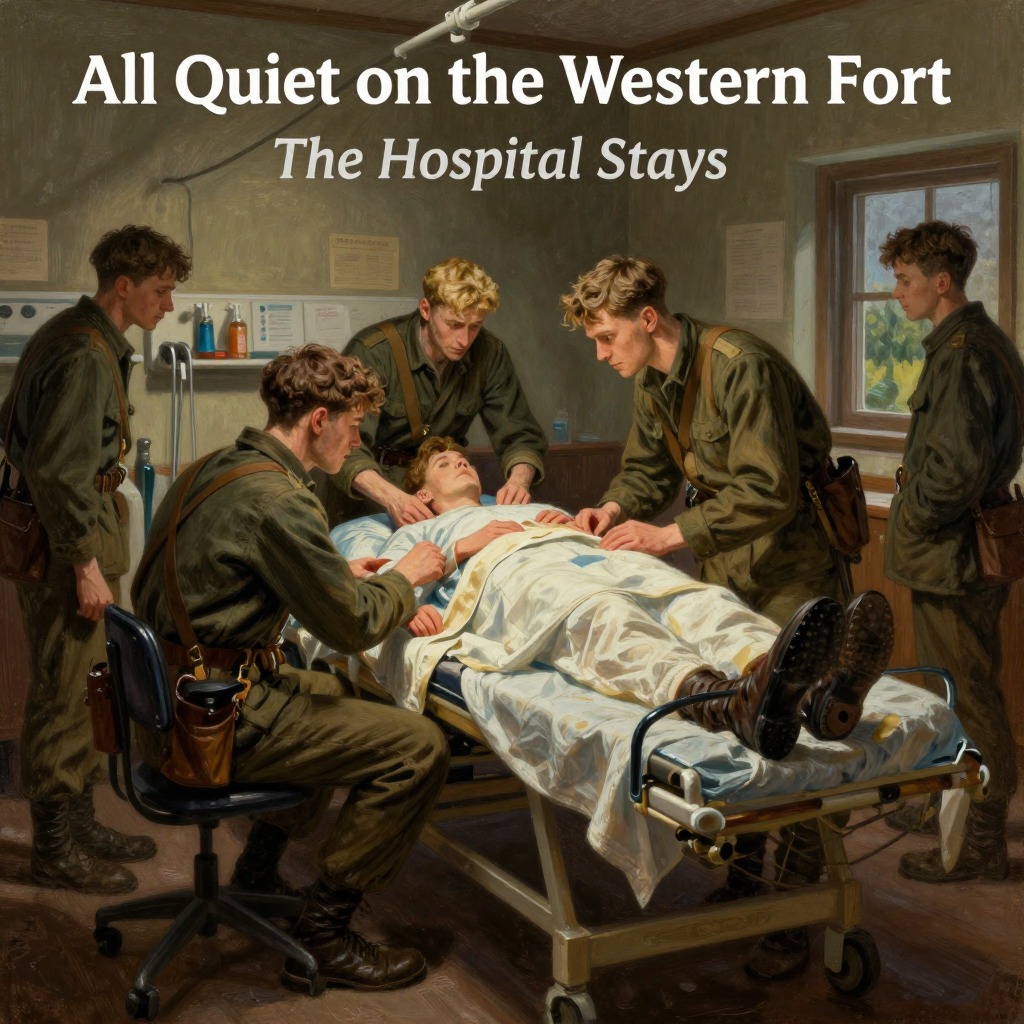
The Dying Room
All Quiet on the Western FrontThe Dying Room is a small, corner room in the Catholic Hospital, containing only two beds and situated conveniently beside the lift to the mortuary. It functions as an institutional sorting mechanism: patients judged beyond recovery are transferred there, not for specialized care but for administrative convenience. The room embodies the war's transformation of death from a personal tragedy into a routine, almost industrial process, where the dying are isolated to minimize disruption to the ward and to streamline the disposal of bodies.
Location and Purpose
The Dying Room occupies a corner of the hospital building, a detail that underscores its marginal, hidden nature. Its proximity to the mortuary lift is no accident; the room is designed for efficient corpse removal. Josef Hamacher, a patient with a "shooting licence" that grants him immunity from punishment, explains the logic to his wardmates: the hospital staff transfer the dying there so they "don't have so much work to do afterwards" and to prevent other patients from dying "in sympathy." The room thus serves a dual purpose: it spares the staff the labor of tending to the dying in a general ward, and it shields the living from the psychological contagion of witnessing death. This spatial segregation reflects a broader military-medical logic that prioritizes operational efficiency over human dignity.
The Experience of Being Sent There
For the soldiers, being moved to the Dying Room is a sentence of death, and they resist it with desperate clarity. When Peter, a young soldier with a severe lung wound, sees his tunic taken from its hook and placed on the trolley alongside him, he immediately understands his fate. "I won't go to the Dying Room," he cries out, trying to roll off the stretcher. His protests are futile; the staff wheel him away despite his pleas. As the door shuts, he raises his black curly head, his eyes full of tears, and shouts, "I will come back again! I will come back again!" But Hamacher, who has seen many men taken there, knows the truth: "Once a man is in there, he never comes through." The room is a one-way passage, and the soldiers' awareness of this makes the transfer a moment of profound terror and abandonment.
The Exception That Proves the Rule
Peter's return from the Dying Room is a rare, almost miraculous exception. Days after being wheeled away, the door flies open and the flat trolley rolls in bearing him—pale, thin, but upright and triumphant. Sister Libertine pushes him back to his former bed, beaming. Hamacher, the veteran patient who knows everything, is forced to admit that this is the first time he has ever known such a thing to happen. Peter's survival does not undermine the Dying Room's function; rather, it highlights the near-certainty of death that the room represents. His return is a statistical anomaly, a flicker of hope in a system designed to extinguish it.
Thematic Significance
The Dying Room crystallizes the novel's critique of how war and its institutions dehumanize soldiers. It is a space where the medical system, ostensibly dedicated to healing, becomes an agent of death management. The room's existence normalizes mass dying, reducing each soldier's end to a logistical step: from ward to Dying Room to mortuary. This process mirrors the broader military logic that treats soldiers as interchangeable, expendable resources. The room also embodies the soldiers' loss of agency; they are moved, processed, and disposed of without consent, their final moments stripped of privacy or dignity. In this way, the Dying Room is not merely a hospital feature but a symbol of the war's ultimate betrayal: the transformation of young men into objects to be efficiently discarded.