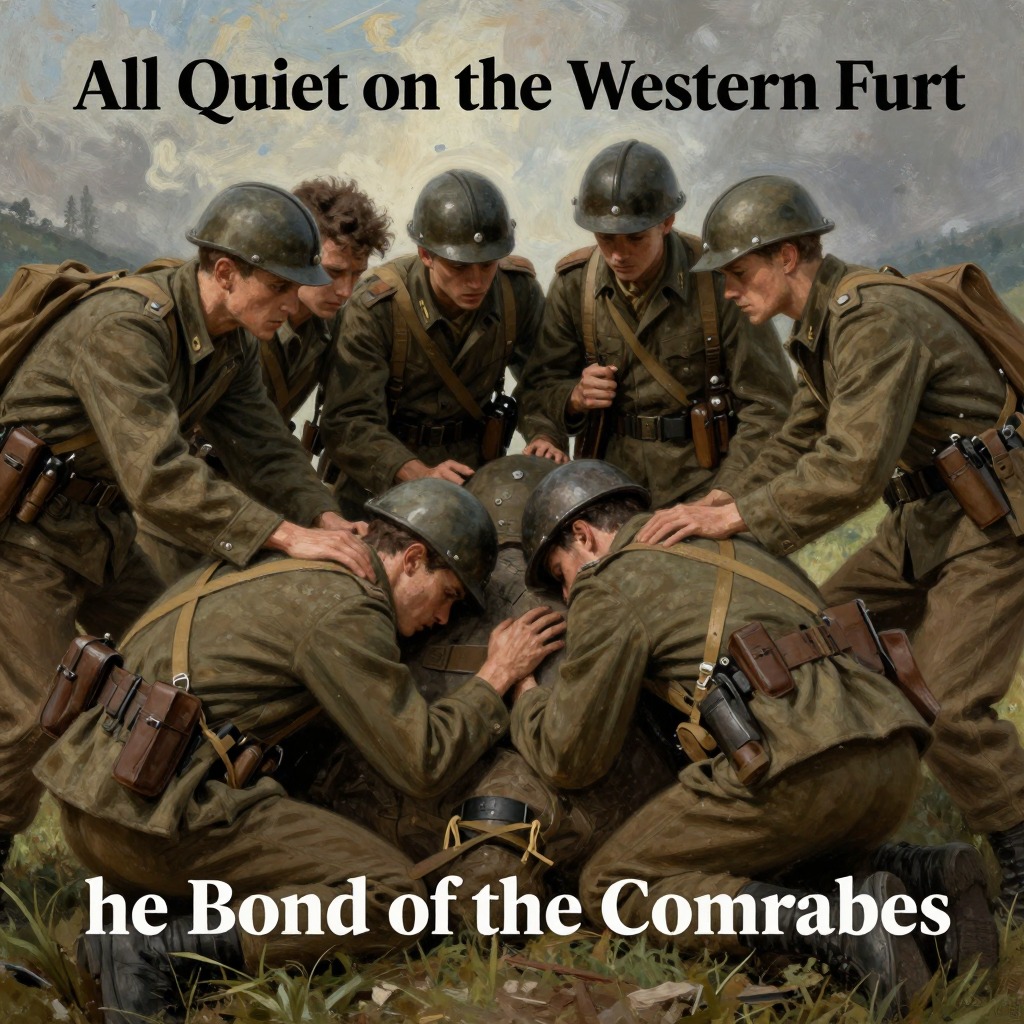
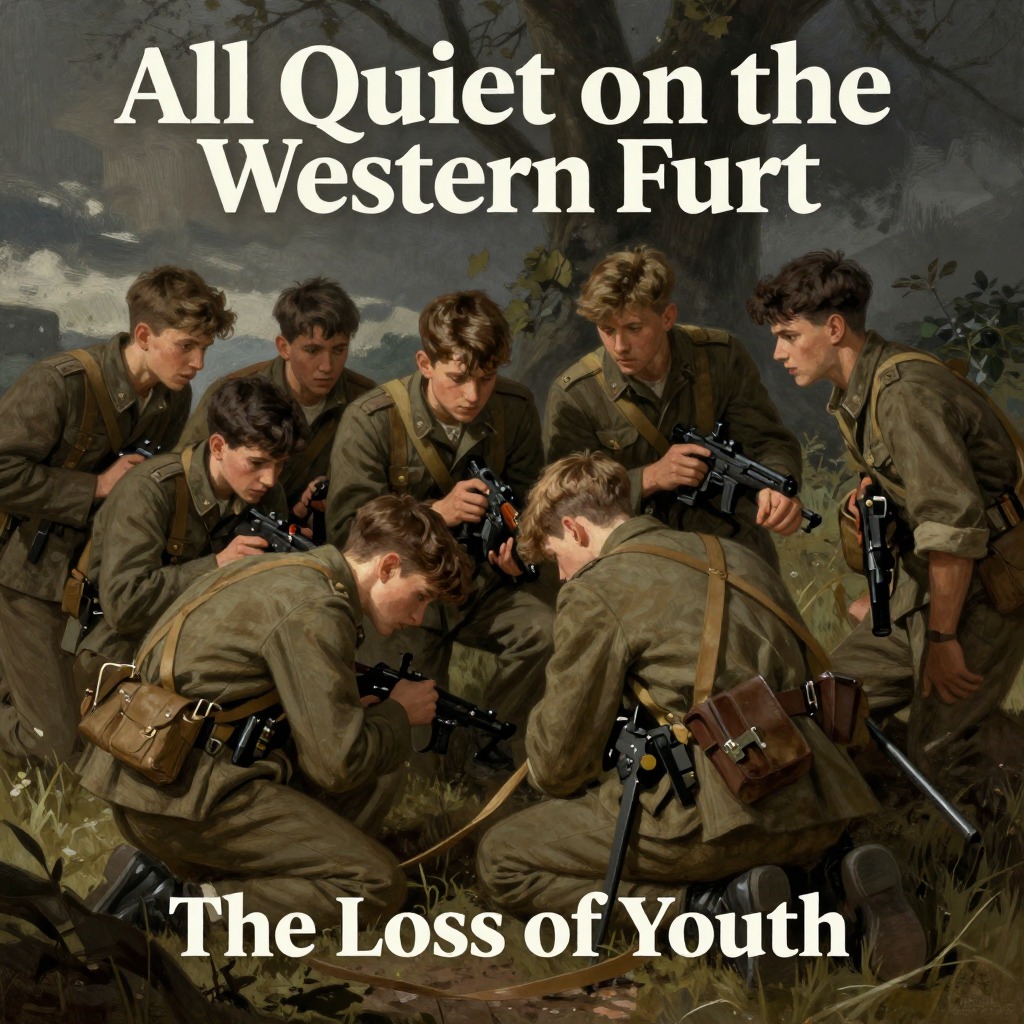
The Last of the Seven
All Quiet on the Western FrontThe Last of the Seven is the designation for Paul Bäumer's final, solitary position among the group of classmates who enlisted together from the same schoolroom. By the autumn of 1918, as the war grinds toward its close, Paul is the only one of the seven still alive. This status is not merely a numerical fact; it is the culmination of the novel's relentless demonstration of how the war consumes an entire generation, leaving behind a single, hollowed-out survivor who must confront a world stripped of his friends and his former self.
Identity and Origin
The seven were a class of twenty young men who, under the influence of their schoolmaster Kantorek, volunteered for military service. Among them were Paul Bäumer, Albert Kropp, Müller, Leer, Franz Kemmerich, and others. They were described by Kantorek as the "Iron Youth," a label they later recall with bitter irony. Their shared background—the same school, the same youthful dreams, the same naive enthusiasm—makes their subsequent decimation all the more devastating. The group's identity was forged in the barracks and the trenches, where they learned to rely on one another for survival, forming a bond that transcended their earlier, more innocent connections.
The Progressive Loss
The narrative charts the steady erosion of this group. Franz Kemmerich is the first to die, his leg amputated, his life ebbing away in a crowded hospital ward while his comrades discuss the fate of his boots. Haie Westhus is killed by a wound in the back through which his lung pulses. Müller, who inherited Kemmerich's boots, is shot point-blank in the stomach with a Verey light and dies in half an hour of terrible pain, bequeathing the boots to Paul. Leer, a good mathematician at school, has his hip torn open by a shell fragment and bleeds to death. Others fall in attacks, counter-attacks, and gas bombardments. Each death is recorded with a stark, unadorned fact, and each one narrows the circle of those who shared the same classroom and the same illusions.
Paul's Final Isolation
By the final chapter, Paul states plainly: "There are not many of the old hands left. I am the last of the seven fellows from our class." This declaration is made without fanfare, but it carries the weight of everything that has been lost. The comrades who had been his family—Katczinsky, Kropp, Müller, Tjaden—are all gone, either dead or scattered by wounds. Paul's survival is not a triumph but a sentence. He is left alone with memories that no one else shares, and with a future that seems meaningless. The language of the soldiers, with its crude humor and its reliance on bodily functions, had been a shared defense against horror; now there is no one left to share it with.
Thematic Significance
The Last of the Seven is the novel's final, most powerful symbol of the war's destruction. It is not just that Paul is the last of his class; it is that the class itself—the generation of young men who were supposed to inherit the future—has been annihilated. Paul's survival is a kind of death-in-life. He has been "crushed without knowing it," and his leave at home reveals that he can no longer connect with the civilian world. The books in his room, the butterfly collection, the familiar streets—all have become foreign. He is a ghost among the living, a remnant of a world that no longer exists. His death in October 1918, on a day so quiet that the army report says only "All quiet on the Western Front," is almost an afterthought, a final, quiet erasure of the last witness. The novel ends not with a hero's return but with the silent, unremarked fall of the last of the seven, whose face, when turned over, shows an expression "as though almost glad the end had come."