Amanda Monk
All the Bright PlacesAmanda Monk is a classmate whose changing connection with Violet Markey and response to Theodore Finch’s death give the novel a small but revealing portrait of guilt, social cruelty, and the possibility of reaching toward someone after loss. Seen first through the judgments and social scenes of high school, she later approaches Violet with an apology and questions that suggest she is trying to understand what Finch experienced.
Identity and Social World
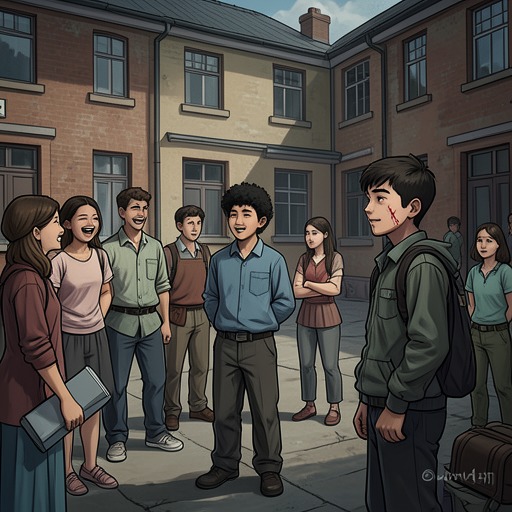
Amanda appears early in Finch’s view from the school tower, below him on the front steps with books held over her head as she moves through the rain. The scene places her amid ordinary school life at a moment when Finch is isolated above it: she is visible, animated, and socially present, while he is alone with his thoughts. That contrast is part of her role in the story, but the narration does not make her merely a symbol of carefree popularity; later scenes show her in conflict and in grief’s aftermath.
Violet remembers Amanda as one of the friends closest to her before their relationship cooled. Since April, Violet has drifted away from her, and quitting cheerleading has left them with less in common. Violet even wonders whether the friendship had been as substantial as she once believed. Amanda’s social life continues in a different register: at a basement party, she lounges with Suze Haines, who has become her best friend again after another rupture, while a larger crowd drinks and dances nearby. The shifting friendship with Suze echoes the instability Violet perceives in her own connection with Amanda, without establishing that the two relationships are identical.
Reputation and Connection to Finch
Amanda has known Finch since kindergarten, but she describes him as having grown stranger over time. Her view reflects the school’s divided response to him. Finch is a local legend: some students dislike his fights and rule-breaking, while others admire the same defiance. His performances include playing in several bands, recording an album, arriving at school painted red, wearing a cape for a month, and disrupting a classroom. Amanda’s comment treats his eccentricity as familiar history, yet it also places her among the students who circulate stories about him rather than among those who are shown understanding him closely.
She is also linked to Finch through Brenda Shank-Kravitz, who is identified as his friend. At the party, Amanda is part of the social scene surrounding Violet, while Finch’s reputation becomes an object of discussion. Later, when Amanda waves her phone and asks whether Violet saved Finch from jumping from the ledge, the headline from the Bartlett Dirt makes the rescue public knowledge. The moment demonstrates how a private crisis becomes school gossip. Amanda knows the story, but the evidence does not show that she was present at the rescue or that she understands its full emotional circumstances at that point.
Conflict and Distance
The novel places Amanda within a school culture where insults and intimidation shape how students treat Finch. After a collision in the hallway sends Gabe Romero into Amanda, the contents of her purse scatter across the floor and she screams. Finch runs before Gabe and Ryan Cross can attack him. The episode makes Amanda a direct, unintended participant in the chain of events that exposes Finch to danger, but it does not indicate that she caused the collision deliberately. Its immediate consequence is that Finch flees, expecting retaliation.
Amanda’s later apology clarifies that she has also contributed to Finch’s mistreatment: she tells Violet she should not have called him a freak. She adds that she has broken up with Gabe Romero, who had been Finch’s aggressor. These are concrete admissions and a change in her relationship with Gabe, though the novel does not describe the reasons for the breakup or present it as a completed act of restitution. Her words arrive after Finch’s funeral, when acknowledgment cannot reach him. Their timing makes the apology both important and limited: Amanda can take responsibility before Violet, but she cannot undo what she said or restore the person she insulted.
Apology and Aftermath
Until the Wednesday after Finch’s funeral, Violet has been eating lunch with Brenda, Lara, and the Brianas. Amanda approaches that group, sets down her tray, and apologizes directly to Violet for Finch. She does not look at the other girls as she does so. The gesture interrupts the established lunch arrangement and turns a public school space into a brief, personal encounter. Violet’s account also recalls an earlier moment when Amanda’s face went blank upon seeing her, underscoring the distance between them before this approach.
Amanda’s apology does not instantly restore the friendship. Instead, it marks a willingness to speak across the separation and to name her own part in Finch’s humiliation. Her decision to break up with Gabe is presented alongside the apology, connecting her changed conduct toward him with her acknowledgment of what she did to Finch. The scene leaves the reconciliation unfinished: Amanda makes an opening, but the supplied account does not establish that the girls return to their former closeness.
Trying to Understand
Amanda’s later conversation with Violet moves beyond apology. Sitting on the floor against a wall, she asks whether Violet is okay and then says she wants to know what suicide feels like and what a person thinks about. She explains that she has seen Finch at a support group she has attended for some time, though she says she does not really need to go and that her mother is making her attend. The group gives Amanda a connection to Finch’s crisis that is different from the school’s gossip, even though the evidence does not say that they spoke there or describe what she witnessed.
Amanda tells Violet that, in such moments, a person may feel darkness taking over, as if events are happening to someone else, and may not think about the people left behind. She then asks whether Finch ever saw a doctor. Her questions are direct, but they are not presented as proof that Amanda fully understands his experience. Instead, they show her trying to approach what had previously remained distant or reduced to a label. In her arc, the movement from repeating an insult to asking about the inner reality of suicidal distress is significant precisely because it remains incomplete: she cannot reverse Finch’s death, but she begins to listen to the person she once helped mischaracterize.