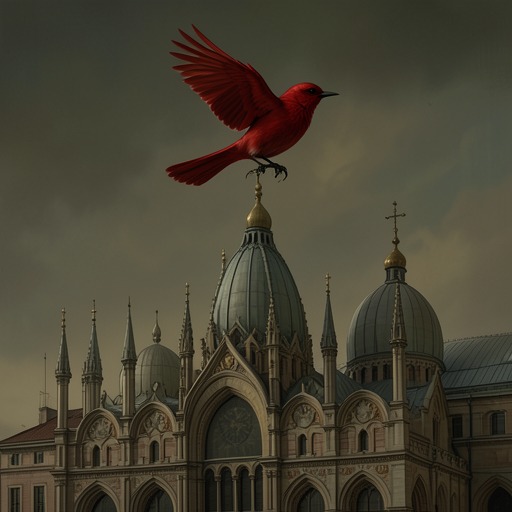
Cardinal
All the Bright PlacesThe Cardinal is a bird from Theodore Finch’s childhood whose death becomes more than a remembered accident: it is a story about the limits of rescue, the damage done when a home displaces another creature’s home, and Theodore’s enduring sense of responsibility. The bird repeatedly flies into the glass doors of the Finch family home, trying, as Theodore later understands it, to return to a tree that has been cut down and built over. Its body is buried in a mud nest; the memory recurs in family conversation, in Theodore’s account to Violet Markey, and in his reflections on his own life.
The bird and the glass doors
As a child, Theodore watches a Cardinal strike the house’s sliding glass doors again and again, knocking itself unconscious before getting up and flying away. A female Cardinal watches from a tree nearby; Theodore imagines that she is the male bird’s wife. Unable to understand why the bird keeps returning to the glass, he asks his parents to bring it inside, believing that shelter with the family would keep it safe. His sister Kate Finch calls the Audubon Society, and the explanation she receives changes the story’s scale: the bird may be trying to reach its tree, which stood there before it was cut down and a house built in its place. The obstacle is not simply the transparent door. The house itself occupies the space the bird is trying to get back to.
The glass makes the conflict visible as a repeated failure of recognition. From inside, the doors are part of a family home; for the Cardinal, they block a route toward a former habitat. Theodore’s childhood solution is intimate and compassionate—let the bird live with the family—but it cannot restore the tree or undo the construction that removed it. The story therefore holds two kinds of care together: the desire to protect a vulnerable animal and the harder recognition that protection inside the house would not return it to the place it seeks.
Death and the family memory
The Cardinal eventually dies after striking the glass once too often. Theodore finds the body on the back deck and buries it in the mud, naming the grave a mud nest. In his account to Violet, he recalls telling his parents that there had been nothing to make the bird last a long time, while blaming them because they might have helped it survive if they had let it inside. The child’s accusation treats survival as a choice the adults could have made; his later understanding is less certain. The family’s house displaced the tree, but he also wonders whether anyone could have prevented the bird’s death.
The memory becomes a recurring family story, but its retellings do not carry the same meaning. Mrs. Finch invokes it to describe Theodore as sensitive even when he was little, recalling both his plea to bring the bird indoors and his remark about the mud nest. Theodore answers that he does not want to hear about the Cardinal again. He imagines that the bird would have died indoors too, only more slowly, and extends that grim possibility to the Finch family: marriages and love die, and people fade away. The bird’s death has become, for him, a way to speak about a larger fear of decline within the family, not simply an unhappy childhood incident.
The first black mood
When Theodore tells Violet the story while describing the dark moods he sometimes cannot shake, he identifies the Cardinal’s death as the beginning of his first black mood. He says he remembers little of what happened afterward for a while. The sequence does not establish the bird’s death as a complete explanation for those moods; it shows instead how closely Theodore associates the loss with his first remembered period of emotional darkness. The childhood story gives that darkness a concrete shape: a bird repeatedly meets an invisible barrier, falls, rises, and finally does not rise again.
The contrast between Theodore’s first response and his later reflection matters. As a child, he believes that bringing the bird inside could save it and that his parents’ refusal helped cause its death. Later, he can acknowledge both the family’s role in displacing the tree and the possibility that the bird’s fate could not have been prevented. Responsibility remains, but certainty loosens. In a later reflection, Theodore again connects the bird’s former tree to the house built where it stood, while conceding that perhaps no one could have stopped what happened.
The story’s return
After Theodore’s death, Violet Markey visits Kate Finch and wonders whether the patio outside the sliding glass doors is the same place where Theodore found the Cardinal. The passage makes no claim that she can verify the location; the patio brings the remembered story back into the present. In the Finch family home, the bird’s death has passed from Theodore’s childhood into his mother’s recollection, his confession to Violet, and Violet’s own encounter with the place associated with it.
The Cardinal’s story remains deliberately unresolved at its center. The Audubon Society’s explanation is presented as a guess, and Theodore’s later reflection cannot settle whether anyone could have saved the bird. That uncertainty distinguishes the story from a simple lesson about kindness or blame. The bird’s repeated flight is an image of an attempted return, while the glass and the house mark what stands in its way. Its remembered death helps explain why Theodore experiences the incident as both a failure of protection and a loss that exceeds any one person’s power to repair.