Devils Hollow Shoe Tree
All the Bright PlacesDevils Hollow Shoe Tree is an informal roadside landmark near Milltown, Indiana, where visitors leave shoes among the branches of several trees. For Violet Markey, the visit becomes more than a stop on her remaining wanderings: she adds shoes belonging to herself and Eleanor Markey, then finds a pair marked by Theodore Finch and uses an earlier text message to establish when he was there. The trees turn an anonymous public custom into a place where absence becomes legible through objects and dates.
Setting and Approach
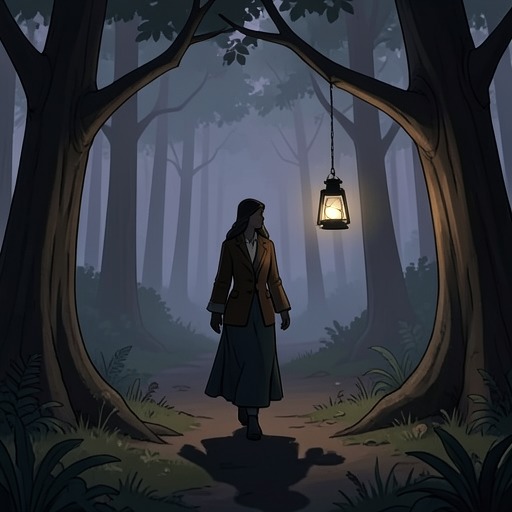
Milltown, with a population of 815, lies close to the Kentucky border. Violet has to ask a local woman named Myra how to find the shoe trees. Following her directions, she soon leaves the paved road for a narrow dirt trail, looking upward as instructed. When the route seems to have lost its destination, a four-way intersection appears among the woods. The approach is consequently part of the visit: the site is not presented as a formal attraction with a clear entrance, but as a place Violet has to seek out by asking and following directions.
At the intersection, children’s voices carry from nearby, while trees at all four corners display shoes on their branches. Hundreds upon hundreds hang by their laces, resembling oversized Christmas ornaments. Myra cannot say how the custom began or who left the first pair, though people travel from far away to add to it. A rumor that basketball player Larry Bird left a pair there further suggests how the accumulating collection attracts stories as well as visitors. Its origin remains uncertain; its continuing use is plain.
The Shoes Violet Leaves
The task Violet understands is simple: leave a pair behind. She has brought green Chuck Taylors from her own closet and yellow Keds that belonged to Eleanor. Among the many shoes already hanging overhead, the choice of what to leave is a small but deliberate act: she brings two pairs associated with the sisters and places them together rather than treating the visit as observation alone.
Violet chooses the original tree, the one carrying the heaviest load of shoes. Its trunk is black and looks dead, evidence, to her, that lightning has struck it more than once. It also appears too fragile to climb. She writes “Ultraviolet Remarkey-able” and the date on one Chuck Taylor with a Sharpie, then jumps to reach a low branch. The shoes bob and twist before settling; Eleanor’s Keds go beside them. The inscription gives the shoes a dated, personal mark within a collection whose beginnings are unknown, while the placement keeps the sisters’ pairs together on the tree Violet identifies as the original.
Finch’s Trace
Violet initially tells herself that there is nothing more to see and that the drive has been long for a collection of old shoes. She stays to look, however, allowing for the possibility that the place holds something beyond its visible objects. High on the original tree, separate from the shoes she has just hung low, she notices a pair of sneakers with fluorescent laces. Both bear the black initials TF, and a package of blue American Spirits protrudes from one shoe. These distinctive objects identify the pair with Finch for Violet and make the tree a record of his presence as well as of the visitors’ custom.
The discovery leaves the timing uncertain. Violet wonders whether Finch came before or after he left, then recalls the phrase “I am on the highest branch.” She has to run back to the car because her phone is there. Leaning across the seat, she scrolls through her messages with Finch; there are few recent ones, so she finds the relevant text quickly. Its date places it a week after he left. The tree alone cannot tell her when the shoes were hung, but the message links Finch’s words to the highest branch and fixes his visit in relation to his departure.
Significance
The site brings together two different kinds of evidence. The shoes are physical traces left in a public place, exposed to weather and added to by strangers; the text message supplies the date that makes Finch’s trace intelligible to Violet. Her own inscription is likewise dated, but it records her presence in the moment, while the message lets her reconstruct his visit after he was gone. The resulting discovery does not explain every uncertainty about Finch’s movements; it confirms that he came to Devils Hollow and that the visit occurred after he left.
The scene’s contrasts give the location its emotional force without changing its ordinary materials. Children laugh nearby as Violet stands alone with the shoes and her phone; the main tree looks dead and lightning-struck, yet its branches continue to hold a human accumulation. Violet’s paired offering and Finch’s high, solitary pair occupy the same tree at different heights. The shoe trees are therefore both a communal custom with an unknown beginning and a private landscape of recognition: for Violet, one pair bearing Finch’s initials and one dated message transform a long drive to old shoes into proof that he was there.