Finch Chokes Roamer and Is Expelled
All the Bright PlacesTheodore Finch Chokes Roamer and Is Expelled
The Assault at School
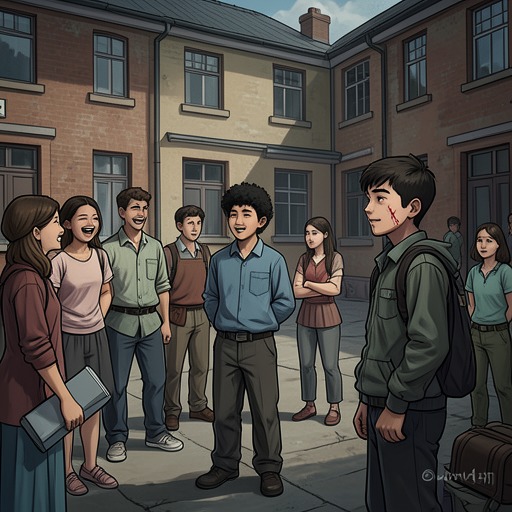
Theodore Finch’s attack on Gabe Romero follows a brief, public insult. The morning after a discussion with Mr. Embry about symptoms, hypomania, and psychotic episodes, Gabe walks past Finch after gym and mutters, “Freak.” Other students are still milling around, but Finch describes no deliberation before he reacts; the violence happens in a flash. He pins Gabe against a locker and chokes him while Charlie Donahue tries to pull him away. Finch keeps going, absorbed by the sight of Gabe’s throbbing veins and his head seeming to shine like an illuminated bulb. It takes four people to wrench Finch off him. As Finch is dragged away, he fixes his eyes on Gabe and says, “You will never call me that again.”
The Immediate Aftermath
As Finch is pulled away, his anger takes the form of blame: he thinks that Gabe has put him in this position and made the violence happen. The thought does not undo the assault or make its target responsible; it shows how completely Finch’s attention has narrowed around the insult and the force of his own response. His final warning to Gabe turns the moment into an explicit boundary, but it arrives only after Finch has choked him and four people have had to intervene. The scene’s abruptness matters: the insult is quiet, the reaction immediate, and the consequences public.
The next confirmation of those consequences comes through Finch himself. On March 10, after third period, Violet Markey receives a phone call from him; he is waiting outside near the river and tells her that he has been expelled. The account does not detail the school’s disciplinary process, but Finch’s statement establishes that the assault has removed him from school. His invitation to Violet follows without a pause for explanation: he wants to leave for the day, while daylight remains and he is still using gas.
The Expulsion and the Proposed Journey
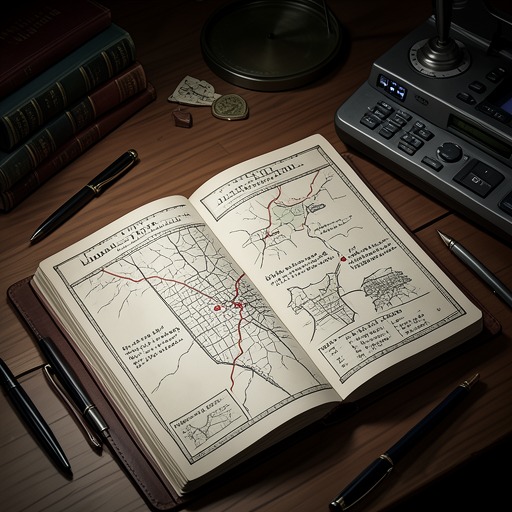
Finch has already turned his attention toward another destination. He wants to drive south to Evansville to see the Nest Houses, human-sized huts woven from saplings by an Indiana artist. Their windows and doors make the structures resemble enormous bird’s nests; Finch wants to find out whether any remain. His plan is specific, but it is also expansive: after Evansville, he proposes crossing the Kentucky border and photographing himself with one foot in each state, then extending the same exercise to Illinois, Michigan, and Ohio.
Violet points out a practical complication: the Ohio River runs along the border, so standing in Kentucky and Indiana at once would require a bridge. Finch carries on with the idea rather than answering her objection. The exchange gives his post-expulsion departure its characteristic momentum: a concrete report of a serious consequence is followed by an invitation to travel, and a logistical correction becomes another prompt for imagining more places to go. Violet is wearing one of Finch’s flowers in her hair when he calls, a small sign of their closeness amid the sudden news that he can no longer return to class.
The Warning Before the Outburst
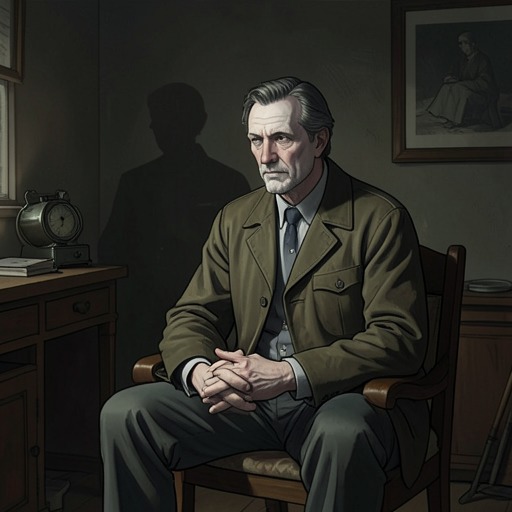
The assault is preceded by a classroom encounter in which Finch’s body is already being read as a possible threat. As Mr. Embry discusses symptoms, hypomania, and psychotic episodes, the bell rings; Finch rises more abruptly than intended, sending his chair clattering against the wall and onto the floor. He imagines how the movement might look from outside himself, especially given his size, and tries to explain that it was accidental. Before he can, Mr. Embry stands. Finch raises both hands in surrender, then offers a handshake as an olive branch. Mr. Embry eventually takes it, but holds on and pulls Finch close enough that their faces are nearly level only from nose to chin. His reassurance, “You are not alone,” is immediately paired with a firm insistence that their discussion is unfinished. The scene does not make the next morning’s violence inevitable; it does establish a charged contrast between Finch’s effort to signal peaceful intent and the physical intensity with which others encounter him. At school the following day, an insult precedes another abrupt bodily act, but this time the force does not stop at a clattering chair or a held handshake: it becomes an assault that requires others to intervene.
Narrative Significance
The scene’s first-person narration keeps the reader close to Finch’s shifting attention without making his perception a justification for what he does. In the instant of violence, Gabe Romero’s physical signs become objects of Finch’s fascination: the pulsing veins and the brightness of his head eclipse the people trying to stop the attack. Charlie Donahue pulls at Finch; Mr. Kappel arrives with his bat; and four people are ultimately needed to separate them. This narrowing of attention makes the assault feel less like a considered response than an abrupt bodily escalation, while the surrounding efforts to restrain Finch keep its physical danger unmistakable.
The insult and Finch’s final warning frame the assault around a name imposed on him and a boundary he tries to enforce through force. The warning comes too late to prevent harm, and the expulsion that follows makes the consequences extend beyond the locker-room encounter: Finch is no longer going to class, and his next plan is a drive away from school. The transition does not resolve the conflict; it carries the story from public violence into motion, with Finch turning immediately toward a proposed journey with Violet Markey.