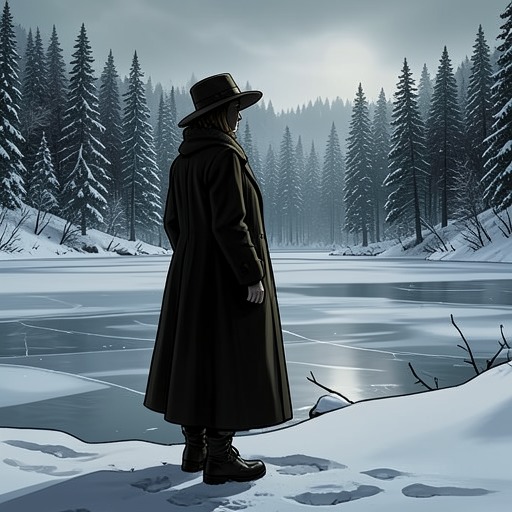
Finch Hikes to Get Flowers and Gives Them to Violet
All the Bright PlacesTheodore Finch’s six-mile run to a country nursery turns an episode of frantic, seemingly purposeless movement into a deliberate gift for Violet Markey. Leaving a family gathering overwhelmed and unable to settle, he drives across the countryside, runs until his body is strained, and then asks strangers to help him bring flowers to Violet. The gesture answers winter not with a promise that everything is well, but with something living that he can place in her hands.
Flight and the search for direction
After trying to contain himself at the gathering, Finch leaves and walks across town to Little Bastard. He drives without a map or destination, crossing fields in successive directions—north, west, south, then east—and pushing the car to ninety. By sunset he is cutting through Indianapolis, smoking his fourth American Spirit cigarette. The speed does not satisfy him; he suddenly resents the car for slowing him down when he needs to keep moving.
When his throat is raw and he feels sick, Finch pulls onto the shoulder and gets out. He bends over, waits, and then starts running along the road, leaving Little Bastard behind. He runs harder as if daring his lungs and legs to fail. A small uncertainty about whether he locked the car becomes impossible to set aside, and he drives himself onward through that fixation. He cannot remember where his jacket is, or even whether he had one. The sequence makes his agitation physical: driving and then running offer motion without an apparent destination, until the idea of flowers gives that motion a specific purpose.
The nursery and the flowers
Finch finds himself among farms and passes commercial greenhouses and nurseries. Although it is Sunday and the nursery is closed, he runs up the drive of one that looks like a family business. A two-story white farmhouse stands behind it, and cars and trucks crowd the driveway. He hears laughter inside, wonders whether he could simply enter and make himself at home, and instead knocks—then knocks again before catching his breath.
A white-haired woman answers, still smiling from the conversation she has left. Finch imagines how he must appear: red-faced, coatless, sweating and gasping. He explains that he is on his way home and asks whether he can choose flowers for his girlfriend, calling it an emergency. When she takes the word seriously, he qualifies it, then tells her what makes the request urgent to him: winter has arrived, he does not know where he will be by spring, Violet is named for a flower, and he wants her to know that he is thinking of her. He describes the season not as one of death but as one for living. The appeal is both practical and intimate: he needs flowers, but he also needs to make his concern for Violet visible.
The woman’s husband comes out from the gathering inside. Finch explains himself again while the couple look between him and each other; the husband calls back for someone to stir the cider, then takes Finch to the nursery and unlocks it with a janitor’s keychain. Finch talks rapidly, offers to pay double, and even offers to send a photograph of Violet with the flowers. The man instead tells him to take what he needs. Inside, Finch is struck by the warm, bright space and the scent of living flowers. The couple help him select the brightest blooms: violets, daisies, roses, lilies, and others he cannot name. Margaret Ann and her husband wrap them in a refrigerated shipping bucket to keep them hydrated. Finch tries to pay, but they refuse his money, and he promises to return the bucket.
By then the couple’s dinner guests have gathered outside to see the young man who needs flowers for the girl he loves. The kindness of the strangers changes the scene’s scale: a private errand becomes a small act of welcome, with Finch accepted into the nursery and addressed as a son. Henry drives him back to Little Bastard, expecting the return to take much longer than it does. When Henry realizes Finch has run six miles, he asks, "Six miles. Son, you ran all that way?" Finch confirms that he did and apologizes for interrupting dinner. Henry does not reproach him; he tells him to greet Violet and to drive home.
A late-night delivery
Finch reaches Violet’s house after eleven and waits in Little Bastard with the windows down and the engine off, smoking his last cigarette. The house is lit. He knows Violet is inside with her parents, who love her but, as he sees it, hate him, and he does not want to intrude. The delay matters: even after going to such lengths to obtain the flowers, he hesitates at the threshold of her home.
Violet texts that she is glad to be back and asks when she will see him. Finch tells her to come outside. He brings the bucket and explains why he wanted her to have the flowers. Violet sets it down, undoes the latch, and pauses to breathe in their scent. Then she turns and kisses him without speaking first. When she does speak, she says, "No more winter at all. Finch, you brought me spring." Her response gives the delivery its emotional resolution: the flowers do not erase the winter or the anniversary of the accident approaching, but for this moment they let Violet experience something other than its return.
Motion made into care
The scene hinges on a change in what Finch’s movement can accomplish. At first, speed is an end in itself: ninety in the car is not fast enough, and the run becomes an effort to outrun the thought of a forgotten lock. At the nursery, the same urgency is redirected into choosing, carrying, and delivering something meant for another person. His body remains in motion, but the trip acquires an object and a recipient.
The refrigerated bucket, which keeps the flowers hydrated, carries the blooms safely from the warm nursery back into the winter night. Finch’s own words connect that living cargo to uncertainty about spring and to his desire for Violet to feel remembered. The simple contrast between the flowers and the season therefore holds both tenderness and foreboding: he can offer her a sign of life, but he cannot promise where he will be when spring comes. After the kiss, Finch sits for a long time in the car, reluctant to break the spell. His attention settles on Violet’s eyes, her absorbed way of reading, and the way she looks at him as if she can see past his outward self. The night’s strenuous errand ends not in escape from his distress, but in a moment of closeness that makes him feel seen.