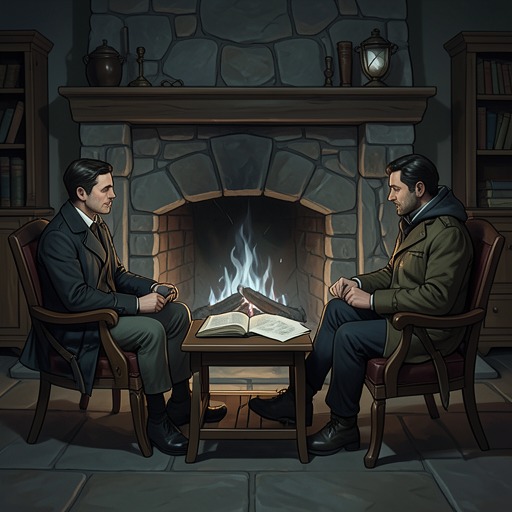
Finch’s Song Manuscript
All the Bright PlacesFinch’s Song Manuscript is Theodore Finch’s intimate musical message to Violet Markey, discovered by her at Taylor Prayer Chapel after his death. Its three sheets join lyrics to musical notation, allowing Violet not only to read what Theodore Finch left but to give it sound. In the chapel, where remembrance and healing meet, the manuscript turns a feared reckoning with loss into an enduring expression of affection.
The Manuscript at Taylor Prayer Chapel
Violet Markey finds the pages at the altar of Taylor Prayer Chapel, tucked into a white envelope inside the Bible. The chapel’s history, displayed on a laminated sheet propped against a vase of flowers, describes the place as a sanctuary for weary travelers and a memorial to people killed in auto accidents. It is also intended as a place of healing, open to the public day and night. That setting matters to Violet’s understanding of why Theodore Finch chose it: she recognizes that the chapel was meant for Eleanor Markey, for herself, and for Theodore Finch, too, as a weary traveler in need of rest.
The manuscript is not immediately visible as a message waiting for Violet. The white envelope pokes out from the Bible, and her name is written on it as “Ultraviolet Remarkey-able.” Before opening it, she sits in a pew, grounding herself in the solid wood beneath her. She fears that the pages may tell her how she failed Theodore Finch, how much she hurt him, or what she might have done differently. The envelope therefore holds more than unknown writing: for Violet, it first carries the possibility of accusation and renewed self-blame.
Pages Made for Reading and Playing
Inside are three sheets of thick staff paper. One is covered in musical notes; the other two are covered in words that look like lyrics. The arrangement makes the object both a written text and a musical score. Its words can be read silently, but its notes offer Violet a way to bring the work into sound herself. The surviving lines address a beloved whose presence makes the speaker happy and safe, and whose influence makes him feel lovely. Among them is the declaration, “You make me lovely, and it’s so lovely to be lovely to the one I love.…”
The lyrics transform the envelope’s threatening uncertainty. Violet had anticipated discovering evidence of harm or a list of things she should have noticed. Instead, the words she reads describe tenderness and the happiness Theodore Finch associates with her. The manuscript does not erase her grief or answer every question she brings to the chapel; its force lies in offering a different kind of knowledge about their relationship. What remains on the pages is an expression of love, not an explanation that makes his loss comprehensible.
Violet’s Encounter with the Song
Violet’s first response to the lyrics is physical and overwhelming: she cries loudly, with hiccups, as though she has been holding her breath and can finally breathe. She reads and rereads the words, returning to the lines about happiness and loveliness until she knows them by heart. The manuscript thus changes from an unopened, feared object into something she can carry inwardly. Her response is neither a quick consolation nor a simple resolution; she stays in the chapel until her tears stop and dusk’s pink light fills the room.
The encounter continues after she leaves. At home, Violet takes out the staff paper and plays the notes on her flute. The tune enters her head and stays there; days later, she is still singing it. The song’s afterlife depends on this act of performance: Theodore Finch’s notation becomes sound through Violet’s playing, and the melody persists in her memory beyond the chapel and the paper itself. The manuscript is therefore not merely a message she reads once, but a work she can repeat and make present again.
What the Pages Leave Behind
The song acquires particular significance beside the couple’s unfinished wandering project. Violet realizes that she need not regret that they never filmed their travels, collected souvenirs, or assembled the experiences into a record intelligible to anyone else. The manuscript gives her a different measure of what endures: not a complete archive of where they went, but a song Theodore Finch left and that she can remember, play, and sing. In that contrast, the physical pages matter both as a keepsake and as a prompt for something that exceeds the object.
The manuscript’s ending is consequently not a conventional explanation of Theodore Finch’s death or a final resolution of Violet’s grief. It gives her words and notes with which to remember him, while leaving the pain of his absence intact. Its connection to the chapel’s memorial purpose brings personal affection into a place built around loss; its movement from envelope, to reading, to flute, to remembered tune traces how a material object can carry feeling into the life of the person who survives. What Violet takes away is not a completed account of their time together, but a song she can keep sounding.