Gabe Romero
All the Bright PlacesGabe Romero is Theodore Finch’s longtime antagonist at school, a presence whose insults and confrontations repeatedly challenge Finch’s attempts to contain his anger. Finch calls him Roamer and also uses other derisive nicknames, but the conflict is more than name-calling: it reaches back to middle school, recurs in public and private school settings, and eventually becomes physically dangerous. Gabe’s role is defined by that persistence, while the shifting responses around him show how the rivalry tests Finch’s self-control.
Identity and Place at School
Gabe is most often identified through Finch’s hostile narration as Roamer. Early in the story, Finch singles him out as an exception to the temporary generosity he feels toward the people below the school tower: even from that precarious vantage, he cannot extend the same softened judgment to Gabe. The reference also links Gabe to the social group around Amanda Monk, whom Violet Markey is said to spend time with. This places him within the school’s visible peer circles, although the evidence does not establish that he and Amanda are close friends or explain his wider social life.
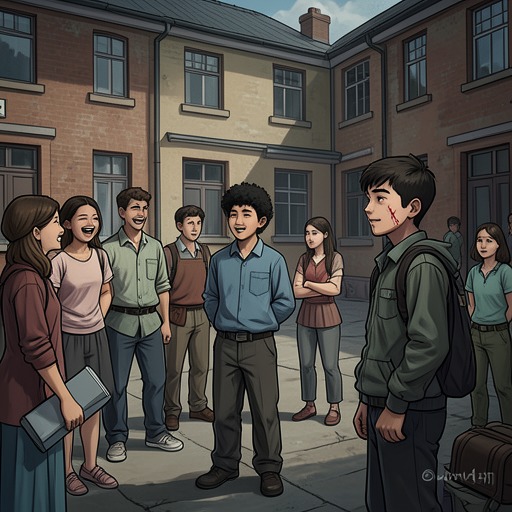
Gabe appears alongside Amanda and Ryan Cross when he blocks Finch after class. His presence is thus not confined to one-on-one encounters: at times, the antagonism unfolds before an audience or in the company of other students. The group context makes the confrontations part of the school’s public social climate, where a remark or gesture can invite attention and reinforce who is being targeted.
A Rivalry Built Through Provocation
The narrator describes Gabe and Finch as sworn enemies since middle school. Their established pattern is clear in a hallway encounter: Gabe warns Finch not to look at him, and Finch answers with an insult rather than backing down. Gabe then knocks the books from Finch’s hands and tells him to pick them up. The incident resembles familiar school bullying, but Finch describes the anger it awakens as immediate and powerful. He recalls a previous outburst involving a desk and clarifies that, contrary to Gabe’s account, he had thrown it at a chalkboard rather than at Gabe. The distinction matters: the rivalry includes not only what each does, but competing accounts of Finch’s earlier loss of control.
Gabe also uses a homophobic slur against Finch. The book presents this as one instance of the hostile language between them, not as a diagnosis or a full account of Gabe’s beliefs. In the same exchange, Finch says that being Awake leaves him feeling intensely alive, making his urge to retaliate especially difficult to manage. He nevertheless counts to sixty and resolves not to earn detention or expulsion. Gabe’s taunts therefore function as a recurring pressure on a choice Finch is actively trying to make: whether to answer provocation with violence or hold himself back.
Confrontations and Escalation
The rivalry is recalled in another setting when Gabe drinks beer and says Finch should have been allowed to jump from the tower, referring to the earlier chalkboard incident in which Finch nearly struck him. The remark connects Gabe’s contempt for Finch with the history both boys share, and shows that the earlier conflict remains available as ammunition. It also underscores the gap between Finch’s crisis and Gabe’s treatment of it: Gabe responds with derision rather than concern.
Later, by the river, Gabe gets in Finch’s face after Finch has been in the water. Finch answers with a crude taunt, and Gabe attacks him, sending them both down the bank into the water. Violet urges Ryan to intervene; Ryan says he did not start the fight, but Violet insists that he act anyway. This episode briefly widens the rivalry beyond the two boys. The bystanders’ response becomes part of the scene, while Violet’s demand that someone step in establishes that Gabe and Finch’s conflict affects those forced to witness it.
A subsequent threat in the locker room shows that the river fight has not ended the antagonism. With Charlie Donahue gone and Mr. Kappel elsewhere, Gabe corners Finch and warns him that he is dead. Finch says he would like to fight back but chooses not to, remembering Violet’s earlier request that he let Gabe go. He begins counting instead. The contrast with his earlier confrontations is important: Finch’s restraint is not an absence of anger, but a decision shaped by the consequences he fears and by Violet’s appeal.
Consequences and Narrative Role
The rivalry reaches its most serious point after Gabe again calls Finch a derogatory name under his breath. Finch attacks him at a locker and is eventually pulled away by others. The narration emphasizes the speed and intensity of Finch’s response, making the encounter a stark reversal of the restraint he had managed in the locker room before. The school conflict has now crossed from repeated provocation into an assault with immediate consequences for both students. The supplied events establish the attack but do not detail Gabe’s later recovery or his subsequent relationship with Finch.
Gabe serves as a recurring antagonist through whom the novel shows the unstable boundary between insult, accumulated grievance, and action. The pattern does not make him the sole cause of Finch’s violence: the narration records Finch’s own choices, including moments when he counts rather than retaliates and a later moment when he does not. Gabe’s taunts help shape the circumstances of those decisions, while the differences among the scenes preserve Finch’s responsibility for them. The character’s significance lies in this repeated pressure and escalation, not in a resolution or transformation that the available account does not provide.