Graduation countdown
All the Bright PlacesThe Graduation countdown measures Violet Markey’s remaining days until graduation, turning an approaching milestone into a repeated count she can watch diminish. Its most consequential moment comes when she stops treating the future as a sequence of days to cross off: after realizing she has forgotten to mark one, she tears down the calendar and hides it. What began as a way of making time legible ends in a deliberate refusal to keep counting toward a future she cannot yet imagine.
Identity and Form
The countdown appears in Violet Markey’s narrative as a dated marker, expressed in the recurring phrase days to go. The figures establish a clear direction: graduation is approaching, and the number is meant to decrease. The evidence records 142 days to go, then 138, and later a sequence of 135, 134, and 133 days to go. These markers do not account for every intervening day; instead, they punctuate the story at selected moments, making elapsed time visible without turning the narrative into a day-by-day log.
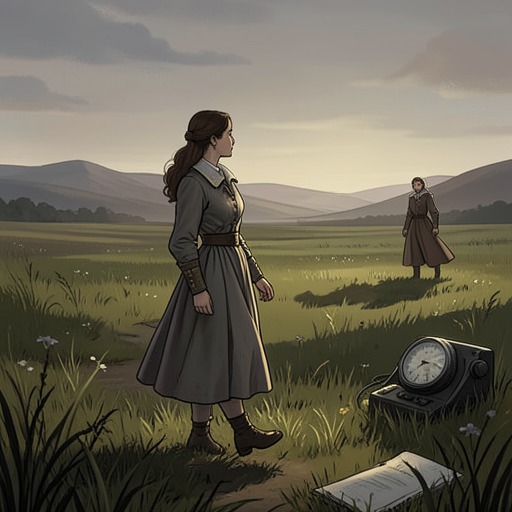
The count also has a material counterpart. Violet keeps a calendar laid out through graduation and freedom, with a black marker always within reach for crossing off each day. The distinction between the dated markers and the physical calendar matters: the first registers time in the narration, while the second makes the countdown a repeated action in her room. Graduation is not merely a date at the end of the count; Violet associates it with freedom, giving the dwindling number both the promise of release and the pressure of an approaching threshold.
The Count in the Story’s Progression
The 142-day marker establishes a long interval still to come. By the time the narrative reaches 138 days, Violet is looking back through the notebook she shares with Theodore Finch and remembering their visits to Bookmarks and the Purina Tower, which she wants preserved even though they are not official wanderings. The countdown therefore runs alongside a life made up of experiences that do not fit neatly into formal milestones. Her concern with what should be remembered offers a contrast to the calendar’s simpler logic: days can be counted, but the significance of what happened within them requires a record of its own.
At 135, 134, and 133 days to go, the repeated marker gives the narrative a faster sense of approach. Around this stretch, Violet learns that Finch has been absent from school for a week and hears conflicting rumors about his suspension or an overdose. The school’s rumors circulate after Principal Wertz shuts down the Bartlett Dirt, while a classmate makes a cruel remark about Violet being on suicide watch and another student intervenes. The countdown does not explain these events or settle what has happened to Finch; its steady arithmetic instead sits beside uncertainty, registering the school future as measurable while the immediate circumstances remain unclear.
The Calendar Is Torn Down
At 133 days to go, Violet’s parents confront her after she has missed the remainder of the school day. Later, she registers the domain for Germ Magazine and messages Finch that her parents have discovered her skipping school and that the wandering project may be over. That evening, with the lights off and her eyes closed, she realizes she has forgotten to cross off the day for the first time. The lapse interrupts a routine that had been maintained closely enough for the marker to remain within reach.
When Violet looks at the calendar, its rows of days no longer give her the reassurance of a finite interval. She sees that there are fewer than half a year until graduation and freedom, but beyond that she does not know where she will go or what she will do. The count thus changes meaning at the point when it reaches toward life after school: a future once represented as a destination now opens into unanswered possibilities. Rather than resume marking the days, she caps the black marker, tears the calendar from its place, folds it, and puts it at the back of her closet, leaving the pen behind with it.
Narrative Significance
The countdown’s progression links measured time to Violet’s changing relation to the future. Its numbers move toward graduation in small, legible steps, but the calendar’s removal shows that a count cannot make the next stage knowable. The turn is especially sharp because Violet does not destroy the calendar; she folds it away. The object remains, but it is no longer displayed as a daily instruction to move toward a fixed endpoint.
The sequence also places counting beside other forms of keeping time and memory. Violet wants the unofficial visits recorded in the shared notebook, while the calendar reduces time to days remaining. When that reduction stops helping, she puts away the count rather than pretending it answers what lies beyond graduation. The episode gives the Graduation countdown a double significance: it marks an approaching freedom, yet its final appearance exposes the uncertainty hidden behind that promise.