Hoosier Hill
All the Bright PlacesHoosier Hill is the highest point in Indiana, a low rise that stands just 1,257 feet above sea level and proves far less imposing than its distinction suggests. For Theodore Finch and Violet Markey, however, it is more than a geographic fact: their first visit makes the overlooked landmark the starting point of a shared project to see Indiana differently, and a place where they leave a small, deliberate trace of themselves.
Discovery and Setting
Finch learns about Hoosier Hill in a U.S. Geography class, in the school’s newly introduced Wander Indiana section. Though he has lived in Indiana all his life, he discovers that the state’s high point is only eleven miles away. Neither his family nor his teachers had mentioned it before. The discovery sharply contrasts with the class’s stated effort to inspire pride in the state’s local history: the landmark has been close at hand, yet absent from Finch’s sense of home.
The lesson supplies concrete details. Hoosier Hill reaches 1,257 feet above sea level and lies in the backyard of a family home. In 2005, an Eagle Scout from Kentucky received permission to build a trail and picnic area and put up a sign. Finch imagines going there and standing at the highest point, wondering whether the view might look different from that elevation. The question turns a classroom fact into an invitation to go and see for himself.
The First Visit
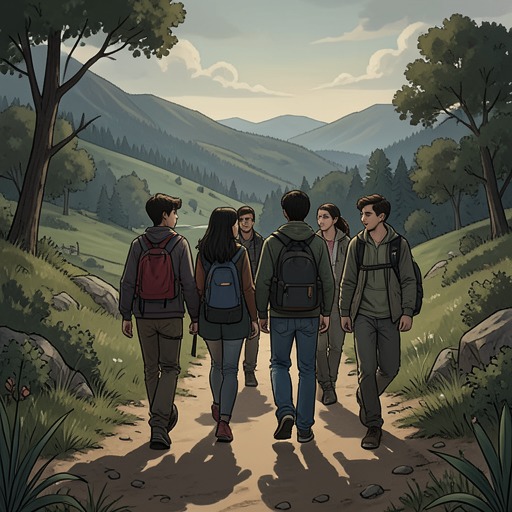
When Violet asks where Finch would go if he could go anywhere, he names Hoosier Hill and imagines going there with a beautiful girl. The visit becomes their first wander together. They ride bicycles through a winter landscape: a grove of trees on one side, flat farmland dusted with snow on the other. Finch guesses which way to go, and they leave their bikes by the tree line before crossing the road and following a short dirt path. Their aching legs and Violet’s breathlessness make the approach a bodily undertaking, however small the distance.
A group of children is gathered by the field fence. One tells them to go ahead, adding that people come from all over the world to see the place and that they are not the first visitors. The path leads through brown winter trees to a clearing with a bench under a tree and a picnic table. A sign identifies the Indiana high point and its elevation. The marker itself is a wooden stake among stones, no wider or taller than a pitcher’s mound. Violet finds the arrival underwhelming. The gap between the superlative title and the unimpressive marker is part of the encounter: the place offers no grand spectacle to match the expectation created by the word highest.
A Shared Landmark
The low-key summit becomes a setting for play rather than disappointment alone. Finch and Violet jump as the children approach, land dusty and laughing, and Finch adopts an Australian accent to jokingly present them as professionals. The scene makes the hill’s small scale an advantage: it is a place they can inhabit and play on, rather than a vista that dictates how they should feel.
They leave British coins, a red guitar pick, and a Bartlett High keychain inside a fake rock used to hide a key, which Finch found in his garage. He wedges it among the stones around the high point. The objects are ordinary, but their placement gives the visit a lasting, shared mark: the pair have put something of their own into the site. They take turns posing for photographs on the summit, turning the visit into a record they can carry away as well as a deposit they leave behind.
The Start of the Wandering Project
At Hoosier Hill, Finch brings out a map and a college-ruled notebook. He asks Violet to keep the notes, explaining that his handwriting is difficult to read. Her reluctance to write in it is part of the moment, but the map and notebook make the outing more than a spontaneous excursion: they establish a way to record and continue their travels. The hill is thus both a destination and a beginning, the first point in a project organized around visiting places in their home state.
Hoosier Hill’s narrative significance rests on the contrast between its modest physical form and the meaning the teenagers make there. What first appears to be a barely elevated marker becomes a shared place through the ride, the jokes, the photographs, the hidden keepsakes, and the map and notebook. The visit does not make the landmark grand; it makes the familiar landscape newly available to Finch and Violet as something they can explore together.