I am here
All the Bright Places“I am here” is Theodore Finch’s affirmation of present-tense existence, most forcefully spoken after he stops a dangerous drive before it becomes fatal. The phrase makes survival more than an outcome: it is something he registers in his body and chooses to acknowledge, against the pull of risk, inherited self-condemnation, and mental absence.
The phrase and wakefulness
Finch first expresses the idea as gratitude for still being present. He says, “I’m still here, and I’m grateful, because otherwise I would be missing this. Sometimes it’s good to be awake.” The emphasis falls not on an abstract promise that life will improve, but on the experience he would otherwise miss. In this moment, being awake means being able to notice and value what is happening now.
That small recognition has a social and emotional context: Finch imagines Violet Markey smiling at her computer, picks up his guitar, and begins making up words and a tune. His immediate response is musical; the thought of Violet accompanies his awareness that he is still alive. The passage presents wakefulness as fragile but capable of opening onto gratitude and connection.
A declaration after danger
The clearest formulation comes during Finch’s high-speed drive in Little Bastard. He accelerates toward one hundred miles per hour, describing an intensifying rush and the possibility of ending in crushed metal and fire. At the last moment, he lifts his foot from the gas. The car sails over the rutted pavement and lands hard, partly in a ditch.
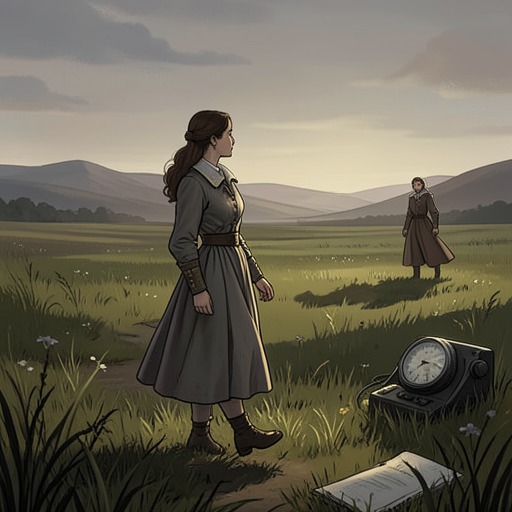
After catching his breath, Finch finds that his hands are steady. He looks at the starry sky, the fields, and the dark houses, then says, “I am here.” The short sentence follows an action that could have ended his life, so its plainness carries the force of a reversal: he has approached destruction and, at the decisive instant, pulled back. The surrounding landscape and the stillness of the houses give the statement a concrete setting; he is not merely imagining survival but locating himself in the world after danger.
Repetition against self-erasure
The phrase belongs to a broader pattern in which Finch tries to remain awake and counter the language he has absorbed about himself. During a winter run, he recalls growing up with the words “Worthless. Stupid.” He fears that letting them in will allow them to fill him, and tries to outrun them by repeating, “This time will be different. This time, I will stay awake.” Running becomes both a physical routine and an effort to resist an identity imposed through repeated insults.
Later, after finding wreckage associated with Violet Markey and Eleanor Markey, Finch takes a license plate from the site because leaving it exposed feels wrong. He runs home carrying the cold metal, and again repeats, “This time will be different. This time, I will stay awake.” The direct “I am here” is not repeated in that passage, but the related refrain links presence to an ongoing struggle: Finch tries to hold himself in the present through movement, touch, and words, even when grief and the evidence of death press in around him.
Significance
Across these moments, “I am here” is neither a cure nor a guarantee. Its meaning is immediate and deliberately modest: Finch has survived this instant, is able to feel and observe, and can name that fact. The phrase gains force through its contrast with his dangerous acceleration, his fear of disappearing into the words “Worthless” and “Stupid,” and his repeated insistence that he will stay awake. Its affirmation is therefore both a recognition of survival and an effort to remain present.