Mr. Embry
All the Bright PlacesMr. Embry is the Bartlett High School counselor who tries to monitor Theodore Finch’s safety, first through increasingly frequent sessions and later through an honest reckoning with what those efforts could and could not accomplish. His encounters with Finch expose the strain between institutional supervision and personal care; his conversation with Violet Markey after Finch’s death turns that strain toward the needs of the bereaved.
Identity and Approach
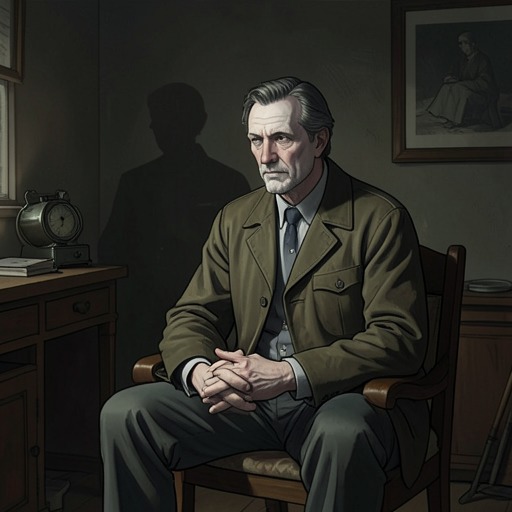
Finch has known Mr. Embry since sophomore year and refers to him privately as Embryo. He describes the counselor as short and thickset, built like a bull, and finds him predictable because he gets to the point. That bluntness is not warmth in an uncomplicated form: Mr. Embry can fix Finch with the look of someone trying to crack a suspect, and he does not accept humor as an adequate answer to questions about self-harm. Yet Finch also says that he likes him. The relationship contains genuine regard alongside evasions, irritation, and the need for supervision.
Mr. Embry’s role begins in a school environment where Finch is already on probation. Finch has agreed to weekly counseling among other conditions after a series of disciplinary incidents, including smashing a guitar at assembly, using fireworks illegally, and throwing a desk at a chalkboard. By the time Mr. Embry questions him about the Bartlett High School bell tower, the counselor is therefore responding both to a specific alarming scene and to a longer record of trouble. Finch, however, experiences the attention as a spotlight he does not want following him through school and the rest of his life.
Monitoring Finch’s Safety
After Finch is seen on the bell tower ledge, Mr. Embry asks directly whether he was planning to jump. Finch deflects with a joke about pizza day, but Mr. Embry makes clear that he needs to know whether Finch has planned or is planning to harm himself. He warns that Principal Wertz could expel Finch if the incident is reported, and he also raises his own responsibility should Finch return to the tower and jump. His concern is therefore presented through two registers at once: the immediate question of Finch’s safety and the school’s disciplinary and legal consequences.
Mr. Embry does not let Finch’s joking assurance end the matter. He says that another incident, or even Finch thinking about it again, will mean contacting Finch’s mother and requiring a drug test. He also increases their meetings from once to twice a week, setting appointments for Monday and Friday so he can check how Finch is doing. Finch protests that he is fine and tries to treat the extra sessions as unnecessary, but the counselor makes the schedule nonnegotiable. The insistence shows a real attempt at continued contact, even as Finch’s resistance makes clear that attendance and candor are not the same thing.
That gap becomes visible when Finch misses a Friday appointment. Mr. Embry leaves a voicemail asking where he is; he has read the Bartlett Dirt and suspects he understands what happened on the ledge. Finch deletes the message, notes that he passed the drug test, and tells himself he will arrive early on Monday to make up for the missed session. The exchange gives Mr. Embry evidence of a missed check-in, but not access to the danger Finch conceals afterward: Finch goes to his room and considers hanging himself. The episode underscores the limits of a monitoring relationship when Finch can perform reassurance while keeping his most serious thoughts private.
A Relationship Marked by Evasion and Partial Trust
When Finch returns to counseling, he decides to tell Mr. Embry about Violet Markey, though not by name. He wants to speak to someone beyond Charlie Donahue and Brenda Shank-Kravitz, whose responses tend toward teasing or warnings about Ryan Cross. The choice marks Mr. Embry as a possible confidant, but the disclosure remains carefully limited. Their sessions also include recurring questions about whether Finch has tried to hurt himself, a routine that makes risk explicit without guaranteeing that Finch will reveal it.
In a later conversation, Mr. Embry discusses symptoms, hypomania, and psychotic episodes with Finch. When the bell rings, Finch rises abruptly and knocks his chair into the wall. Mr. Embry initially reacts to the apparent disturbance, but accepts Finch’s offered hand and insists on the continuing importance of their conversation, telling him that he is not alone. This moment contrasts with the earlier emphasis on rules and liability: the counselor speaks not only as the person tasked with monitoring a risk, but as someone trying to keep a connection open. The scene does not establish a diagnosis or resolve Finch’s crisis; it shows an effort to address what may be happening while Finch remains difficult to reach.
Mr. Embry’s care is also tested by the conditions around Finch. Finch is subjected to bullying by Gabe Romero, including a homophobic slur, and later attacks him after another insult. These events form part of the social world surrounding Finch’s distress, but Mr. Embry cannot simply remove that world through counseling. The novel presents his work as repeated contact within limits: he can ask, warn, schedule, discuss symptoms, and offer connection, while Finch retains the ability to conceal, miss an appointment, or act impulsively.
After Finch’s Death
After Finch dies, Principal Wertz and the school board require his friends and classmates to attend at least one counseling session. Violet Markey asks specifically for Mr. Embry because he had been Finch’s counselor. She arrives carrying guilt over the route she and Finch took and the possibility that a different choice might have prevented her sister Eleanor Markey’s death; that existing grief becomes entangled with the belief that she should have recognized Finch’s danger and done more.
Mr. Embry does not present himself as blameless. He calls Finch a good, troubled kid who should have received more help and admits that he feels responsible. He then qualifies that admission: he did what he believed he could do, while acknowledging that everyone can wonder whether more was possible. Rather than make the uncertainty disappear, he recognizes that Violet may be asking herself the same unanswerable question. His response gives the scene force because he is neither an all-knowing professional nor a figure who can offer a neat explanation for Finch’s death. He shares the burden of hindsight without allowing it to become proof that Violet alone caused the outcome.
Mr. Embry tells Violet that people can go to great lengths to hide what is happening to them, and cautions her that she cannot be responsible for everyone—not Finch, and not Eleanor, who had no choice in the accident. He leaves room for uncertainty about Finch’s own sense of choice without claiming to know everything Finch felt. He also gives Violet SOS: A Handbook for Survivors of Suicide and urges her to read it and talk with him, her parents, and her friends rather than bottling up her grief. Violet reads the thirty-six-page booklet at home; its language about accepting a life permanently changed stays with her. Mr. Embry cannot remove her loss, but he helps her name it as grief that deserves support rather than private punishment.
Narrative Significance
Mr. Embry links the novel’s early warnings about Finch’s risk to its later account of the people left behind. Before Finch’s death, his practical measures—direct questions, a drug test, and twice-weekly appointments—show that the danger has been noticed, while Finch’s concealment demonstrates why noticing is not the same as knowing. Afterward, Mr. Embry’s willingness to acknowledge both his efforts and their limits resists a simple answer to the question of responsibility. His role is defined by that unresolved balance: he tries to intervene, cannot fully see into Finch’s private life, and then offers Violet a way to seek help without pretending that grief can be settled by an explanation.