Overnight Stay at Purina Tower and Parents’ Ban on Dating
All the Bright PlacesThe overnight stay at Purina Tower becomes a turning point for Violet Markey and Theodore Finch: a private night together ends not with an ordinary return home but with her parents’ fear, a direct confrontation, and a ban on seeing him. The tower first serves as a secluded place where the two can extend their time together; by morning, it is the reason Violet must account for her absence and the setting of a rupture that follows her back into the house.
The Detour and the Night Above the Town
After Violet and Finch have been alone together, they hold hands in the car without discussing what has happened. Instead of driving her home, Finch takes a detour to Purina Tower. He retrieves a blanket and pillow from the back of the car and proposes telling her a story there. They climb the steel ladder to the top, passing a Christmas tree, and settle beneath the blanket. The scene changes the immediate direction of the evening: Violet had said she should go home, but Finch offers one more shared experience, and she goes with him.
The story he tells concerns the supposed Jovian-Plutonian gravitational effect. In Finch’s account, British astronomer Sir Patrick Moore announced on April 1, 1976, that Pluto would pass behind Jupiter at 9:47 in the morning, briefly making people weigh less through the planets’ combined gravitational pull. The elaborate, improbable explanation gives the night a playful imaginative frame: rather than treating the tower only as a place to climb, Finch turns it into a setting for a story shared between them. Violet responds warmly, calling him weird while telling him that what he has said is the nicest thing anyone has said to her. Their time together is intimate, but its emotional center in this scene is also the pleasure of being addressed and understood.
The morning chapter shifts the meaning of that refuge. Violet wakes before Finch beneath the blanket, which covers them like a tent, and watches him sleep with his arm around her. She wonders whether he is dreaming of her. Then the light makes the unplanned consequence plain: the sun has gone down and come up while she has remained at the tower, and she has neither gone home nor called her parents. The night’s extension, which had felt private to the couple, has become an absence her family experienced without explanation.
The Return and the Confrontation
Violet and Finch take a long time to descend the tower’s twenty-five thousand steps, as she describes them, and reach the ground. She phones her parents from the car. Her mother begins crying; her father takes the call to ask whether Violet is all right and safe. Finch drives her home quickly, concentrating on the road, while the two say little. As they approach her street, Violet’s alarm at what she has done returns. They rush toward the house, whose door is standing open, and Violet tells Finch that she should speak to her parents alone.
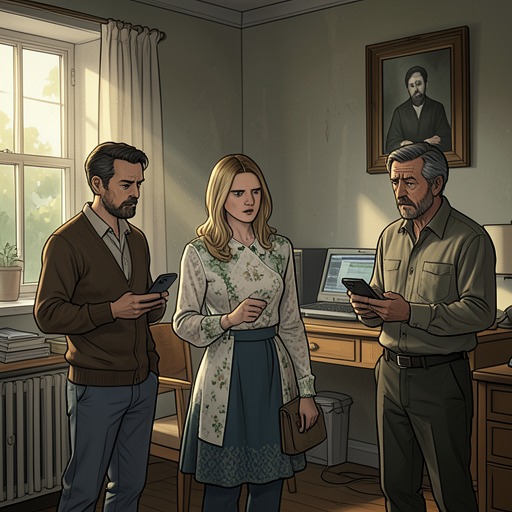
James appears before that separation can happen. He checks Violet’s face and pulls her into a tight embrace, then tells her to go inside and say goodbye to Finch. The instruction sounds final to her. Finch intervenes, saying that they lost track of time and asking her father not to blame Violet. Violet answers that Finch is not at fault. Her mother pulls James away from following Finch, and both parents embrace Violet as Finch drives off. The sequence makes the disagreement more complicated than a simple argument over rules: her parents’ first response is fear for her safety, while Violet and Finch each try to prevent the other from bearing the blame.
Once they have calmed down, James explains that he considers Finch troubled and unpredictable, and says Finch has dealt with anger issues since childhood. Violet realizes that her parents have called Finch’s mother after remembering the carefully written contact numbers Finch had given her father. The episode therefore discloses a channel of communication between the families that Violet had not fully considered. The parents’ judgment is based partly on what they learned through that contact, although the scene does not specify everything they were told. Violet challenges their decision as distrust and connects their protectiveness to Eleanor Markey’s death, asking whether they are trying to prevent anything like that from happening to her.
The Ban and Its Immediate Cost
Sheryl Markey responds that she and James are trying to make sure Violet is safe, not to suffocate or punish her. James then makes the restriction explicit: Violet is no longer to see Finch or drive around with him. He adds that he can speak to her teacher about the schoolwork she has missed and arrange for her to make it up in another way. The ban reaches beyond the single night at the tower; it targets both the relationship and the wandering that has become part of Violet’s life with Finch.
Violet complies outwardly, answering that they are understood and invoking extenuating circumstances. That answer does not mean she accepts her parents’ view. From her bedroom window, she watches the street as though Finch might return and imagines climbing out to tell him to drive as far and fast as he can. He does not come back. The separation is thus made concrete in the space between the house and the street: Violet can imagine choosing Finch, but in the immediate aftermath she remains inside, listening to her parents’ voices downstairs and believing they will never trust her again.
The conflict grows from a mismatch in what the night means to its participants. For Violet and Finch, the detour has extended a shared evening; for her parents, an unannounced night away raises an urgent safety concern, intensified by their knowledge of Finch and Violet’s grief over Eleanor. Their intervention protects Violet in their understanding, but it also removes her ability to continue the relationship on her own terms. The parents’ fear and Violet’s sense of being mistrusted remain side by side rather than resolving into agreement.
The Tower’s Place in the Larger Story
Purina Tower belongs to the pair’s wider practice of wandering, in which reaching a place and leaving something behind make an experience feel shared beyond the moment itself. Their stated rules include navigating with paper maps rather than phones and leaving an offering at each site as proof that they were there and as a way of giving something back. At another high point, they leave British coins, a red guitar pick, and a Bartlett High keychain inside a fake-rock key holder, then take photographs together. Such details establish that a visit is not merely arrival and departure: it becomes a record, an object left in place, and a memory they can revisit.
Their other encounters at heights also show that the tower’s danger and appeal coexist. In one scene, Finch stands at an edge and shouts what he hates and wants to change; Violet holds his shirt while looking outward rather than down, and eventually joins him in song. This is not the same night as their stay at Purina Tower, but it clarifies how elevated places in their shared life can provide both release and unease. The overnight stay takes that pattern into a private setting: the tower offers distance from home, yet it cannot keep the consequences of staying away from reaching them.
Later, Purina Tower becomes the site of a candlelight gathering for Finch. Brenda Shank-Kravitz, Charlie Donahue, Violet, Ryan Cross, and Amanda Monk sit together at the top, speak about him, and listen to songs associated with him. Brenda dances, the others join her, and Violet experiences an unexpected return of laughter. This later use of the tower does not undo the ban or the separation that began after the overnight stay. Instead, the place holds sharply different kinds of gathering: first a secluded night with Finch, then a memorial shared with friends. Its meaning shifts from a refuge for the couple to a place where Violet and others remember him together.