Quicksand
All the Bright PlacesQuicksand is the survival metaphor Theodore Finch uses to give shape to a depressive crisis that feels both slow and physically inescapable. He turns advice about staying still, breathing, and moving carefully into an eight-step manual for enduring emotional danger. The image is more than a comparison: it organizes the way he describes being pulled downward, and later gives language to the exhausting effort of getting himself to medical care.
The metaphor and its rules
Finch frames quicksand as a trap in which panic can make the danger worse. Recalling reports of people swallowed by quicksand—including a young mother on a beach in Antigua and teenage boys in a man-made pit in Illinois—he sets grim examples beside the claim that a person can survive by remaining still. His methodical list begins with the uselessly late instruction to avoid the hazard, then considers preparation, shedding weight, relaxing, breathing deeply, lying back, moving slowly, and taking breaks. The list borrows the form of practical survival instruction, but its subject is the crisis Finch is already inside.
Each step translates a physical survival principle into a way of enduring distress. Preparation matters, he suggests, but danger may not announce itself before it is too late; once caught, a person should drop what weighs them down. Relaxation and deep breathing are linked to buoyancy, while lying back means spreading the body out, freeing the legs, and inching toward solid ground. Slow movement and frequent rests replace the fantasy of a sudden, forceful escape. The sequence acknowledges how little control a person may have, yet insists that small, careful actions remain possible.
Finch gives this system a concrete setting when he moves into his walk-in closet, a space he has used before and calls Finch Survival Boot Camp. He pushes his clothes aside, puts his bed comforter on the floor, and arranges a jug of healing water from Mudlavia, Violet Markey’s picture from the Blue Flash, and the license plate he took from the A Street Bridge Crash. He leaves a cigarette unlit because the air already feels close. These objects bring together his own history, Violet Markey, and a previous accident in a confined refuge that resembles a cave. The retreat is not presented as an instant cure: Finch says he will stay as long as he needs to, making duration part of his survival plan.
A slow, churning descent
At school, Finch’s description of quicksand becomes an account of how his crisis affects ordinary tasks. At lunch he sits with Charlie Donahue among other people but feels alone; he pretends to read, smiles and nods, and cannot properly hear the conversation around him. Charlie notices his state and says that Finch is bringing him down. In U.S. Geography, Mr. Black speaks at the board while Finch tries to write, but the words disappear from his grasp. Violet Markey sits beside him, and when she glances at his paper, he covers it with his hand.
Finch imagines his condition as a dark vortex that churns slowly, with a great weight attached to his feet and pulling him down. The pace matters: this is not a sudden plunge but a gradual immobilization that makes attention, reading, and writing unreliable. The image also makes visible a distress that he conceals socially. He can perform a smile and appear to follow a conversation while inwardly experiencing the downward pull he cannot explain aloud.
His attempt to take stock of his life sharpens the tension. Finch runs through a checklist—an amazing girlfriend, decent friends, shelter, and food—and then recalls his height, his ability to think, and his musical and songwriting talents. The inventory records real sources of connection and competence, but it does not cancel the vortex. The contrast between things he can affirm and the weight he feels resists a simple explanation of his suffering as a failure to appreciate what he has.
From image to action
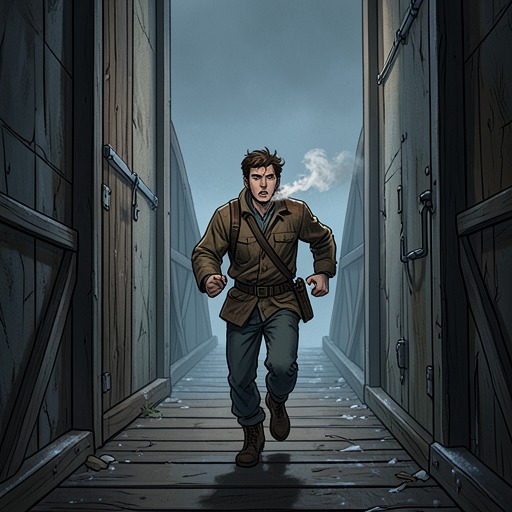
The metaphor returns during Finch’s pill crisis in a bodily form. He can barely lift his head, and his feet seem far away; the pills seem to tell him to stay still. He describes blackness pressing him down into the floor and calls the condition being asleep. Against that paralysis, he forces himself upright, goes to the bathroom, and tries repeatedly to make himself vomit. He then puts on his sneakers and runs, even though his limbs feel heavy and he feels as if he is moving through quicksand.
Finch follows his regular nighttime route down National Road to the hospital, crosses the parking lot, and enters the emergency room. He tells the first person he sees that he swallowed pills and cannot get them out, and asks for help. Staff members lead him to a room. The movement does not erase the metaphor’s weight; rather, the scene turns its survival instructions into action. Finch is not suddenly free of the drag he describes. He breathes, persists through heavy limbs, and reaches other people who can respond.
Significance
Quicksand gives Finch a vocabulary for a state that otherwise resists clear description. Its rules hold two truths together: panic and frantic movement may deepen the danger, but passive endurance alone is not the whole route out. The list allows him to imagine survival as a sequence of manageable efforts—breathe, spread out, move slowly, rest—rather than as a single dramatic escape. Its recurring force comes from the mismatch between the ordinary practicality of the instructions and the profound crisis to which Finch applies them.
The metaphor also joins concealment to disclosure. At school, Finch hides his writing from Violet Markey and maintains a social smile while feeling pulled downward; in the emergency room, he names what he has done and asks directly for intervention. Across those moments, quicksand describes not only helplessness but the labor of resisting it. The image cannot promise safety, but it makes Finch’s effort legible: even when forward movement feels slow and weighted, reaching for solid ground can begin with one deliberate action.