Signs
All the Bright PlacesSigns are both things to find and things to read in Theodore Finch and Violet Markey’s story: a hilltop marker, a place’s legends, a painted declaration, or a terse message left behind. Their meaning is never guaranteed by the object alone. A sign can be underwhelming when it merely names a destination, intimate when it makes a place feel shared, or devastating when it confirms that Theodore Finch was somewhere Violet Markey could not reach him.
Markers and places
At Hoosier Hill, the official marker identifies the Indiana high point and gives its elevation as 1,257 feet. The marker itself is a wooden stake among stones, in a brown clearing with a bench and picnic table. Violet Markey’s immediate response is disappointment: the celebrated high point seems almost nothing at all. The scene sets a useful contrast for the concept of signs. A sign can accurately identify a place without giving it emotional force; meaning depends on what the people arriving there bring to it.
At Bookmobile Park, the seven vintage trailers stand in a line among the cornfields, each advertising a category of books. Their labels organize the place, while the location awakens Violet Markey’s memory of bookstore hunts with her parents and Eleanor Markey. The scene links signs to recognition and memory: the trailers are not personal messages, but their arrangement helps Violet Markey reconnect with an earlier family ritual.
At the top of Purina Tower, Theodore Finch and Violet Markey look down on Bartlett’s lights and the dark spaces between them. Violet Markey calls the view lovely; Theodore Finch says, “It’s like it’s ours.” The place does not change, but his words make the town feel briefly shared. Here, what matters is not a written marker but the act of naming a common experience.
Local stories and returning to the Blue Hole
On the first warm day, Theodore Finch brings Violet Markey to the Blue Hole, a private, tree-ringed pool. He recounts local stories that describe it as bottomless, connected to an underground river, associated with buried treasure and stolen cars, and dangerous to swimmers. He also relates that an expedition by two sheriff’s deputies in 1969 found a whirlpool but no bottom. These stories make the lake a place layered with competing explanations: rumor, reported history, and physical danger all attach themselves to the same water.
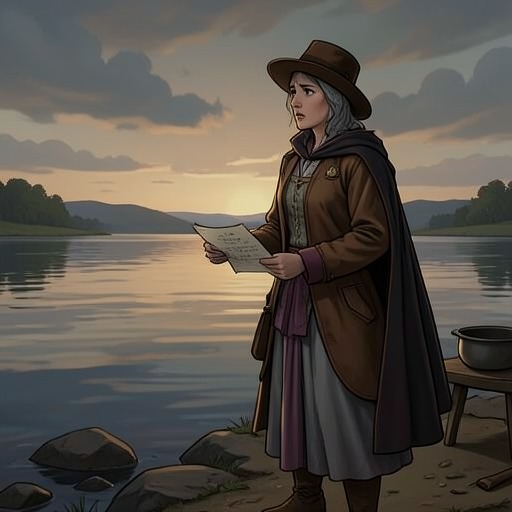
After Theodore Finch’s disappearance, Violet Markey returns to the Blue Hole. She recognizes its round blue water and trees from their earlier visit and notices how closely the water’s color recalls his eyes. The familiar setting now carries the weight of his absence. The place is a trace of their shared time, but it cannot answer the questions that matter most to her; its stillness offers no confirmation of when Theodore Finch came there or what happened.
Messages left behind
In the days after Theodore Finch’s disappearance, brief messages appear in sequence: “I am on the highest branch”; “We are written in paint”; “I believe in signs”; “The glow of Ultraviolet”; and “A lake. A prayer. It’s so lovely to be lovely in Private.” Their compressed, suggestive language gives Violet Markey fragments to follow rather than a complete account. The sequence moves among height, inscription, belief, color, water, and prayer, but it does not make their meanings certain. “I believe in signs” becomes a statement of faith in interpretation at precisely the moment when Violet Markey most needs clues.
At the abandoned Pendleton Pike Drive-In, Violet Markey approaches the remaining screen from behind and circles it before seeing the red words Theodore Finch has painted on its face: “I was here. TF.” The message turns the derelict screen into proof of his presence. Violet Markey’s grief is immediate and physical; she sinks into the dirt and wonders where she was while he climbed up and painted it. The words tell her that he came, but not when, or what he wanted her to understand.
A can of red spray paint sits nearby, its cap on. Violet Markey takes it, climbs the screen’s steel supports, and adds, “I was here too. VM.” The paired inscriptions convert a solitary mark into a shared one. She understands the act as the completion of their project: they began it together, and she ends it by answering Theodore Finch’s message in the same place. The painted words do not undo his absence; they give her a way to stand within the project they made together.
Unanswered traces
At Taylor Prayer Chapel, Violet Markey finds a small white chapel and steeple beyond a wooden cross and the sign bearing the chapel’s name. She stops the car and wonders whether Theodore Finch came there on the day he died or the day before, and how he found the place. The sign identifies the destination, but not his connection to it. That uncertainty is central to the novel’s treatment of signs: traces can establish presence and sustain a relationship across absence, yet they cannot always disclose motive or settle what happened.
The signs therefore form a fragile record rather than a code with a single solution. Some orient the travelers; others gather private memory, local legend, or shared authorship. After Theodore Finch is gone, Violet Markey follows what he left and adds her own mark, moving from searching for his whereabouts toward completing something they had begun together. The final meaning rests not in a sign’s ability to explain everything, but in the act of recognizing and answering it.