The First Wander: Hoosier Hill
All the Bright PlacesThe First Wander: Hoosier Hill transforms a classroom assignment into Theodore Finch and Violet Markey’s first journey together. The destination is only eleven miles from Bartlett, yet neither the height nor the outing’s significance is apparent at first: Hoosier Hill proves anticlimactic as a landmark, while the shared acts of reaching it, standing on it, and leaving something there give the visit its force. Their first excursion establishes the wandering project as both a way to encounter Indiana and a setting in which their relationship begins to change.
The Assignment and the Call to Go
In U.S. Geography’s new Wander Indiana unit, Finch discovers that his family has lived in Indiana all his life only eleven miles from the state’s highest point, without anyone having told him. Mr. Black explains that Hoosier Hill rises 1,257 feet above sea level and sits in the backyard of a family home. He also recounts that an Eagle Scout from Kentucky received permission in 2005 to build a trail and picnic area and put up a sign. The local high point becomes newly visible to Finch through this combination of an ordinary fact and a small, deliberately constructed landmark.
Finch proposes that the class take a field trip, arguing that places such as the Grand Canyon or Yosemite must be experienced in person to be appreciated. His suggestion is partly sarcastic, but the impulse beneath the joke is sincere: he wonders what it would be like to stand at the state’s highest point and whether the view might look different from there. Mr. Black turns the idea into a semester project. Students, working in pairs, must visit at least two—and preferably three—Indiana wonders, photograph or film them, investigate their histories, and explain what makes them worth Hoosier pride. If the places can be linked, so much the better. Finch asks whether the students may choose their partners; his eventual trip with Violet gives the assignment a personal direction beyond its grading requirements.
The Ride to Hoosier Hill
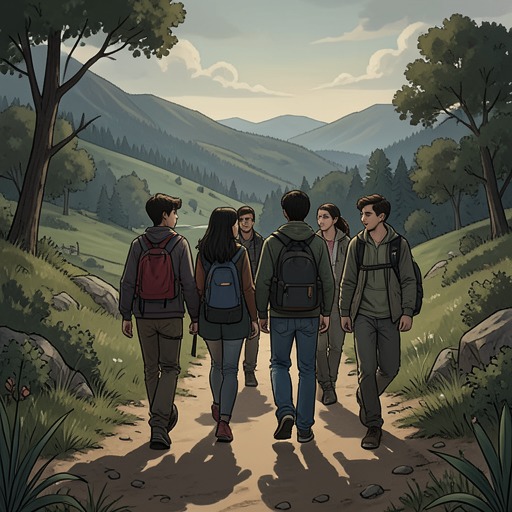
The first excursion begins with Violet reluctant to go, while Finch insists that they are already committed to the project and that reaching Hoosier Hill will let her get the obligation over with. The route takes them past cornfields on a cold, bright day. As they travel by bicycle, Finch talks about driving as the pleasure of forward motion and the possibility of going anywhere. Violet points out that this is not driving, but his image gives their small outing a larger horizon: movement matters to him as a feeling of possibility, not simply as transport.
Finch answers her question about where he would go by saying that he would go to Hoosier Hill with a beautiful girl. Violet recognizes in the day a remnant of the person she was before the accident, the ordinary teenage self she calls Violet Unremarkey-able. That glimpse does not erase what has changed, but the ride lets her experience motion and open air without making the journey itself a confrontation. Near the destination, a grove stands beside flat farmland dusted with snow. They leave their bicycles by the trees, cross the road, and follow a short dirt track toward the high point.
The Marker and the Jump
The landmark is small and plain. In a brown clearing, a wooden bench sits beneath a tree and a picnic table stands nearby. A sign identifies the place as Indiana Highpoint, Hoosier Hill, elevation 1,257 feet. Ahead, a wooden stake rises from a pile of stones no larger or higher than a pitcher’s mound. Violet asks whether this is it; the sight is underwhelming, though she has already wondered what she expected a state high point to look like.
Finch pulls Violet by the hand onto the stones. The contact produces a physical jolt that Violet first tries to explain away as unfamiliarity, then experiences as currents moving up her arm while Finch rubs her palm with his thumb. The modest site consequently acquires an intimacy its scenery cannot supply. The shift is not announced as a declaration; it registers first through touch, through Violet’s startled attention to her own body, and through her decision not to pull away when their hands meet again.
After Violet suggests that they can cross the visit off as one completed destination, Finch stays to take in the place rather than immediately reaching for the map. He then proposes that they jump. Violet notes that it is, after all, the highest point in Indiana, and Finch tells her he needs to know whether she is with him. She agrees. They leap just as the nearby children arrive, land dusty, and laugh. Finch performs for the onlookers in an Australian accent, warning them not to try the stunt at home. The jump turns a low, easily dismissed mound into a shared act: the pair do not merely inspect the official marker but play on it together.
Leaving a Trace and Extending the Journey
The pair hide British coins, a red guitar pick, and a Bartlett High keychain inside a fake-rock hide-a-key container Finch found in his garage. He wedges it among the stones. The objects are modest and eclectic, but their placement gives the visit a material afterlife: they have left a concealed trace at the place they came to see. Finch reflects that, whether Violet wants it or not, they will always be part of the site unless the children find and steal their cache. Violet photographs them posing on the high point, preserving the visit in images as well as in the objects hidden there.
Finch takes out a map and a college-ruled notebook, asking Violet to keep notes because his handwriting is difficult to read. He then marks locations across the state, circling such destinations as Dune State Park, the World’s Largest Egg, the home of Dan Patch the racehorse, the Market Street Catacombs, and the Seven Pillars above the Mississinewa River. Violet says the list is too long; Finch leaves open the possibility that it is not. Their first stop thus expands the assignment from a requirement of two places into a possible itinerary across Indiana. The map makes the next journeys imaginable, while the notebook gives Violet a practical role in recording them.
Significance
Hoosier Hill’s importance rests on a contrast between its physical smallness and what the pair make of it. The site is a brown circle, a short path, a sign, and a stake among stones—not the grand spectacle Finch’s classroom comparison evokes. Yet being there matters: the two climb onto the marker, feel the charge of first contact, jump, leave objects, and document the visit. The location becomes meaningful through these actions and their shared attention rather than through grandeur inherent in the landscape.
The outing also establishes the wandering project’s double purpose. It gives Finch and Violet a reason to travel beyond the classroom and a structure for returning to unfamiliar or overlooked places; at the same time, it offers them a way to be together without reducing the encounter to conversation about grief or the past. Their first stop joins a school task to a burgeoning relationship, and the marked-up map points forward from one small high point to the many places they may yet reach.