Theodore Finch and Ted Finch's father-son relationship
All the Bright PlacesThe father-son relationship between Theodore Finch and Ted Finch is defined by a history of violence and abandonment that Theodore learns to anticipate, endure, and eventually confront. Ted’s moods are treated within the family as something to wait out, but their effects reach beyond any single outburst: they shape Theodore’s memories of childhood, his fear of repeating harm in close relationships, and his decision to draw a boundary when Ted attacks him again.
Family History and Abandonment
Theodore describes a childhood in which Ted’s anger could turn toward members of the family. When Theodore was ten, Ted’s violence sent Linda Finch to the hospital; a year later, Theodore says, he became the target. These events give context to the fear and anger Theodore carries into later encounters, though the family’s language often makes the episodes sound temporary and manageable. Linda calls Ted’s moods something that will pass if everyone gives him time, a framing that asks the children to accommodate his behavior rather than name its consequences.
Theodore also tells Violet Markey that Ted left the family when Theodore was ten or eleven, saying he could no longer cope with them. Ted later returned, then eventually left for good, telling the children that the family was responsible for his departures. Theodore suspects Ted had been involved with his later wife for years, possibly during his earlier absence, but this remains Theodore’s suspicion rather than a confirmed account. He likewise questions whether her seven-year-old son, Josh Raymond, is Ted’s child. His account presents the new household as an unsettling contrast: Ted had said he could not manage a family, yet later formed another one.
The Basement Confrontation
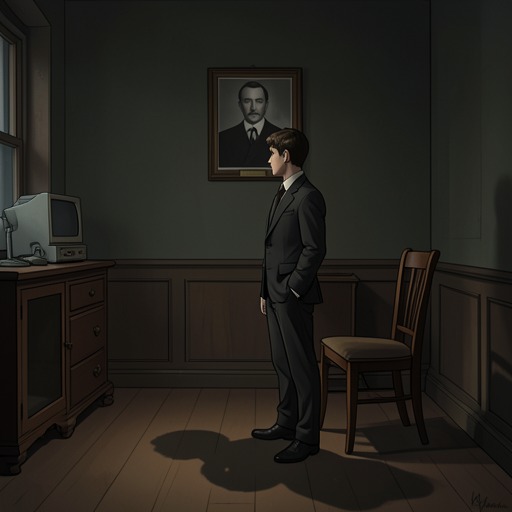
At a family dinner, Theodore learns that Ted is home but downstairs, where Ted’s moods are expected to be taking hold. In the finished basement, Ted sits before a large television, watching a game and drinking beer. Theodore approaches and asks him to come upstairs because the family is waiting. He also challenges Ted’s attention to his new household, insisting that the family from his earlier life is present too.
Theodore recognizes that speaking to Ted so directly is unusual, but he feels little fear in that moment. Ted responds by breaking his beer bottle against the table and lunging at Theodore, knocking him into a wall. Theodore gets back upstairs before Ted can strike him again. At dinner, Ted behaves as if the confrontation has not occurred: he greets his wife, sits down, and does not address Theodore for the rest of the visit. The abrupt return to ordinary table manners contrasts with the violence downstairs and leaves the conflict unacknowledged rather than resolved.
Afterward, Theodore tells Linda he loves her and leaves for a drive in Little Bastard. His hands are shaking, and he connects his anger toward Ted to the earlier assaults on both his mother and himself. Sitting in the car with the garage door still closed, he recognizes how easy it would be to remain there. The scene links his immediate reaction to Ted with a broader, dangerous crisis in Theodore’s state of mind; it does not present the father-son conflict as safely contained by the dinner’s end.
Effects on Theodore’s Intimacy
Theodore later explains to Violet that he cannot promise to remain in a relationship or protect a partner from the damage he fears he might cause. He calls himself broken and worries that he could hurt someone emotionally, even as he distinguishes that fear from the physical harm he associates with Ted. His account of his scar returns to his father’s black moods and to the fact that, when he was smaller, he did not know how to get out of the way.
This disclosure makes the history with Ted part of Theodore’s understanding of his own capacity for closeness. Theodore does not claim that his past excuses future harm; instead, he warns Violet that she should know what she is entering. Violet answers that she is already involved and also feels broken. Their exchange does not erase the history, but it shows Theodore attempting to speak about it rather than keeping it entirely behind the guarded family language of moods and waiting.
A Changed Confrontation
Later, Theodore sees Ted’s SUV before entering the family home and briefly considers driving on. He chooses to go inside and calls for Ted to come confront him. Ted sends him across the kitchen, but this time Theodore rises without retreating. When Ted raises his arm again, Theodore laughs; the unexpected response makes Ted pause. Theodore then tells him that further beatings will not make him feel anything and catches Ted’s wrist as he moves to strike once more. He says Ted will not do that again.
The boundary is both physical and spoken, but its immediate force lies in Ted stopping. Theodore had not expected his words to work. He then tells Linda that Violet is safe and goes to his room. Unlike an earlier childhood strategy of locking the door and pushing furniture against it, he leaves the door open and waits. No one comes to check on him. The scene therefore marks a real change in Theodore’s response to his father without offering reconciliation: Ted desists in that moment, but the household’s silence and distance remain.
Significance of the Relationship
Ted’s role in Theodore’s life is neither reduced to a single confrontation nor resolved by Theodore’s resistance. The earlier scenes establish a recurring pattern: Ted’s moods and violence, the family’s effort to move around them, and the quiet that follows. Theodore’s later confrontation interrupts that pattern by making a limit explicit. Yet the open bedroom door and the absence of anyone coming in preserve the emotional isolation that has accompanied the conflict. The relationship helps explain both Theodore’s suspicion of his own ability to love safely and the importance of his eventual refusal to accept his father’s violence as inevitable.