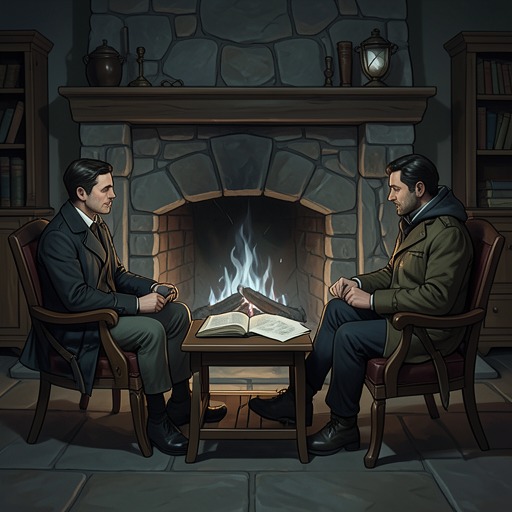
Theodore Finch and Violet Markey
All the Bright PlacesTheodore Finch and Violet Markey’s relationship begins on the ledge of the Bartlett High School bell tower, where Finch recognizes Violet’s danger and helps her get down. Their connection develops through a school wandering project that brings them across Indiana, but its deepest movement is from shared adventure toward trust: Violet revisits painful memories with Finch, while he explains why her attention matters to him. Later, the places they visited become part of how Violet remembers him.
Meeting and the First Act of Trust
In January, Finch is on the bell tower ledge when he notices Violet standing on the far side. She is without shoes, holding her boots, and appears unable to move. Finch speaks calmly and tells her not to look down. His opening attempt at humor gives way to practical instructions: she should throw her shoes toward the bell, hold the rail, lean against it, and lift one foot over. When she nearly loses her balance, he tells her not to nod and warns her not to step forward. The scene establishes a defining tension in their relationship: Finch is himself in danger, yet he turns his attention toward helping Violet act safely.
Once they are back on the concrete, Finch publicly thanks Violet for saving him, allowing the crowd below to understand her as the person who helped him. The gesture is not simply a reversal of who rescued whom; it gives Violet a way to leave the ledge with her own part in the encounter acknowledged. Finch’s counselor, Mr. Embry, is among those looking up. The meeting therefore begins under public scrutiny, but the first trust between the two is formed in the more immediate exchange of instructions and assistance.
Wandering as Courtship and Shared Attention
Finch draws Violet into a school assignment by making her his partner before she has agreed. She later tells him that he ambushed her in front of everyone and admits that she would otherwise have tried to avoid the project. His answer is an argument for going: he has a map in his car, believes overlooked places deserve to be seen, and suggests that even small places can matter if they matter to the people who visit them. His invitation joins travel to the rescue on the tower: he urges Violet to leave the ledge, and then offers wandering as a reason to keep moving beyond it.
Their first visit to Hoosier Hill gives that idea a concrete form. The Indiana high point is marked by a sign identifying its elevation as 1,257 feet and by a wooden stake amid a small pile of stones. Violet finds the destination underwhelming, but Finch takes her hand and draws her up onto the stones. She describes a sudden physical response to his touch and tries to explain it away as unfamiliarity; his thumb moving over her palm makes that explanation less convincing. The modest summit does not match the grandeur a visitor might expect, yet the moment makes the place important through what happens between them there.
Finch later tells Violet why he chose her as his partner. The ledge is part of his reason, as is a feeling of responsibility toward her, but he places particular weight on the genuine smile she gave him in class. He distinguishes it from the less sincere expression he believes she shows other people. Violet dismisses it as only a smile; Finch replies that it meant more to him. The exchange reveals how closely he watches her and how their relationship grows through acts of attention that one person may regard as small while the other remembers them as significant.
As they travel, the project also gives Violet a setting in which to speak about her sister, Eleanor Markey. Finch asks about the accident, and Violet recalls leaving a party with Eleanor after Eleanor had argued with her boyfriend. Violet says she had urged Eleanor to take the A Street Bridge. She remembers the warning that the bridge iced before the road, the car sliding, and Eleanor saying she could not hold on; after the crash, Violet remembers waking in hospital hours later. Finch’s question opens a history she carries with guilt, not just a story of the accident.
Violet describes Eleanor as smart, stubborn, moody, funny, sometimes mean when angry, and sweet and protective toward those she loved. Eleanor’s favorite color was yellow, and she was the sister Violet could tell anything because she did not judge her. Violet calls her best friend. In explaining this closeness, she also gives Finch a definition of friendship: being able to show both one’s better and worse qualities while remaining loved. Finch says he has never had a best friend. The conversation makes their own growing intimacy legible through Violet’s account of what trusted companionship can offer.
Places Made Meaningful Together
The wandering project repeatedly converts destinations into shared experiences rather than a checklist. At Bookmobile Park, outside Bartlett on a country road, Violet leans forward to see the book trailers. Their arrangement recalls a family tradition from California: she, her parents, and Eleanor would search bookstores for chosen books, sometimes visiting eight or ten stores in a day. Violet gets out of the car and heads toward the first trailer, a 1950s Airstream; seven trailers of different makes, models, and years stand in a line, each advertising a category of books. The stop links the new partnership to a happier family practice and brings Eleanor’s memory into their travels without making her presence reducible to grief.
At the top of Purina Tower, after climbing the steel ladder and settling beside the tower’s year-round Christmas tree, Finch and Violet look out at the lights below. Violet finds the view beautiful and calls it lovely. Finch praises the word and says the town seems to belong to them. The exchange captures a shared habit of renaming familiar surroundings through attention: the town is no longer only the place they live, and the word lovely becomes a way to register what Violet has noticed. Finch’s response also encourages her to value her own description rather than regard it as ordinary.
On the first warm day, Finch brings Violet to the Blue Hole, a three-acre lake on private property near Prairieton. He collects the stubs of her SAT pencils and four broken guitar strings as offerings. He leads her down to the round pool, which is ringed by trees, and imagines the two of them as the only people on earth. The place’s privacy and silence make it a setting for closeness, but the story Finch tells about it is full of danger: rumors claim it has no bottom, contains quicksand, or draws people toward an underground river. He also recounts the disappearance of teenage swimmers and an expedition by sheriff’s deputies who found a whirlpool but not the bottom. The Blue Hole thus gathers both attraction and risk into one setting, a pattern that becomes more painful in Violet’s later return.
Remembrance and the Relationship’s Afterlife
After Finch’s death, Violet drives back to the Blue Hole. The April day is unusually warm, and the water’s blue recalls Finch’s eyes. She passes no-trespassing signs and walks down to the same pool they had visited together. Although the place is deserted and peaceful, she nearly turns back before seeing what is there. The return changes the site from a private setting in their shared life into a place Violet approaches alone, carrying the knowledge of his absence. Its earlier association with imagined escape and togetherness cannot be separated from that loss.
Violet’s search for another remembered place takes her along a private road. She initially passes the turn she needs and reaches a dead end near AIT Training and Technology. When she retraces the road, she sees the fork and follows it to Taylor Prayer Chapel, a small white chapel with a steeple beside a wooden cross and a sign. She sits in the car after turning off the engine and wonders whether Finch came there on the day he died or the day before, and how he found the place. The questions do not establish that he visited the chapel; they show Violet searching the landscape for traces of a life whose final movements she cannot know.
Across the relationship, maps, roads, a hand held out at a hill, and destinations that first appear unremarkable acquire emotional weight through shared attention. Finch offers Violet movement and company without erasing the grief she carries for Eleanor; Violet, in turn, recognizes that a small gesture such as a smile can matter profoundly to him. Their wandering does not resolve every danger or loss. It leaves Violet with places to revisit, memories that remain attached to those places, and the unfinished task of understanding what Finch’s journey meant.