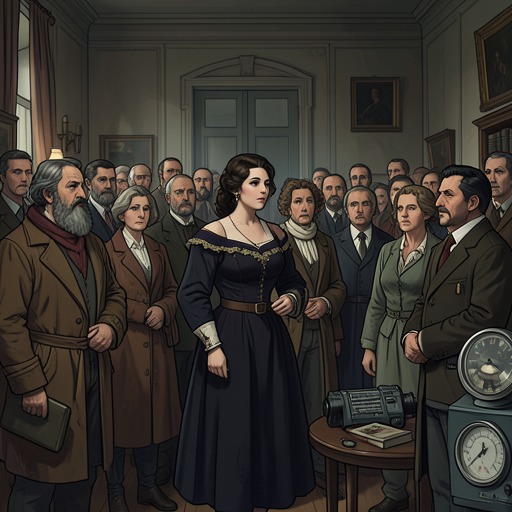
Theodore Finch’s funeral
All the Bright PlacesTheodore Finch’s funeral brings Violet Markey face to face with the public rituals and unanswered questions surrounding his death. Held at Golden Acres Cemetery, the service presents his death as a tragedy while avoiding the word suicide; the family calls it an accident, and Violet cannot settle on what Finch intended. The event therefore offers no final explanation. Instead, it exposes the distance between an official account and private grief, while beginning a longer reckoning with memory, blame, and the possibility of carrying the dead forward.
Background and the Public Account
By the morning of the funeral, Violet is already measuring how grief has changed her. Dressed in black, she wears Finch’s black T-shirt beneath a belted skirt. In the mirror, she sees a face marked by loss, not the carefree girl she remembers from before. A posed photograph briefly makes her look like her old self, but the image cannot disclose that it was taken after Eleanor Markey and Finch were gone. The contrast captures the difficulty of mourning in public: appearance can conceal a changed inner life.
Violet’s parents want to accompany her, and she resists their close attention even as they insist on coming. Their concern is entangled with anger toward Mrs. Finch, and her father speaks of confronting Finch’s mother before Violet might hear him. That anger forms part of the atmosphere around the service, but the funeral itself does not resolve the families’ conflict or assign responsibility.
The service’s account of Finch’s death is shaped by what his family says and what the preacher leaves unsaid. Because no proper note was found, his family calls the death an accident. The preacher speaks instead of a young life ended too soon and possibilities left unrealized, without mentioning suicide. Violet believes the death was not an accident, yet she also considers that Finch may not have been trying to kill himself and may instead have been searching for the bottom. She recognizes that she cannot know for certain. The funeral makes that uncertainty central rather than closing it.
The Ceremony and Its Attendees
The funeral takes place on a rainy day at Golden Acres Cemetery, the largest cemetery in town. Finch’s family stands in the front row beside the casket, although Finch had wanted to be cremated. Ted Finch is there with the woman Violet understands to be Finch’s stepmother, who has an arm around a very small boy; Decca Finch, Kate Finch, and Mrs. Finch stand beside them. The family is crying, including Ted Finch, whose presence unsettles Violet’s prior picture of him as she sees him for the first time.
The gathering extends well beyond the family. Around two hundred students from Bartlett High School attend, along with Ryan Cross, Gabe Romero, Principal Wertz, Mr. Black, Mrs. Marion Kresney, and Mr. Embry from the counseling office. Amanda Monk and several cheerleaders are among those who weep. Violet stands off to the side with her parents, Brenda Shank-Kravitz, and Charlie Donahue; Brenda’s mother is also present. Charlie faces the casket with his hands folded. Brenda watches the classmates she regards as hypocritical, her eyes dry and angry.
The attendance has a double edge for Violet and Brenda. Many of those gathered had called Finch a freak, ignored him, or spread rumors about him, and now participate in public mourning. Violet sees the difference between a crowded service and the intimate knowledge of a person: the congregation can grieve the young life described by the preacher without acknowledging the person Finch was to her. Charlie calls the assembled mourners phonies, without specifying whether he means classmates, Finch’s family, or everyone present. Brenda imagines Finch looking on with irreverence, a way of resisting the service’s solemn public performance.
Violet’s Grief and the Unresolved Loss
Violet’s mourning is not detached observation. She stands in Finch’s shirt and thinks about the last words she said to him: angry, ordinary words whose precise content she cannot recover. The possibility that she might have spoken differently if she had known it was their last encounter sharpens her sense of unfinished business. The funeral gives her no last conversation and no certainty about Finch’s final intentions.
She also feels abandoned. Finch had urged her to live fully, to notice what lay before her and find her mountain, and now he is gone. His death recalls the loss of Eleanor, which he knew had already shaped Violet’s life. She directs anger at him for leaving, but the anger exists alongside love and the recognition that he had once helped her move toward life. The funeral does not make those feelings compatible; it forces Violet to hold them together.
After the service, people approach Finch’s family to offer condolences, while no one says anything to Violet. Mrs. Finch then finds her and holds her in a close embrace, asking whether she is all right. Ted Finch embraces her too, until Violet’s father intervenes and leads her away. The encounter places her inside Finch’s family’s grief for a moment, but her father’s curt response and the family’s earlier anger keep that contact tense. At home, her parents speak carefully about the Finches, showing how the funeral’s strain continues beyond the cemetery.
Aftermath and Continuing Presence
The funeral’s public language does not end Violet’s relationship with Finch; it makes the difference between public remembrance and private connection more visible. Her later search in his closet turns the space into a place of absence and evidence: she takes his black T-shirt, reads the Post-its on the wall, and looks for something he might have left behind. Those objects offer no definitive explanation for his death, but they keep his presence materially close. The contrast with EleanorandViolet.com is telling: Violet and Eleanor had built the site as a magazine for sisters with distinct perspectives, but after Eleanor’s death Violet could not bring herself to continue it, feeling that her words had died with their shared project.
In a later conversation with her parents, Violet refuses to keep treating Eleanor and Finch as subjects that must be avoided. She admits her regret about suggesting the bridge route on the night Eleanor died, and her grief over both losses; she also says that loving Finch mattered, even though her parents disapproved of him and she wishes he had not left. Her mother tells her that what happened is not her fault. This exchange does not erase Violet’s guilt, but it gives her a way to speak openly about the people the funeral’s public account could not restore.
The image of water also changes in the story’s later remembrance. At the Blue Hole, Violet thinks of Finch and of the places she will still wander, describing herself as no longer rooted but flowing and feeling new capacities emerge. Her memory of him remains attached to the blue landscape, not simply to the ceremony or the unanswered question of how he died. The funeral marks a public ending, while Violet’s later acts of remembering make clear that Finch’s influence continues without supplying the certainty the service could not provide.