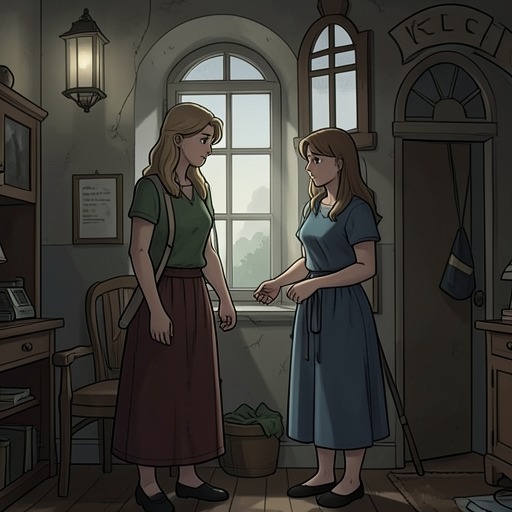
Violet Markey and Eleanor Markey's sisterly relationship
All the Bright PlacesViolet Markey and Eleanor Markey’s sisterly relationship is both a living partnership and the absence around which Violet’s grief takes shape. Before Eleanor’s death, the sisters shared a creative project that gave form to their different perspectives; afterward, Violet’s silence, the untouched website, and the things Eleanor left behind make that partnership impossible to resume in its old form. Violet’s eventual insistence that her family remember Eleanor marks a change: grief need not be hidden for love to continue.
Sisters and a Shared Project
After the family moved to Indiana, Violet and Eleanor started EleanorandViolet.com, intending it as an online magazine through which they could offer two distinct perspectives on fashion, beauty, boys, books, and life. The site was not merely a collection of topics: its premise depended on the sisters’ difference and their ability to make those perspectives coexist. Eleanor’s friend Gemma Sterling, a star of the Web series Rant, mentioned the site in an interview, and its following tripled. That attention gave the project a public reach, but its underlying identity remained personal: it was a site about sisters.
Eleanor’s death stopped Violet from working on the site. She could not see a point in continuing a project whose central relationship had been broken by the crash, and she describes the loss as extending to her own words. Her difficulty is not simply that she has lost an activity; the activity itself had been built around a shared voice. When a teacher later raises the website alongside Violet’s missed college application deadline, Violet refuses to discuss it. The refusal registers how closely the project is bound to Eleanor and how little use Violet can yet find for a future-facing version of their shared work.
The Bridge and the Reality of Loss
The A Street Bridge makes the sisters’ loss physically present. Running across it, Theodore Finch sees the damaged stone guardrail, an angry hole where part of the wall had been, and a white cross lying on its side, its paint faded gray by Indiana weather. He wonders who placed it there, but the identity of the person remains uncertain. Down the embankment, in the dried-up riverbed, he finds cigarette butts and beer bottles among pieces of glass and metal, including a red plastic taillight eye, a shattered side mirror, and a nearly folded license plate. The debris turns the crash from an acknowledged event into a material scene of destruction.
The bridge also remains part of Violet’s own burden of memory. Much later, she tells her parents that she suggested Eleanor take that route home and apologizes for doing so. The admission shows how grief has become entangled with survivor guilt: Violet revisits a decision made before the crash as if it might explain or assign responsibility for what cannot be changed. Her parents’ eventual answer is unequivocal: what happened was not her fault. The relationship therefore persists not only as affection but as a painful question Violet has to bring into the open before her family can answer it together.
Family Grief and the Sister Who Is Missing
Violet’s parents’ grief shapes the expectations surrounding her future. During a visit to New York University, she senses the weight of what they cannot share with Eleanor: taking their older daughter to college, wishing her well, asking her to come home safely, and reminding her that they are a phone call away. Violet feels that this missing milestone has become one more thing she must make up for because she is all that remains of their children. Her place in the family is thus strained by an impossible substitution: she is loved as herself, yet the future also carries the shadow of the future her parents lost with Eleanor.
At home, that pressure surfaces in a confrontation. Her father tells her that she cannot use losing her sister as an excuse to act out. Violet answers that she was not acting out: she has stopped cheering, quit student council, struggles with orchestra, and feels that other people have continued with their lives while she cannot keep up. She explains that the project she did not want to work on has become almost the only thing she has. The exchange reveals that Eleanor’s absence reaches beyond private sadness into Violet’s daily roles and sense of possibility. Afterward, Violet’s mother finds her in her bedroom and asks about EleanorandViolet.com. When Violet says she let it go because there was no point, her mother quietly agrees, with red eyes, and turns to the paper for a new, nameless web magazine. Their shared tears do not restore the old project, but they allow mother and daughter to acknowledge the loss while leaving room for something not yet defined.
Rooms, Objects, and Continuing Memory
Eleanor’s bedroom preserves a particular map of her life. Its yellow walls hold photographs of Eleanor with friends in Indiana and California; a California state flag hangs above the bed, and her art supplies remain piled in a corner. Violet’s parents have begun slowly organizing the room, a practical process that makes the difference between keeping Eleanor’s things and making decisions about them visible. Violet enters after tearing down the graduation countdown calendar she has kept in her own room. Faced with the days ahead, she cannot continue marking them off as if their destination were already settled.
On Eleanor’s dresser, Violet sets down Eleanor’s glasses, which she had borrowed. She thanks her sister for the loan and acknowledges that the glasses give her a headache and are ugly; she can almost hear Eleanor laughing. The smallness of this exchange matters. The glasses are not a substitute for Eleanor, but returning them lets Violet address her sister through an ordinary object and a remembered response. The scene gives their relationship an intimate texture distinct from the public fact of the crash or the family’s larger grief.
Remembering Without Erasing
Violet eventually asks her parents to talk about Eleanor and not to forget that she existed. She admits that she misses her sister, remembers the route suggestion, and cannot reverse what happened. She also explains that avoiding the subject makes it harder to retain what she wants most: Eleanor’s voice, including the different ways she said Violet’s name when pleased or annoyed. Memory here is specific and active. Violet concentrates on the sounds and holds on to them because she does not want them to disappear.
In the same conversation, Violet tells her parents that she loved Theodore Finch and that thinking about him matters too. She does not treat the two losses as interchangeable; rather, she rejects the idea that speaking of either should be forbidden. She tells her family that Eleanor was here and is gone, but need not be completely gone, and that the same is true of Finch. Her mother draws her close and tells her that nothing that happened was her fault. The exchange changes silence into shared acknowledgment: Violet can name her guilt, her love, and her continuing attachment without pretending that the dead can be brought back.
The relationship’s final significance lies in this movement from a shared project that Violet cannot continue to a memory she chooses to keep speaking. Eleanor remains present in photographs, glasses, a room being sorted, the damaged bridge, and the voice Violet works to remember. These traces do not resolve her grief or restore the sisters’ life together. They let Violet carry the relationship forward without treating remembrance as a refusal to live.