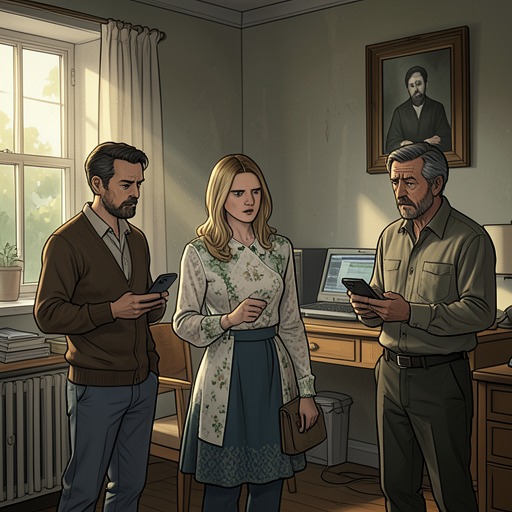
Violet Markey and her parents
All the Bright PlacesViolet Markey’s relationship with her parents is reshaped by the deaths of Eleanor Markey and Theodore Finch. At first, grief leaves Violet unable to speak about the shared project she had made with Eleanor, while painful disclosures about Finch risk disappointing her parents. The relationship changes when Violet tells them what is happening instead of keeping the crisis—and her love for Finch—hidden. In the final family conversation, the Markeys begin to make room for memories and sorrow together, without pretending that either loss can be undone.
Shared Loss and Withheld Words
After moving to Indiana, Violet and Eleanor created EleanorandViolet.com as an online magazine for their different perspectives on fashion, beauty, boys, books, and life. A mention by Eleanor’s friend Gemma Sterling, a star of the Web series Rant, tripled the site’s following. But after Eleanor died, Violet could not bring herself to work on it. To her, it had been a site about sisters; after the crash, even her words seemed to have died. When someone proposes discussing the website, Violet refuses. Her silence marks how grief has interrupted not just a project but a form of expression once shared with her sister.
The loss also has a physical place. On A Street Bridge, Finch runs past the damaged stone guardrail and sees the gap where the wall used to be. A white cross lies on its side beside it, its paint faded gray by Indiana weather; he wonders who placed it there, including whether it might have been Violet or her parents. The possibility is left unresolved. Below the bridge, among cigarette butts and beer bottles, the crash’s remnants—a red taillight eye, a shattered side mirror, and a dented license plate—make the accident suddenly real to him. The scene gives the Markeys’ bereavement a visible, lasting setting, even as it withholds any certainty about what they have done there.
Disclosure and Immediate Care
When Violet learns that Finch may be in danger, she tells her parents that she has continued seeing him. She reminds them that on the first day of school after Christmas break, she climbed onto the bell-tower ledge and Finch talked her down. He had saved her, she says, and she loves him; although she knows her parents are angry and disappointed, she asks them to help make sure he will be safe. Her disclosure ties her secret relationship to an earlier moment when Finch’s presence helped preserve her life, and makes clear why she cannot treat his crisis as someone else’s responsibility.
Violet then tells them everything. Sheryl Markey calls Finch’s mother and leaves a message, while Violet’s parents decide what to do next. Sheryl says a psychiatrist at the college, a friend of James Markey, is already talking with Finch. She acknowledges that the parents are disappointed, but also tells Violet she did the right thing by telling them. Their response does not erase the disagreement or the secrecy that preceded it; it shows them acting on the information and accepting Violet’s trust at a moment when help matters more than reproach.
Grief in Separate Rooms
Violet’s grief does not immediately become a shared conversation. After Finch disappears, she searches his room and closet for something he might have left behind. She takes his black T-shirt and reads the Post-its on the closet wall, looking for a clue among the words. The search is private, and it shows how much of her mourning and uncertainty she is carrying alone. In another later domestic scene, she shows her mother the book Mr. Embry gave her. Sheryl reads while eating dinner, as Violet and her father try to continue talking about college; when James asks whether she has chosen a school, Violet says she might attend the University of California, Los Angeles, but privately feels that all the choices are the same. The ordinary dinner conversation coexists with losses that have made ordinary decisions feel emptied of importance.
Naming What Cannot Be Changed
The turning point comes when Violet asks James and Sheryl to talk about Eleanor and not forget that she existed. She admits that she misses her sister, cannot believe she is alive while Eleanor is not, and feels sorry that she suggested Eleanor take the bridge home on the night of the crash. She does not present the past as repairable: she says they cannot go backward, change what happened, or bring Eleanor or Finch back. She also admits that she secretly continued seeing Finch after telling her parents the relationship was over. Rather than continue tiptoeing around either death or her parents’ feelings, she wants to speak plainly because silence is making it harder to remember Eleanor.
Violet describes trying to recover the sound of Eleanor’s voice: the greeting she used when she was in a good mood and the way she pronounced Violet’s name when annoyed. These small, specific memories show what Violet fears losing—not only her sister as an idea, but the details that made her present in daily life. She extends the same insistence on remembering to Finch. She tells her parents that she loved him, that he was good for her, and that thinking about him matters even though he is gone and she wishes he had not gone. Her account holds love, pain, and regret together instead of simplifying the relationship into either a mistake or an uncomplicated comfort.
A Family That Can Grieve Together
Sheryl answers Violet’s fear of responsibility directly: she says nothing that happened is Violet’s fault. Violet begins to cry. James, initially rigid and silent, also breaks down; Sheryl and Violet move toward him, and the three huddle together, rocking slightly and taking turns reassuring one another that they are all right. The scene does not resolve the deaths or make the family’s grief disappear. Its change is relational: the Markeys stop trying to maintain the appearance that everything is fine and acknowledge their pain in one another’s presence.
Later, Violet describes herself as changed and imagines herself no longer rooted but flowing, with new capacities opening within her. The image connects her continued life to a changed relationship with loss: remembering Eleanor and Finch does not require pretending they remain physically present, and surviving does not require making them irrelevant. Her parents’ embrace offers a modest but consequential form of support within that process. The family cannot reverse what happened, but they can keep speaking of the people they loved—and keep one another company while they do.