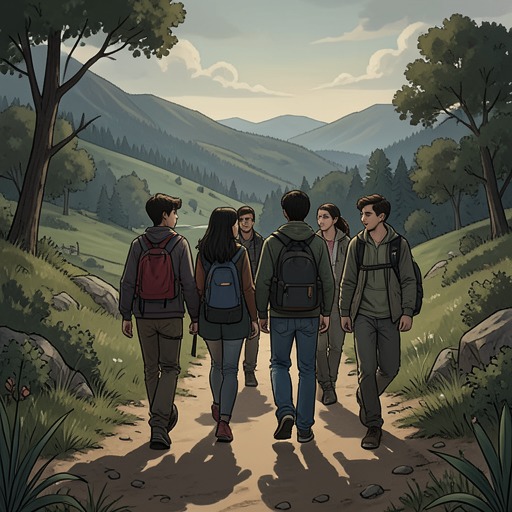
Violet completes the remaining wanderings
All the Bright PlacesViolet completes the remaining wanderings marked on Theodore Finch’s map after his disappearance, turning their shared project into a journey undertaken alone. At shoe trees, a world-record paint attraction, an abandoned drive-in, and a roadside chapel, she encounters evidence of Finch’s own passage and leaves answers of her own. The route does not restore him; it gives Violet a way to meet his absence through particular places, objects, and words—and to begin imagining what she herself will leave behind.
The Map and the Return to Wandering
Violet’s journey begins with a practical discovery: in her bag, after checking three times, she finds the map she had been searching for. Finch has circled five remaining places and numbered them, imposing an order on what might otherwise feel like an impossible, open-ended drive. The map is not simply a checklist. Finch’s numbering gives Violet a route to follow, while every circled stop also carries the possibility that he has been there before her.
That possibility meets a second kind of unfinished beginning at home. Above her desk, Violet has arranged the storyboard notes for Germ, the magazine she is developing, and added a new category called Ask an Expert. The paper explaining the magazine ends with the words “You start here.” The line belongs to her work, but it also resonates with the task of going out again: Violet has not ceased to miss Finch or her sister Eleanor, yet she is beginning to make something in the present rather than leaving her words and plans untouched.
The old project had started with Eleanor. She and Violet created EleanorandViolet.com after moving to Indiana as an online magazine offering two different perspectives on fashion, beauty, boys, books, and life. A mention by Eleanor’s friend Gemma Sterling in an interview had tripled the site’s following, but after Eleanor died Violet could not bring herself to update it. The site had been about sisters, and the crash that killed Eleanor seemed to take Violet’s words with it. Her later work on Germ and her decision to follow Finch’s map therefore mark not a replacement for what she has lost, but a return to making and moving while remembering it.
Reading Finch’s Traces
At Devils Hollow Shoe Tree, Violet initially sees little to distinguish the stop from a long drive to a collection of old shoes. She stays, looks toward the highest branches, and spots a pair of sneakers hanging alone from the highest one. The shoes have fluorescent laces and the initials TF written in black; a package of blue American Spirits is tucked inside one. What looked like an unremarkable destination becomes a message assembled out of the things Finch left there.
The clue becomes more specific when Violet searches her text messages. She finds Finch’s note, sent a week after he left, saying that he is on the highest branch. The date changes the meaning of the sight: the shoes are not merely a remnant from some earlier wander but evidence of his presence after his departure. The map has led Violet not just to places Finch wanted her to see, but to signs that make his independent journey legible in retrospect.
The World’s Biggest Ball of Paint offers another form of record. Located on Mike Carmichael’s property in Alexandria, the attraction is housed in a barnlike shed and is recognized by the Guinness Book of World Records. Violet has called ahead, and Mike and his wife are expecting her. In the visitor book, she looks for a blank place to write her own name, date, and comment, then notices that few people came in April. Turning back a page, she finds Finch’s entry: Theodore Finch, April 3, accompanied by an upbeat message drawn from a familiar children’s book. His handwriting places him in the same public record she is now entering, making the visitor book a meeting point across time rather than a private note addressed only to her.
At the Pendleton Pike Drive-In, the setting bears a different kind of history. Now overgrown on the outskirts of Indianapolis, it had once been a popular 1960s destination, part movie theater and part children’s amusement park, with a mini roller coaster and other attractions. Violet walks around the screen and counts thirty paces before turning back. There, in red letters on its broad white face, Finch has written that he was there, signing with TF. Violet climbs the steel lattice supports with a can of paint and adds her own response beside his: “I was here too. VM.” The exchange makes her the author of a trace in the same landscape, not only its reader.
Offerings, Memory, and What Remains
The journey’s objects acquire meaning through the pair’s earlier practice. On their wanderings, Finch and Violet had agreed to leave something at each location, treating the act as a private version of geocaching: they might receive something from a place, so they would give something back, and their offerings would prove they had been there. The practice joins discovery to obligation. A place is not only something to see or take in; it can also hold a part of the visitors after they leave.
That exchange becomes especially intimate at the chapel. Violet follows a bend in the road she had not taken earlier and finds Taylor Prayer Chapel beside a lake. The chapel is described as a sanctuary where tired travelers can stop and rest, a memorial to people killed in car accidents, and a place of healing. It is open day and night, including holidays. Its purpose makes the location speak directly to Violet’s history: remembrance here is not presented as a refusal to continue, but as something carried alongside the journey.
Inside, Violet finds a plain rock in the outstretched palm of a statue of Jesus. She recognizes it as the stone Finch first gave her, which she later gave back to him, and which has now returned to her. She exchanges it for the offering she brought, a butterfly ring that once belonged to Eleanor. The moment links the two absences without equating them: Eleanor’s ring enters the chapel as Violet’s gift, while Finch’s stone comes back to her as a tangible continuation of their shared exchange. On the way out, Violet sees the chapel’s paired stairways and its instruction that visitors may ascend on their knees, a final reminder of the place’s explicitly reverent character.
A small envelope addressed to “Ultraviolet Remarkey-able” contains three sheets of thick staff paper: one covered in musical notes and two in words that appear to be lyrics. The unusual name and the handwritten music make the discovery personal, but the evidence does not turn the journey into a simple reunion. Finch is absent; what Violet can receive is a message and the work he left behind. The song’s surviving words connect that inheritance to what a heart can do, while Violet’s later understanding is that importance lies not in what someone takes but in what they leave.
Consequences and Significance
The route changes the meaning of leaving a mark. At first, the numbered map directs Violet outward, from one destination to the next. By the time she writes on the drive-in screen and exchanges objects at the chapel, she is participating in the practice rather than merely following Finch’s instructions. His traces confirm that he moved through these places after leaving, but her own marks establish that her continued life is not confined to interpreting his.
The loss of Eleanor remains part of that movement. Violet had blamed herself for the bridge route her sister took on the night of the crash and had avoided speaking openly with her parents about how much she missed her. She eventually tells them that she does not want the family to pretend everything is fine, admits her guilt, and asks them not to let Eleanor’s existence disappear from conversation. She also tells them she loved Finch and that remembering him keeps him from being completely gone. These admissions do not undo either death; they make remembrance something the living can share instead of a silence Violet must carry alone.
In the final movement of the book, Violet thinks of Finch in the open water and imagines her own epitaph still unwritten and the places she will wander. The image shifts her sense of herself from being rooted in what has been lost toward being able to flow into what comes next. Completing the remaining wanderings thus supplies neither a cure nor a final explanation for Finch’s disappearance. Its consequence is more modest and more durable: the map, the rock, the song, and the words left at the drive-in give Violet ways to remember him while beginning again from where she is.