Wandering Map
All the Bright PlacesThe Wandering Map is both an itinerary and a surviving trace of Theodore Finch and Violet Markey’s relationship. It charts their Indiana wanderings, but its significance changes when Finch disappears: Violet discovers that he has kept the map and marked an order for the remaining places. Following those points gives her a way to continue their project alone, while making each destination part of her attempt to understand where he went and what he left behind.
A map made through shared travel
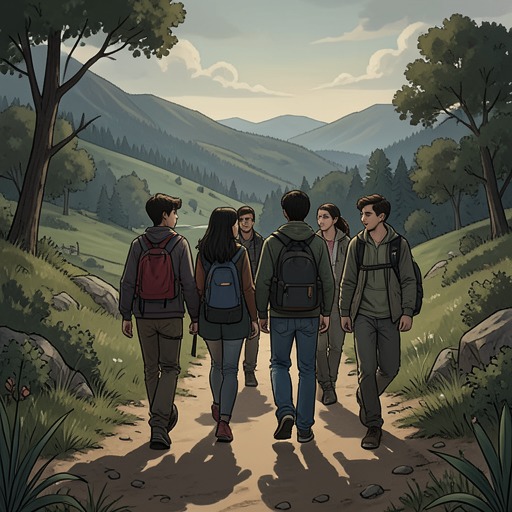
The map belongs to a project that takes shape through visits rather than abstract descriptions of Indiana. At Hoosier Hill, Violet and Finch reach a modest clearing with a bench, a picnic table, and a sign identifying the state high point at 1,257 feet. The marker itself is only a wooden stake among stones. Violet finds the destination underwhelming, a contrast between the grand idea of a high point and its unassuming physical reality. The map’s places matter not because each proves spectacular, but because the pair reaches them together and sees what is actually there.
At the Bookmobile Park, the route brings them to seven book trailers lined up beside cornfields outside Bartlett. Violet’s response connects the stop to an earlier family ritual: in California, she, her parents, and Eleanor would search bookstores for chosen books, sometimes visiting eight or ten shops in a day. The map therefore connects a new shared adventure with a remembered form of closeness to her family. Its destinations gather meanings from what each traveler brings to them.
The trip to the Purina Tower likewise transforms a marked place through being there. After climbing the steel ladder to the top, Violet and Finch sit together beneath a blanket beside a Christmas tree that remains there year-round. Below them, lights and dark tree-covered areas make the town seem continuous with the stars overhead. Violet calls the view lovely; Finch covers her exposed foot and describes the town as seeming to belong to them. The itinerary has led not merely to a point on a page but to a moment in which a familiar town feels newly shared.
On the first warm day, the route takes them to the Blue Hole, a three-acre lake on private property near Prairieton. Finch brings objects associated with Violet—the stubs of her SAT number 2 pencils—and four broken guitar strings. He leads her down an embankment and hill to a wide, round pool ringed by trees. Their visit makes the place feel private and removed from ordinary surroundings, even as Finch recounts local stories about its supposed bottomlessness, quicksand, and dangerous whirlpool. The map’s destinations can hold affection and unease at once.
The map becomes evidence of absence
When Violet later visits Finch’s home, his closet is empty of the things that had made it his refuge: among the missing objects are his guitar and amp, notebooks, blank Post-its, laptop, and the book she gave him. The words and planets he had made on the walls remain, but no longer seem alive. The map is gone too. Violet searches the room for an explanation, calls Finch, and leaves a message saying she is worried and loves him. At this point the missing map is one part of a wider disappearance, not yet an answer to it.
By April 8, Violet has gathered the few things of Finch’s that she possesses and put them in a box at the back of her closet. Two days later she buys another map so she can finish the wandering project without him. She has memories, a couple of pictures, and their notebook, but cannot yet find a form that will make what they saw and did intelligible to anyone else—or even to herself. The replacement map is practical, but it also gives grief a next action: there are still places to visit.
The original map’s location becomes clear at the Blue Hole. Violet finds Finch’s clothes folded in a neat stack on the bank, with his phone in one boot and his glasses and car keys in the other. Inside the leather jacket is their map, folded as carefully as the clothes. Violet puts it in her bag. She cannot tell how long ago Finch was there or where he is now, but the map establishes that he had carried their shared itinerary with him. Its presence among his belongings ties his disappearance to the landscape they had explored together without resolving the questions surrounding it.
Finch’s annotations guide Violet onward
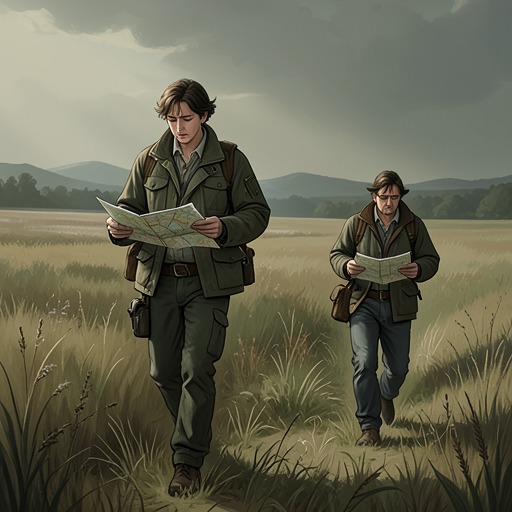
After finding the map, Violet’s relationship to it changes from recovery to interpretation. She worries that she has misplaced it, searching her bag three times before finding it. Spread open, it shows five remaining places circled, with numbers beside them that create an order. Finch’s marks make the map more than a record of destinations they once visited: they provide a route Violet can follow, though they do not tell her why he chose the sequence or when he traveled it.
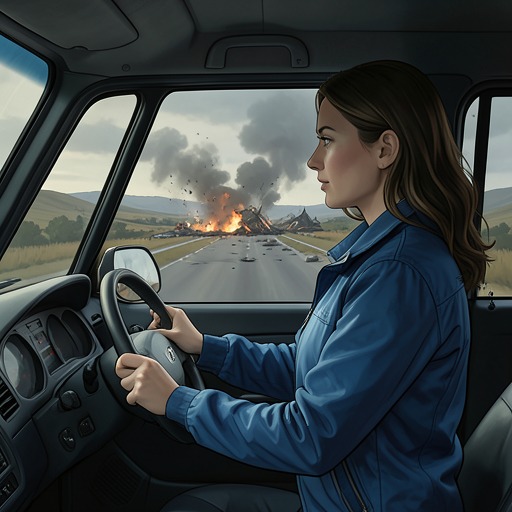
Following that route, Violet drives for hours northwest of Muncie toward the World’s Biggest Ball of Paint in Alexandria. She has read messages Finch left at other places, including one indicating that he had been there. Because the ball is a designated tourist attraction on Mike Carmichael’s property, she calls ahead; on arrival, she fears that whatever Finch wrote may have been painted over. The map directs her toward a trace that could easily be lost beneath another layer of paint. In this way, its numbered stops lead Violet not only through Indiana but toward evidence that Finch had visited them after their shared travels.
The final circled destination is Farmersburg, fifteen miles from Prairieton and the Blue Hole. Violet recognizes the message associated with it as the last text she received from Finch, which mentions a lake and a prayer. The town offers few obvious attractions, and her drive first takes her past a church, a lake, and a dead end. Returning along Private Road, she notices a bend she missed and follows it to Taylor Prayer Chapel, a small white chapel beside a wooden cross and an algae-covered lake. The map has brought her to a place that matches the message, but not to certainty: she still cannot know whether Finch came on the day he died or the day before.
A project carried forward
The map’s numbering gives Violet a sequence and a task, not a complete explanation. It preserves Finch’s choices in a form she can physically unfold and follow, while its gaps leave the crucial questions unanswered. At home after an evening with friends, she sees that one place remains. She wants to delay the last trip because finishing will end the project and leave her with no further destination to seek from Finch. Yet the map also shows that he had visited places without her, an unsettling record alongside the shared memories the project was meant to create.
By making the remaining wanderings possible, the map carries the relationship beyond Finch’s disappearance without pretending to restore what has been lost. Violet can visit the places, examine the messages, and keep moving according to the order he left. Its route is at once an unfinished plan, a record of Finch’s solitary movement, and a structure Violet can use when memory alone feels impossible to organize. The map cannot tell her what happened at every stop; its lasting force lies in leading her toward what can still be found.