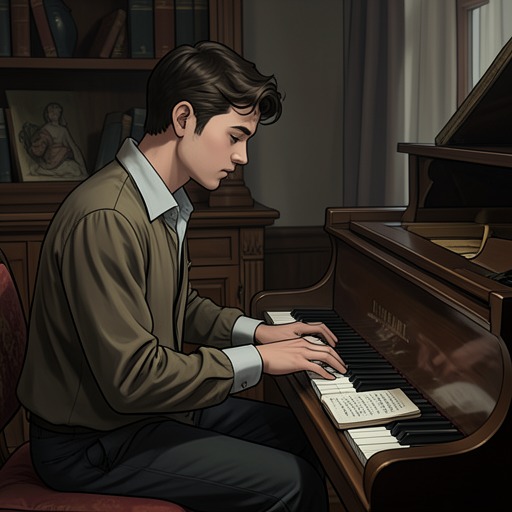
You make me happy
All the Bright Places“You make me happy” is the refrain at the heart of a song Finch leaves for Violet, and its significance grows as she reads, rereads, and finally plays it. What first arrives as paper in an envelope becomes something she knows by heart and can carry in sound. The song’s movement from direct praise to Violet’s act of making music gives their unfinished shared experience a form that remains with her.
The Manuscript and Its Refrain
Violet finds three sheets of thick staff paper inside the envelope: one covered in musical notes and two covered in words that look like lyrics. The pages bring music and language together before she has heard the tune. Their physical arrangement matters: the song is not only a thought about Violet but a composition she can eventually take up herself, reading its words and playing its notes.
The lyric addresses its beloved directly. Its opening, “You make me happy,” is followed by “Whenever you’re around I’m safe inside your smile,” and then “You make me handsome,”. The sequence links happiness and safety with a changed sense of the self. The beloved’s presence is described not as an abstract quality but as something that affects how the speaker feels and sees himself. The refrain’s simplicity makes that intimacy immediately legible, while the surrounding lines give it a more particular shape: to be loved is to feel safe and to become, in the speaker’s own words, handsome.
The lyric also turns toward loveliness. Finch writes, “You make me lovely, and it’s so lovely to be lovely to the one I love.…”. Here the repeated word moves between being made lovely and being lovely toward someone else. The line’s circularity is part of its meaning: affection is both received and returned. It frames the song’s happiness not as a solitary feeling but as something formed between the person addressed and the person singing.
Violet Reads the Song
Before opening the envelope, Violet considers taking it to the car to read. Instead, she sits in a pew, grateful for the solid wood beneath her. The choice places the reading in a quiet, physically steady setting, while her thoughts are unsettled. She fears the pages may tell her how she disappointed Finch, how much she hurt him, or what she might have done differently. The song is therefore encountered under the pressure of her questions about their relationship, not as an uncomplicated keepsake.
Her hands shake as she opens the envelope. As she reads, the lyric redirects the encounter away from the feared accounting of failure and toward Finch’s words of affection. The change is bodily as well as interpretive: Violet cries loudly and hiccupingly, as if a held breath has finally been released. The song does not erase her distress; her tears make its force visible. But the words give her something specific to read and hold, where her earlier questions had offered only imagined blame and impossible revisions of the past.
Violet reads and rereads the words until she knows them by heart. She then folds the pages and returns them to the envelope, remaining in the chapel until her tears stop and the light fades into dusk. The repeated reading marks a movement from receiving the message to memorizing it. The paper can be folded away, but the refrain has already begun to pass into her memory.
From Written Words to Music
After driving home in the dark, Violet takes out the staff paper again and plays the notes on her flute. This is the song’s decisive change of form: what she has first encountered as writing becomes sound made by her own breath and hands. The melody enters her head and stays there; days later, she is still singing it. Its persistence is described through recurrence rather than explanation. The song remains present because Violet continues to carry and repeat it.
The manuscript thus connects Finch’s written expression with Violet’s ongoing response. She does not merely preserve the pages as an object or remember their meaning in abstract terms; she plays the notes and sings the tune. The movement from envelope to pew, from reading to flute, and from a single night to the days that follow gives the refrain a continuing life in Violet’s experience. The song’s emotional significance rests in that sequence of actions as much as in its declarations of happiness and loveliness.
What the Song Leaves Behind
The song also belongs to Violet’s reckoning with what she and Finch did not complete. She recognizes that they never filmed their wanderings, collected souvenirs, or had time to assemble the project into something that would make sense to anyone else. Rather than treating those absences as proof that the experience failed, she reaches a different understanding: what matters is not what they took, but what they left. The thought gives the song a place within a larger account of memory and inheritance.
That conclusion does not make the missing film or souvenirs suddenly exist, and it does not finish the work they had meant to bring together. Instead, the song offers a concrete remainder: three sheets of staff paper, a melody Violet can play, and words she learns by heart. Its refrain becomes especially resonant beside her realization about leaving something behind. Finch’s words continue not because their shared project was completed, but because Violet has received them, made them her own in performance, and carried them forward.