Allied forces
All the Light We Cannot SeeThe Allied forces are represented in the Saint-Malo narrative through the material effects of their campaign: bombs damage the city’s rail station, aircraft strike German positions, and advancing American forces take the château and free prisoners. Their arrival changes the balance of the siege, though the fighting continues for several days after those gains.
Military Presence in Saint-Malo
The account does not describe the Allied forces’ wider organization or command structure; it shows them through their operations around Saint-Malo. As the campaign closes in, Etienne hears that Americans have captured Mont Saint-Michel, about twenty-five miles away, and that liberation may be only days off. The news gives local developments a wider military context: Allied advances are nearing the occupied city even as its residents face immediate restrictions and danger.
Bombing and Damage
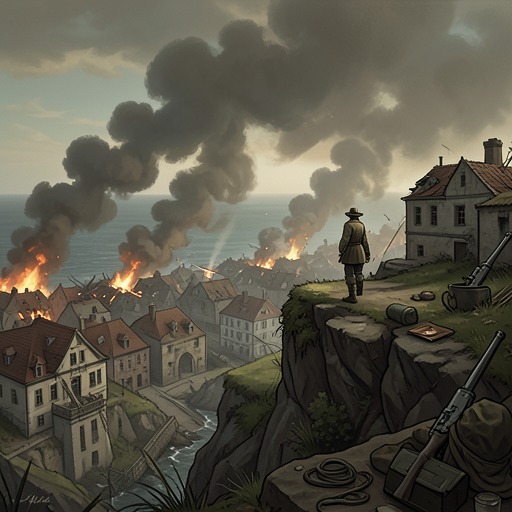
Allied bombs demolish the rail station, while German forces disable the harbor installations. The contrast marks the city as both a military objective and a place whose essential infrastructure is being lost. Aircraft move in and out of the clouds; later, dozens arrive over Saint-Malo. During that attack, Werner and Marie-Laure take shelter in the cellar as thirty bombers release their payloads. The bombardment shakes the bedrock and reaches them through the house, making the air campaign present even to people who are not taking part in the fighting.
Capture and the Release of Prisoners
In the morning, American forces take the château and the last anti-aircraft battery, then free the prisoners held at Fort National. The military advance therefore has an immediate consequence for those detained inside the fortress. Madame Ruelle helps Etienne leave the processing queue, and he embraces Marie-Laure. The scene connects the Allied arrival not only with the changing control of the city, but also with the return of people who had been separated by the occupation and siege.
End of the Siege
The German colonel in his underground fortress across the river holds out for three more days after the château and the last anti-aircraft battery have fallen. An American aircraft called a Lightning drops a tank of napalm through an air vent; five minutes later, a white sheet raised on a pole signals the end of the siege. The account presents this ending as a combination of military pressure and a sudden, decisive strike. Afterward, sweep platoons remove incendiary devices, photographers enter the ruined streets, and some residents return from farms, fields, and cellars. The Allied victory ends the siege, but the damaged city and the work of clearing it remain.