Audubon volumes
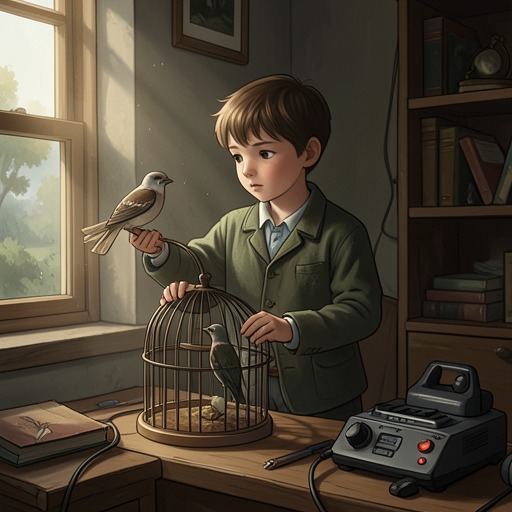
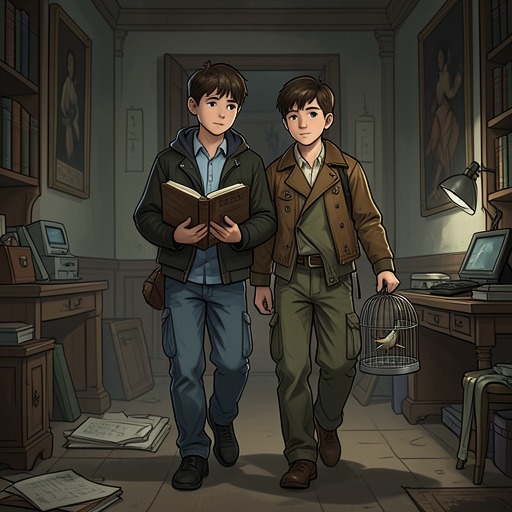
All the Light We Cannot SeeThe Audubon volumes are two immense books of bird paintings that Frederick secretly keeps hidden in his family’s home. When he shows them to Werner, their vivid illustrations and the story Frederick tells about their maker open a space of shared curiosity beyond the rules and pressures surrounding the boys. Their significance lies not only in what they depict, but also in the circumstances of their concealment and in the attention with which Werner learns to see them.
Form and Images
The volumes are enclosed in golden slipcovers, each so large that Frederick compares its size to a crib mattress. After Franny leaves the room, he leads Werner to tall hardwood shelves, climbs a ladder, moves a wicker basket, and retrieves the books from behind it. Their scale and hidden position make the act of showing them deliberate: Frederick has kept this particular object out of ordinary sight and chooses to bring it forward for his friend.
Inside, the paintings present birds in strikingly varied scenes. Two white falcons swoop toward one another with their beaks open; a bloodred flamingo holds its black-tipped beak above stagnant water; and geese stand on a headland beneath a heavy sky. Frederick turns the pages with both hands. The named examples include the pipiry flycatcher, buff-breasted merganser, and red-cockaded woodpecker, with many birds depicted larger than life. The book’s size thus belongs both to its physical form and to its enlarged images: birds Werner may not know become immediate, particular presences on the page.
Frederick’s Account of the Books
Frederick explains that Audubon was an American who spent years walking through swamps and woods. As Frederick describes his practice, Audubon watched an individual bird throughout the day, then shot it, supported it with wires and sticks, and painted it; afterward, he ate most of the birds. Frederick’s account joins close observation to the means by which the paintings were made, and his voice trembles with ardency as he imagines the painter moving through a wilderness with a gun and his eyes fixed ahead.
For Frederick, the volumes are more than a collection of illustrations. Their making suggests a vanished landscape and a kind of sustained attention: someone went into unfamiliar country, watched its birds, and brought images back. Werner tries to understand the appeal from Frederick’s perspective, imagining a time before photography and binoculars. In his response, the book becomes associated with evanescence and mystery, as well as with the effort to observe and preserve what cannot be held still. The scene gives Werner access not just to the pictures but to the intensity with which Frederick regards them.
A Forbidden Possession
Frederick tells Werner that his father has forbidden the family to have the books and that they must remain concealed behind the basket. The stated objection is their provenance: they are American and were printed in Scotland. Frederick contrasts this restriction with their subject, insisting that they are only birds. The gap between the authorities’ concern about where the books come from and Frederick’s insistence on what they contain makes the volumes a small, concrete instance of knowledge and culture being judged by national origin.
The concealment also gives the presentation a private character. Frederick does not merely point out books on a shelf; he retrieves something kept out of sight and lets Werner see what matters to him. When Frederick’s mother arrives, he hurriedly slips the volumes back into their covers. She later climbs the ladder and restores them to the shelf one at a time, a gesture the narration presents as if she were putting away something irritating. The books remain part of the household’s material world, but their place there is uneasy: they are treasured by Frederick, prohibited by his father, and put back out of view in his mother’s presence.
Werner’s Response and Narrative Role
Werner’s thoughts turn from the paintings to the Frenchman’s radio program and Heinrich Hertz’s Principles of Mechanics. He recognizes in Frederick’s voice a thrill like the one those subjects have given him. That connection leads him to say that his sister would love the book. The Audubon volumes therefore create a brief bridge between Frederick’s passion for birds and Werner’s own intellectual enthusiasms, while Werner’s thought of Jutta brings his absent family into the scene.
The books also mark a change of setting for Werner’s friendship with Frederick. Earlier in the visit, the boys lie on the floor of Frederick’s bedroom with comic books, each appearing curious about whether their friendship will continue beyond school. The Audubon volumes give that uncertainty a more intimate answer: Frederick shares an object he has hidden and explains why it matters to him, while Werner tries to see what Frederick sees. For a time, the books draw attention away from school and its constraints. Their importance is not that they resolve the boys’ circumstances, but that they make room for an exchange grounded in mutual attention—one boy revealing a cherished interest, the other recognizing its force.