Ban on listening to foreign broadcasts
All the Light We Cannot SeeThe Ban on listening to foreign broadcasts criminalizes tuning in to broadcasts from abroad, turning a household radio into a potential instrument of punishment. In Werner Pfennig and Jutta Pfennig’s story, the rule reaches into private life through warnings of hard labor and restrictions on movement, while the state’s growing control of radio transmission and possession makes listening itself a political risk.
The Rule and Its Threat
A letter addressed to a professor reports that listening to a foreign broadcast has become a criminal offense. The consequences are described not as a modest fine but as hard labor: breaking rocks for fifteen hours a day, making nylon stockings, or working in the mines. The account presents the punishment as a credible threat shaping daily choices, although it does not identify a statute, court procedure, or specific enforcement case for the offense.
The warning is addressed to children whose circumstances already feel precarious. Frau Elena says they must come straight home from school; the letter explains that, although they are not Jewish, poverty is also dangerous. That juxtaposition conveys their sense of vulnerability without establishing poverty as a legal ground for punishment. The practical effect of the ban is immediate: ordinary activities, including going home after school and deciding whom to trust with a letter, acquire an atmosphere of risk.
Radio as a Window and a Liability
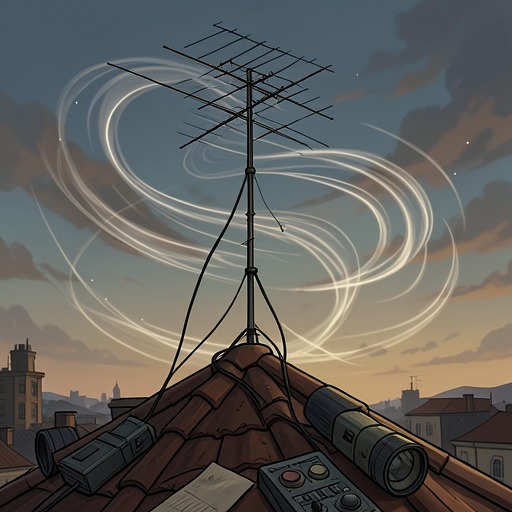
Before the ban’s threat enters their lives, Werner Pfennig and Jutta Pfennig discover a radio among refuse: a wire-wrapped cylinder between two pinewood discs, with electrical leads and an earphone. Their discovery opens a world of distant voices. They listen together at night, and one scratchy broadcast features a young man speaking French about how the brain constructs a world of light. The radio offers knowledge and imaginative connection across borders, not merely entertainment.
That openness becomes harder to sustain as the regime’s broadcasting power expands. In the letter, the writer describes a transmitter called Deutschlandsender 3 in Brandenburg, said to be more than three hundred thirty meters tall and to push almost everything else off the dial. A neighbor is said to hear its broadcasts through her tooth fillings; the letter treats this as an intriguing possibility, not a verified technical fact. The contrast is pointed: the state’s own signal is imagined as nearly impossible to escape, while receiving outside voices is made a crime.
Fear, Secrecy, and Uneven Control
The letter’s writer says that no one will help mail it, not even her brother, and resolves to send it alone. The ban therefore governs more than the act of tuning a receiver: it encourages secrecy and makes even communication about listening feel dangerous. The letter itself becomes a risky attempt to maintain contact with a broadcaster whose voice has not been heard for at least two months. Its uncertainty—whether the broadcasts have stopped or reception has failed—shows how censorship and technical interference can be difficult to distinguish from one another.
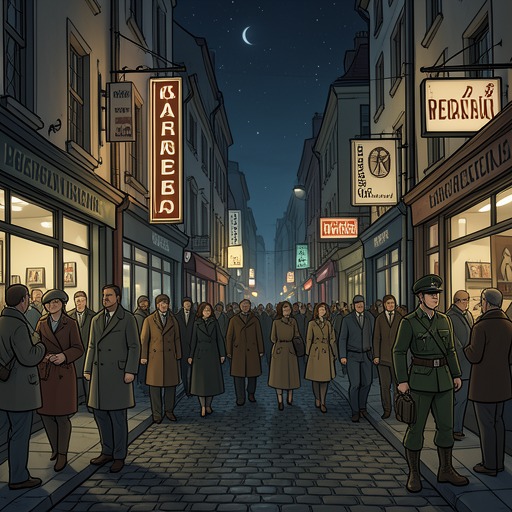
A separate order in occupied Saint-Malo requires residents to surrender radio receivers at 27 rue de Chartres by noon the next day, under threat of arrest as saboteurs. This is a compulsory confiscation order, not the same rule as the ban on listening to foreign broadcasts. Read alongside it, however, it shows two distinct forms of radio control: criminalizing reception and removing the equipment that makes reception possible. Together they make radio both a channel for distant voices and an object exposed to state coercion.