Berlin
All the Light We Cannot SeeBerlin is a recurring setting in which private interiors and public danger converge. Werner Pfennig first encounters the city through a visit with Frederick, whose family home opens a brief view of life beyond the school; later, Berlin becomes the destination of Dr. Hauptmann’s transfer and a place Werner revisits to see Frederick changed by injury. In 1945, the city receives Frau Elena and the last girls from Children’s House as forced industrial work and nightly bombing shape their daily existence. These distinct passages make Berlin less a single backdrop than a sequence of altered homes, workplaces, and shelters.
Arrival and a private household
Werner’s first journey to Berlin takes six hours. The train repeatedly waits on sidings while troop trains hurry toward the front, so the approach to the city is bound to wartime movement even before Werner and Frederick arrive. At a dim station they climb a long flight of stairs, each step bearing the same advertising phrase. Berlin appears to Werner as the largest city he has ever seen, an impression that makes the arrival a threshold into an unfamiliar scale of life.
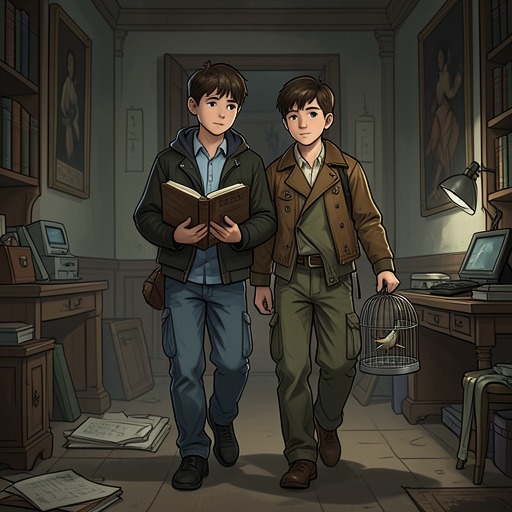
Frederick leads Werner to a five-story town house just off Knesebeckstrasse. The entrance is dim, and the boys stand before a pair of matching doors; when Frederick presses a button, machinery rattles high in the building and the elevator begins to descend. Werner’s surprise at this ordinary convenience marks the difference between the city home and the world he knows. The visit gives the building a distinct place in the narrative: it is not merely a destination, but a setting where Werner sees Frederick as a son in his own household, surrounded by objects and relationships outside the school’s discipline.
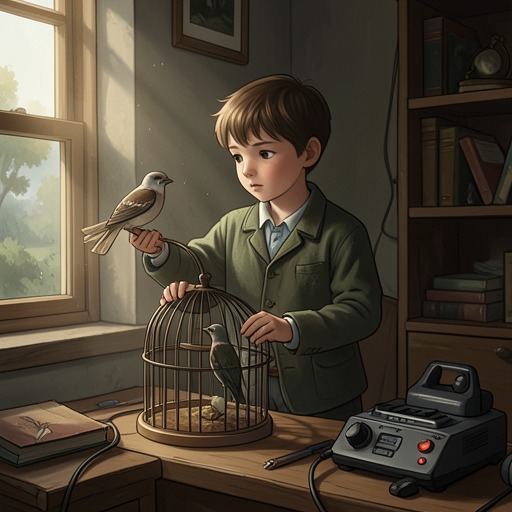
Inside, Frederick shows Werner richly colored bird paintings in large volumes. The images range from falcons swooping toward one another to geese looking into a heavy sky, and the birds’ scale on the printed pages exceeds their scale in life. Frederick handles the books with care and returns them to their slipcovers when footsteps approach. His mother enters wearing a green ski suit with white stripes and greets him with an embrace, then examines a mostly healed cut on his forehead. Frederick looks over her shoulder with a trace of panic. The narration leaves the source of that look open: he may fear that she will discover the forbidden book, or react to his bruises. Her silence likewise leaves her thoughts unknown. The household’s welcome and the school’s violence remain together in the same room, without the visit resolving the unease between them.
A wartime destination
In March 1942, Dr. Hauptmann tells Werner that he has been called to Berlin to continue his work. His office is crowded with half-packed crates, and the hounds are absent. As he paces, he appears overwhelmed by events beyond his control. He places an hourglass in a crate and leaves his pale, silver-tipped fingers suspended in the air. Berlin is presented here as the next destination in the scientist’s career, but the packing and the gesture also make the transfer feel like a departure under pressure rather than a confident new beginning.
The novel later leaves Hauptmann’s whereabouts unresolved: he is presumed to be in Berlin, or at the front with everyone else. That uncertainty prevents the city from serving as a simple explanation of what became of him. Instead, Berlin remains one possible endpoint in a wartime system that moves people and work while obscuring individual outcomes.
Werner returns to Berlin after spending the last of his money on train fare. The afternoon is bright, yet the city seems gloomier and dirtier than he remembers. The passage qualifies the change: perhaps it is not Berlin alone that has altered, but the eyes through which Werner now sees it. The city’s appearance therefore carries both material deterioration and the mark of his changed experience, without separating one from the other.
Frederick’s altered home
At Frederick’s family home, Werner is met first by Franny and then by Frederick’s mother, who comes from a side room in tennis clothes. Frederick is still wearing his old black-framed glasses. Someone has been feeding him; porridge remains on the glass table and on the mat beneath his place setting. Werner cannot look at the scene. The visit establishes the consequences of Frederick’s injury through the altered routine of the household rather than through an account of the attack itself. A domestic task now requires care from someone else, and the friend Werner remembers is present in a condition he struggles to face.
The contrast with Werner’s earlier visit is sharp. Then, Frederick had led him through the house and turned the pages of the bird books himself; now another person feeds him, and Werner cannot bear to look at the signs of that dependence. Berlin holds both versions of the friend in adjacent memories: the boy sharing forbidden books with Werner, and the injured young man whose home has become a place of care. The city’s importance to this strand of the story lies in that return, which makes change visible through a familiar room and its ordinary objects.
Labor, bombing, and shelter
In January 1945, Frau Elena and the last four girls living at Children’s House—Hannah and Susanne Gerlitz, Claudia Förster, and fifteen-year-old Jutta Pfennig—are transported from Essen to Berlin. They are sent to work in a machine-parts factory. The move places the girls within a wartime labor system that assigns work and location without presenting the transfer as a choice. Berlin is both their new workplace and the city in which they must endure the final months of the war.
Throughout the spring, bombers come every night. The girls usually hurry to a cramped shelter at the end of the block, where the crashing of stonework keeps them awake. The repeated nightly journey gives the city’s danger a routine form: shelter is not a single dramatic refuge but a place the girls repeatedly seek, while the noise of destruction remains part of their nights.
In May, three Soviet soldiers break into the printing company below the apartment, searching for liquor. Finding none, they begin damaging the walls. Upstairs, Frau Elena sits in her striped ski parka with an abridged New Testament in its pocket. She holds the girls’ hands and moves her lips in silent prayer as shots are heard below. The scene locates the girls’ vulnerability inside a domestic refuge that cannot fully insulate them from the violence in the building. Frau Elena’s joined hands with the girls’ mark a small, concrete act of care in a moment when she cannot control what is happening downstairs.
Berlin’s later outlines
A later image places a man with his mother outside west Berlin, in a middle unit of a triplex. The apartment’s only windows look toward sweet-gum trees, a large, barely used supermarket parking lot, and an expressway. This quieter view differs from the crowded wartime interiors, factory labor, and shelters elsewhere in the novel’s Berlin passages. It does not erase those earlier settings; it offers another scale of urban life, measured by a home, a view, and the roads beyond it.
Across these episodes, Berlin gathers separate experiences without making them identical. It is a place of technological novelty and private family life for Werner and Frederick, a destination within the movement of military research, and a site of labor and danger for Frau Elena and the girls. Its recurring rooms and thresholds—town-house entrance, family table, factory-bound relocation, apartment shelter—show how public events reach people through the spaces where they live, work, and try to protect one another.