Bombing of Saint-Malo (1944)
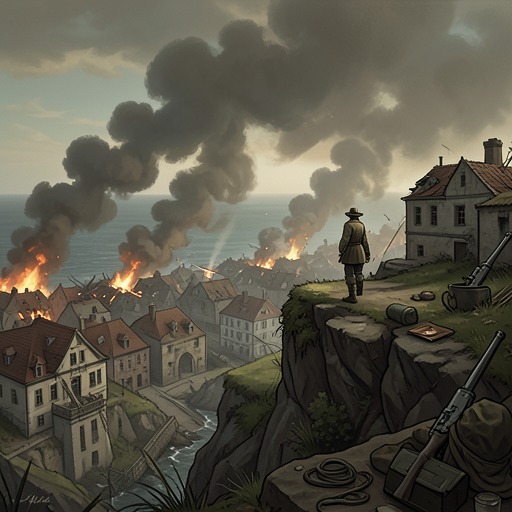
All the Light We Cannot SeeThe Bombing of Saint-Malo (1944) turns an approaching military attack into a catastrophe measured both in numbers and in intimate losses. On the night of 7–8 August, twelve bombers unload 480 bombs over the walled city. Fires race through streets and buildings, the public library’s books burn, and the Hotel of Bees anti-aircraft strongpoint is torn apart. In the upper floor of Number 4 rue Vauborel, Marie-Laure LeBlanc clutches a stone and a small model house while the real city collapses around her.
Warning and Approach
At dusk on 7 August, leaflets fall across the ramparts and rooftops, urging the town’s inhabitants to leave for open country. The warning arrives as the tide climbs and American artillery units fire incendiary rounds toward mortar positions around the beachfront hotels. The town is given notice of danger, but the subsequent assault comes from above and at night, as the aircraft cross the Channel at midnight.
There are twelve bombers, identified by names taken from songs, including Stardust, Stormy Weather, In the Mood, and Pistol-Packin’ Mama. From above, the crews pass over the sea and make out the low islands along the horizon. As they approach the coast, anti-aircraft fire rises in red threads. Below them are ruined or burning ships and, on an outer island, sheep fleeing between rocks. The walled city on its granite headland becomes the target: seen through the bombardiers’ aiming windows, it is reduced to a dark shape to be struck.
The attack’s preparation is described through the bombers’ measured approach and the bombardiers’ countdown. That deliberate sequence contrasts with the chaos their release will produce. The city is not merely under threat in the abstract: the aircraft line up on it, descend, and open their bomb bays over the rooftops.
The Bombs and the Firestorm
As the countdown reaches twenty, the sea gives way beneath the aircraft to rooftops. Two smaller planes mark the corridor with smoke; the lead bomber releases its payload, and the other eleven follow. The bombs fall diagonally while the aircraft climb and turn back toward the Channel. The account makes the scale unmistakable: forty bombs per aircraft, 480 in all, carrying seventy-two thousand pounds of explosives. The tally is not a substitute for the impact; it establishes how completely the attack fills the sky above the city.
The first effects are described as a violent transformation of ordinary spaces. Doors tear from their frames, bricks become powder, and clouds of chalk, earth, and granite erupt upward. Flames take hold of parked cars and the furnishings inside buildings, then spread through the city. Smoke follows dust, ash follows smoke, and even a burning newsstand floats through the destruction. In the old city, four-hundred-year-old beams catch fire. One section against the western walls becomes a firestorm whose flames reach as high as three hundred feet; the force of its demand for oxygen draws objects heavier than housecats toward the blaze. Birds driven from chimneys catch fire and fall as sparks into the sea.
The destruction reaches landmarks and shared civic spaces as well as private homes. Most of the public library’s twenty thousand volumes burn, while fire climbs the ramparts and spills through alleys, rooftops, and a car park. On the rue de la Crosse, the Hotel of Bees anti-aircraft strongpoint is lifted briefly by a spiral of flame before breaking apart and raining back to earth. The account’s sequence from individual objects to whole districts makes clear that the raid does not leave the city’s familiar places intact.
Civilians in the City
People shelter in cellars and crypts as the bombardment overwhelms the town. The narrative registers their presence through oaths sent up from below, children shrieking, dogs howling, and old men holding hurricane lamps. Their prayers and cries coexist with the physical collapse overhead; they offer no protection from it. The scale of the assault also reaches beyond the streets: Marie-Laure’s great-uncle is among several hundred people locked inside Fort National, a quarter mile offshore. Looking up as the sky darkens with bombs, he sees a mass moving in ranks, an image that measures the attack from the point of view of someone trapped within its reach.
The bombing’s sound becomes part of its bodily violence. The sirens disappear beneath the roar, and then everything is inaudible. The force is described as strong enough to separate the membranes in the middle ear. Even the anti-aircraft guns fire their final shells as the twelve bombers turn away unharmed. The contrast is stark: the aircraft leave, but the town remains inside the fires and falling debris they have unleashed.
Marie-Laure and the Ruined City
On the sixth floor of Number 4 rue Vauborel, sixteen-year-old Marie-Laure is beside the Saint-Malo City Model, the miniature city she has been studying. As the attack strikes, she crawls beneath her bed. She holds the stone in her left fist and a little model house in her right. Nails shriek in the timbers while fragments of plaster, brick, and glass fall onto the floor, onto the model city, and onto the mattress above her.
The scene places a carefully constructed miniature beside the destruction of the real city it represents. The model’s streets and landmarks had made Saint-Malo available to Marie-Laure through touch; now debris falls across the model as the surrounding house shakes. The contrast does not make the miniature a refuge from the attack. Instead, its small, ordered version of the city is exposed to the same violence as the larger one, while Marie-Laure’s immediate actions narrow to sheltering and holding on.
The raid’s decisive consequence is therefore both collective and particular: Saint-Malo is engulfed by fire, while a blind teenager endures the assault inside one threatened house. The aircraft’s departure does not resolve the catastrophe. On 8 August the destruction continues in the streets, where fire spreads through homes, civic buildings, and military positions; for those sheltering in the city, survival begins amid damage that has already reached their doors.