Braille Edition of Twenty Thousand Leagues Under the Sea
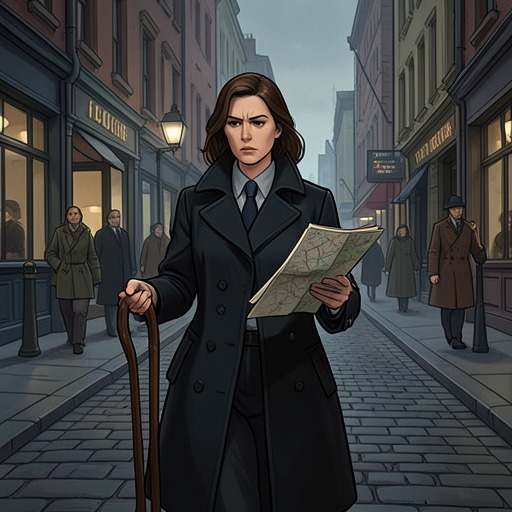
All the Light We Cannot SeeThe Braille Edition of Twenty Thousand Leagues Under the Sea is both a work of imaginative escape and a concrete part of Marie-Laure LeBlanc’s life as a blind reader. Its two volumes accompany her from delighted discovery into a period of upheaval: she explores its undersea world by touch, returns to its pages until she nearly knows the first part by heart, and then finds that, in the museum’s sudden disintegration, even familiar words will no longer join together. When her father hurries her away, the book’s size and weight make it something she must leave behind.
The Gift and Its Two Volumes
The book arrives as a tactile gift in stages. Inside one package Marie-Laure finds two Barnier bonbons, which she unwraps and puts in her mouth together. In the second is a thick stack of Braille pages bearing the title. Her father explains that the bookseller has divided the novel into two parts; he had hoped that, if they continued saving, they might buy the second the following year. The book is therefore not presented as a complete possession all at once. Its continuation is something anticipated and worked toward.
The first volume opens a story whose scale matches its title. Its narrator, the famed marine biologist Professor Aronnax, works at the same museum as Marie-Laure’s father. Ships are being rammed around the world, and Aronnax weighs possible explanations: a moving reef, a gigantic horned narwhal, or a mythical kraken. After an expedition to America, he insists on reasoning and scientific inquiry rather than fables. The mystery gives Marie-Laure a sequence of questions to follow, while the narrative’s appeals to evidence offer a counterpoint to the fantastic possibilities it raises.
The novel also carries her beyond the circumstances of the room where she reads. In her imagination she boards the swift, two-funneled Abraham Lincoln with Aronnax, watches New York City recede, and passes the forts of New Jersey as they salute the ship. Channel markers bob in the swell; a lightship with twin beacons slips by, and the Atlantic opens ahead. These particulars make reading an act of mental travel: the Braille pages do not merely describe a voyage but give her a route through one, encountered sentence by sentence with her fingers.
A Book Worn Familiar
Marie-Laure reads the first part in many places: the key pound, the toilet, the corridors, the benches of the Grand Gallery, and the paths of the gardens. She returns to it so often that she practically memorizes it. The book is thus more than a single episode of escape. Repetition makes its language familiar, while the continuing voyage supplies a world she can revisit from the changing locations of everyday life.
The sea in Aronnax’s account is described as covering seven tenths of the globe and as the receptacle of prodigious, supernatural things. It is presented as movement, love, and a living infinite. At night, Marie-Laure imagines herself inside Captain Nemo’s Nautilus, beneath gales and under drifting canopies of coral. The contrast between the Braille pages held close to her and the immense ocean they evoke gives the book its particular imaginative force: a bounded object opens onto a space without apparent limit. Its marine wonders also preserve a place for marvel even as Aronnax argues that mysteries should be pursued through logic and science.
The Second Volume and the Interrupted Reading
On the morning of her twelfth birthday, the expected puzzle box has not replaced the sugar bowl. Her father is too busy for that familiar gesture, but he has obtained the second Braille volume, as thick as a sofa cushion. Marie-Laure’s excitement registers in her fingers. The gift completes what had been promised as a two-part book, arriving as the household and the museum are being overtaken by events beyond her control.
She opens the new volume on the floor of the key pound. The first part had ended with Aronnax only six thousand leagues into his journey, leaving a great distance still to travel. But now the sentences do not connect as they once did. She reaches a passage about a formidable school of sharks following the ship, yet the words fail to form a continuous sequence. The difficulty becomes still more pronounced when Captain Nemo is about to take Aronnax and his companions underwater through oyster beds in search of pearls: Aronnax fears the sharks, and Marie-Laure longs to discover what happens, but the prose breaks apart. Words become letters, and letters become bumps she cannot make intelligible. She feels as if large mitts cover her hands.
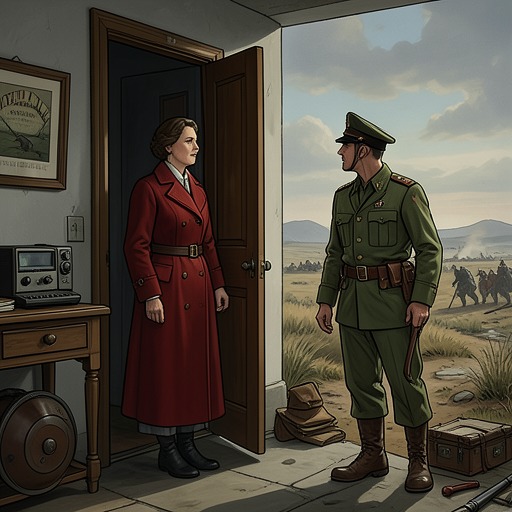
The change in reading occurs amid the museum’s unravelling. Workspaces have been stripped of typewriters; halls serve as packing yards, and straw, sawdust, and twine litter the floors. At the guards’ station, a warder turns the wireless knobs but hears only hiss and crackle; when he switches it off, silence closes over the museum. In that atmosphere Marie-Laure wishes the breakdown might be a puzzle her father had constructed, with doors to pass through before everything returned to normal. The book’s interrupted sentences belong to this wider rupture: the familiar order of the museum and the dependable continuity of reading are both failing her.
The Book Left Behind
When Marie-Laure tells her father about the book, he urges her to hurry. She asks for it; he says it is better to leave because it is too heavy. He pulls her out of the key pound and locks the door. The decision makes the book’s material weight decisive. Until then, its thickness has meant abundance: a first volume repeatedly explored and a second, sofa-cushion-thick continuation. In the emergency, the same substantial object cannot travel with her.
That departure does not cancel what the book has already made possible. Marie-Laure has traced its sentences through repeated reading, followed the Abraham Lincoln out across the Atlantic in imagination, and spent nights aboard the Nautilus beneath coral. Yet the scene refuses to make reading an effortless refuge: at the moment she most wants to know what comes next, the words will not hold together, and at the moment she wants to keep the book, her father judges it too cumbersome to carry. The Braille edition’s place in the story rests on that double truth. It opens a vast imagined world, but remains a physical object exposed to interruption, weight, and loss.