Children’s House
All the Light We Cannot SeeChildren’s House is the orphanage in the coal-mining district of Zollverein where Werner Pfennig and his younger sister, Jutta Pfennig, are raised. Its crowded rooms contain children’s illnesses, newborns’ cries, and the battered trunks that preserve the last belongings of parents lost to the mines. Yet the institution is more than a setting of deprivation: under Frau Elena, it offers Werner a first workshop, an audience for his radio, and a household whose ordinary warmth he carries into war. When he is sent away, Children’s House remains the measure of the home he has lost.
Setting and daily life
Children’s House stands on Viktoriastrasse in Zollverein, a four-thousand-acre coal-mining complex outside Essen, three hundred miles northeast of Paris. The surrounding district is marked by smokestacks, rail lines, slag heaps, and mines. Its landscape of industrial work and extraction presses close to the orphanage: the children grow up among the consequences of an economy that claims parents and threatens to claim Werner as well.
Poverty shapes the house’s routines. In Werner’s earliest years, jobs are scarce, food is scarce, and rheumatic fever threatens the children. There is no butter or meat, fruit is only a memory, and during the worst months the house directress sometimes has nothing to offer her dozen wards but cakes made from mustard powder and water. The children’s trunks hold patchwork dresses, tarnished wedding cutlery, and faded photographs of fathers swallowed by the mines: intimate remnants set against a landscape that repeatedly takes people away.
Werner’s childhood unfolds inside this material hardship, but the narrative also shows his appetite for discovery. He captures snowflakes and tadpoles, studies hibernating frogs, makes crude toys, and brings milk to the babies. His questions reach from everyday objects to the natural world. The contrast is central to the place’s meaning: Children’s House cannot protect its residents from poverty or the mines, yet it gives Werner room to observe, experiment, and imagine beyond the future expected of a boy in Zollverein.
Frau Elena and the children’s community
Frau Elena, a Protestant nun from Alsace, is more attached to the children than to strict supervision. She sings French folk songs, sometimes falls asleep standing, and on some nights lets her wards stay up while she tells them stories of her girlhood among snowy rooftops, cold streams, and frost-covered vineyards. Her stories open a space of warmth and imaginative travel inside an otherwise constrained life. The children’s home is not presented as an institution of perfect order; its emotional center is Frau Elena’s care and the collective habits she makes possible.
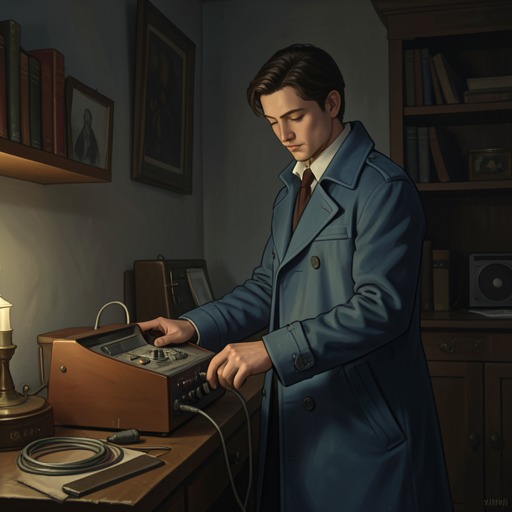
That care becomes especially visible through music and radio. After Werner finds a makeshift receiver in refuse behind a storage shed, he teaches himself to dismantle and rebuild it, gathers salvaged parts, and gradually redesigns it. Each evening he brings the set downstairs, and Frau Elena lets the children listen together for an hour. They gather in a semicircle to hear news, concerts, operas, national choirs, folk programs, and speeches. The radio gives the children access to voices and events beyond Zollverein, while their shared listening makes Werner’s technical work part of household life rather than a solitary hobby.
The listening hour also makes the house vulnerable to political pressure. In a letter associated with the children’s home, a correspondent describes a powerful transmitter in Brandenburg overwhelming other stations and reports that listening to foreign broadcasts has become a criminal offense carrying the threat of hard labor. The message connects the children’s interest in radio to a widening system of surveillance and punishment. What began as Werner’s found object and a source of communal entertainment exists within a world increasingly determined to control what people may hear.
Werner’s departure and the home he remembers
The radio helps Werner’s abilities become visible beyond the orphanage. When a letter summons him to Schulpforta, he stands in the parlor among the cracked walls, sagging ceiling, and benches worn by generations of children. He understands the call as a way out, but Frau Elena’s response is immediate and practical: the household cannot pay. The moment binds the promise of departure to the poverty that has defined the home. Werner’s opportunity does not erase the conditions he leaves behind; it makes his separation from them possible.
At Schulpforta, Werner’s technical skill quickly distinguishes him. Given a kit of electrical components and a one-hour assignment to assemble a Morse-code practice circuit, he builds a working oscillator in under a minute. The solution recalls his earlier experiments in the attic room at Children’s House, where he learned through repeated handling of salvaged parts. His new achievement therefore carries the imprint of the orphanage: institutional instruction tests a capacity first developed through curiosity and improvisation at home.
The distance becomes tangible in Jutta Pfennig’s letter to him. She writes about cold weather, scarce fuel, laundry work, and mending military clothing with Hannah and Susanne Gerlitz and Claudia Förster. Enclosed in a homemade envelope is Werner’s childhood notebook, titled Questions. Its pages preserve drawings and inventions, including an electric bed heater he wanted to make for Frau Elena and a bicycle designed to drive both wheels. Jutta’s gift returns the boy’s earlier mind to him in material form; the notebook is not merely a record of technical ideas but a trace of the ordinary life and relationships left behind.
Wartime dispersal and narrative significance
As the war advances, Children’s House is recalled through fragments rather than as a stable refuge Werner can return to. During a night in the field, the sound of an earlier broadcast brings back the image of Werner crouched beside Jutta’s cot after the French professor signed off, with a coal train rattling the windows. Another memory gathers the house around its stove: Frau Elena tending the fire, children in their beds, and baby Jutta asleep in her cradle. These scenes make the orphanage a measure of intimacy against the machinery of military life and the violence surrounding Werner.
The institution’s residents are eventually displaced. In January 1945, Frau Elena and the last four girls still living at Children’s House—Hannah and Susanne Gerlitz, Claudia Förster, and fifteen-year-old Jutta Pfennig—are transported from Essen to Berlin for work in a machine-parts factory. They spend ten hours a day, six days a week, taking apart forging presses and sorting reusable metal. Their new rooms are above an abandoned printing company, where hundreds of misprinted dictionaries are burned page by page in a potbelly stove. The change from the orphanage to factory labor makes the wartime destruction of ordinary life concrete: the girls’ work, shelter, and even heat are absorbed into systems of production and scarcity.
Children’s House therefore holds two meanings that the narrative keeps together. It is materially fragile, situated in a mining district where illness, hunger, and labor shape childhood; it is also a place where Frau Elena’s stories, the children’s questions, and Werner’s improvised radio make a shared intellectual and emotional life possible. Its rooms survive in memory and objects—the notebook, the imagined stove-warmed dormitory, the remembered broadcast—even as war scatters their occupants. The home’s significance lies not in shielding the children from history, but in showing precisely what they carry with them when history takes them away.