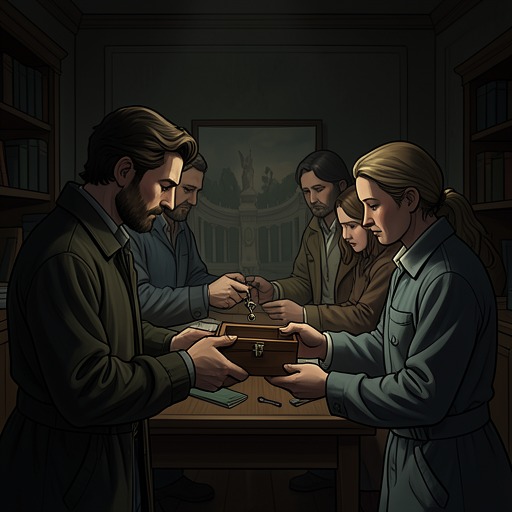
Crazy Harold Bazin
All the Light We Cannot SeeCrazy Harold Bazin is a Great War veteran who lives on the margins of everyday life in Saint-Malo, but becomes a guide to the city’s history and a hidden place beneath its ramparts. Through his stories and his secret route, he connects the defensive walls above the town with the unfamiliar world below them—and gives Marie-Laure LeBlanc a place she may be able to find for herself.
Identity and Life in Saint-Malo
Crazy Harold Bazin sleeps in an alcove behind the library, whether the weather is sunny or snowy. He is a veteran of the Great War who lost his nose, left ear, and one eye to shellfire; an enameled copper mask covers half his face. The account identifies these facts without making them a complete explanation of him: he is not only a figure marked by war, but also a resident whom Madame Manec includes in her rounds of food deliveries.
Several days a week, Madame Manec brings food to Crazy Harold Bazin. His place behind the library situates him among the neighbors who receive her help, rather than apart from the town’s daily life. When Marie-Laure LeBlanc and Madame Manec visit, he is eating soup. From that ordinary encounter, he turns their attention toward a place neither of them knows.
The Ramparts as History and Story
Crazy Harold Bazin speaks to Marie-Laure LeBlanc about the walls of Saint-Malo as a record of repeated danger. In his account, the ramparts have kept out Romans, Celts, Norsemen, marauders, and even, in some tellings, sea monsters. He gives particular weight to the English: for thirteen hundred years, he says, their sailors came ashore or attacked from offshore, firing flaming projectiles at houses and trying to burn and starve the inhabitants into submission.
His account of the walls also carries a domestic history. He recounts the warning that mothers once used to make children behave: an Englishman might come in the night. Madame Manec asks him not to frighten Marie-Laure LeBlanc. The exchange sets his vivid inheritance of siege stories beside the practical care of his companions. The ramparts are at once a public defense and a source of stories passed between generations; the threats he describes are remembered in the language of family warnings as well as military attack.
Leading Marie-Laure to the Hidden Grotto
In summer, while sitting with Crazy Harold Bazin and Madame Manec in the library alcove, Marie-Laure LeBlanc hears him offer to show her something. He leads the two women along a route whose first street Marie-Laure cannot identify with certainty: she thinks it may be the rue du Boyer, the rue Vincent de Gournay, or the rue des Hautes Salles. They reach the base of the ramparts, turn onto a lane she has not traveled before, descend two steps, and pass through hanging ivy. The alley narrows until they must walk single file between close walls. Marie-Laure LeBlanc wonders whether her father included this passage in his model; she has not found it by touch.
At the rampart, Crazy Harold Bazin locates a lock and opens a gate. He helps Marie-Laure LeBlanc through, then explains that the space lies beneath the wall, with twenty meters of granite above them. Inside, the floor slopes down to water. He brings her hand to a curved wall covered with snails. Marie-Laure LeBlanc explores further and identifies hermit crabs, anemones, and the snails as a densely varied world of life. Madame Manec is uneasy about the place, but Marie-Laure LeBlanc says she is fine. Crazy Harold Bazin has brought them into a concealed space where her own attention, rather than the city model, can disclose what is there.
A Test of Memory and Direction
Madame Manec eventually coaxes the others out of the grotto. Crazy Harold Bazin leads Marie-Laure LeBlanc back through the gate and locks it behind them. Before they reach the Place Broussais, with Madame Manec walking ahead, he taps Marie-Laure LeBlanc on the shoulder and asks whether she thinks she could find the place again. She answers that she thinks she can.
He then puts an iron object in her hand and asks whether she knows what it is. The passage ends on that question, without identifying the object or giving Marie-Laure LeBlanc’s answer. What it does establish is the shape of his encounter with her: he does not simply reveal a hidden destination and leave it as his own secret. He asks her to consider whether she can return to it, making her ability to locate the place part of the scene’s final emphasis.
Narrative Significance
Crazy Harold Bazin’s role is brief but distinctly practical. He provides food-delivery scenes with a neighbor whom Madame Manec remembers, tells Marie-Laure LeBlanc how the ramparts have been imagined as protection across centuries, and physically guides her to a passage absent from the routes she has learned. His story about the walls prepares one understanding of them—as a barrier against attackers—while the grotto reveals a concealed space beneath that barrier.
The episode also sets different ways of knowing Saint-Malo beside one another. The named streets and the model offer routes and representations; Crazy Harold Bazin’s gate opens onto a place Marie-Laure LeBlanc has not yet mapped through touch. His question on the return journey shifts the emphasis from his knowledge of the entrance to her possible knowledge of the way back. The account does not report what becomes of the iron object or whether she later returns to the grotto with him, so his supported significance rests on this introduction, this remembered route, and the confidence implied by her answer.