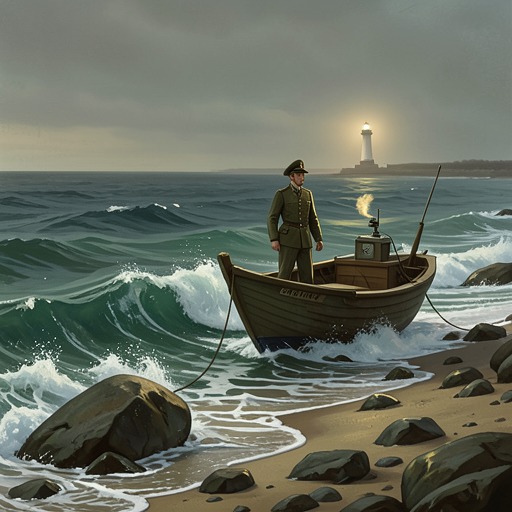
Daniel LeBlanc's arrest and deportation
All the Light We Cannot SeeDaniel LeBlanc's arrest and deportation begin when French and German authorities seize him from a train outside Vitré and treat the tools of his museum trade as evidence of possible sabotage. The arrest separates him from his daughter, Marie-Laure LeBlanc, and exposes the gap between orderly procedures and coercive power: Daniel is questioned, confined, and transported, but receives neither a lawyer nor a tribunal, and no official explanation or rescue arrives. His journey east proceeds through uncertainty, with the border approaching as a forced threshold rather than a destination he has chosen.
Work, Suspicion, and Arrest
Daniel is a locksmith employed at a museum, and his professional equipment becomes the focus of the authorities’ inquiry. They display his notebook and tool case, inspect a ring containing seven skeleton keys, and question him about what the keys open and how he uses the small files and saws he carries. His architectural measurements attract suspicion as well. Daniel explains that he is making a model for his daughter and that the keys belong to the museum where he works. In the circumstances of the interrogation, these ordinary explanations do not restore his freedom; the objects associated with skilled work and family care are recast as possible signs of a plot.
The arrest takes place outside Vitré, hours from Paris. Two plainclothes policemen bundle Daniel off the train in front of a dozen passengers, whose presence makes the seizure public without making it answerable. He is questioned in a van, then in a cold office on a mezzanine, where the walls display poorly made watercolors of oceangoing ships. The personnel shift from French interrogators to German ones after an hour. The change of officials does not produce clarity: Daniel’s equipment is examined again, while the questions seem more fixed on suspicion than on his answers.
Confinement Without Recourse
The authorities take Daniel to a cell whose imposing, old-fashioned lock and hinges prompt him to imagine them as relics from the reign of Louis XIV, or perhaps Napoleon. He expects that the institution’s director or someone from the museum will soon arrive to explain the mistake. That expectation persists even though the arrest has already shown how little his work and identity protect him. The next morning, German interrogators question him again while a typist records the exchange. They appear to suspect him of plotting to destroy the Château in Saint-Malo, although the basis for the accusation remains unclear. Their French is limited, and they seem more engaged with their questions than with Daniel’s replies.
The barriers to ordinary recourse accumulate. Daniel is denied paper, linens, and access to a telephone; he has no officially appointed lawyer and no military tribunal. The museum director does not arrive, nor does a car come to take him away. He is not allowed to write letters, and when he demands a telephone, the guards do not treat the request as something requiring an answer. The arrest therefore becomes more than a brief interruption for questioning: without an announced process or contact with the outside, Daniel cannot establish when, or on what terms, he might leave.
Separation from Marie-Laure
Daniel’s concern for Marie-Laure runs alongside the procedural uncertainty. He longs for cigarettes and lies on the floor imagining himself kissing her once on each eye while she sleeps. The image is a private measure of what the detention has taken from him: not merely his freedom of movement, but the ordinary closeness of a father able to return to his child. Every hour becomes bound to concern for her, while the authorities prevent him from writing to let her know what has happened.
The separation is reinforced by the failure of the institutions Daniel expects to help. His museum employment, which he offers as an explanation for his keys, does not bring the director to the cell. His role as Marie-Laure’s father gives him a reason to hope for contact, but no means of securing it. The arrest makes both relationships inaccessible at once: his professional affiliation cannot intervene, and his daughter remains beyond his reach. The narrative presents this absence through concrete withheld necessities—paper, a telephone, a letter—rather than through any formal announcement of what his family is to endure.
Transport East and the Meaning of Deportation
Two days after the arrest, Daniel is driven to a holding pen a few miles outside Strasbourg. About thirty people sleep on straw laid over frozen mud. Most are French; the group also includes Belgians, four Flemings, and two Walloons. They have been accused of offenses that they discuss cautiously, wary that a question might conceal a trap. Their whispered expectation that they will be in Germany for only a few months, and then sent home, offers a fragile possibility rather than reliable information. Each prisoner entertains the hope despite recognizing how uncertain it is.
Daniel spends three days in the pen. On the fourth day, the prisoners are loaded into a cattle truck and driven east. They understand that they are nearing Germany when they glimpse the far side of a river, but the terrain does not look different to Daniel from the country on the near bank. That apparent sameness sharpens the force of the crossing: deportation is not marked by a visible transformation of place, yet for the prisoners it may as well be the edge of a cliff. The episode establishes the arrest’s immediate outcome as removal from France toward Germany; the evidence here does not specify Daniel’s eventual destination or subsequent fate.
Occupation and Administrative Force
The episode sits within a wider pattern of orders and restrictions imposed on civilians. In Saint-Malo, the population is ordered to surrender radio receivers at 27 rue de Chartres before noon the following day, on threat of arrest as saboteurs. Later, residents are told that the city gates are locked and that men aged sixteen to sixty must assemble at the château’s tower before being marched to Fort National at low tide. These measures are distinct from Daniel’s arrest, but they echo its governing logic: an order defines the population as subject to control, and the threat of detention turns compliance into a matter of survival.
Daniel’s case makes that logic personal and unsettled. He is not shown receiving a clear judgment or a defined legal procedure; instead, suspicion follows his keys and tools from interrogation to confinement, while access to family and communication is denied. The movement from train to cell, holding pen, and cattle truck gives the event its progression: each transfer narrows his ability to choose or appeal. By the time he is carried east, the hope of a simple mistake being corrected has yielded to an uncertain forced departure, while Marie-Laure remains separated from her father.