Daniel’s Recorded Science Broadcast
All the Light We Cannot SeeDaniel’s Recorded Science Broadcast is a preserved voice from Marie-Laure LeBlanc’s family history, distinguished from the novel’s live radio transmissions by its capacity to survive as a recording. Its significance comes into focus after the war, when Marie-Laure recalls that her great-uncle salvaged the one remaining recording of her grandfather, a piece about the moon, and offers to send it to Jutta Pfennig and her son. The object carries not only scientific speech but also a family memory that can be passed on.
Identity and Survival
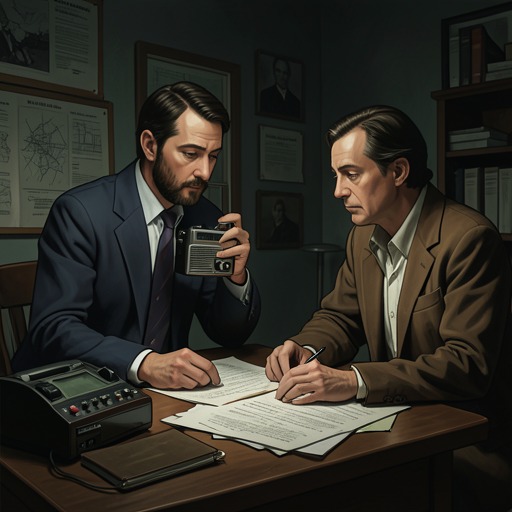
In the closing conversation, Marie-Laure says that after her great-uncle sold the house, he returned to Saint-Malo and salvaged the sole remaining recording of her grandfather. She identifies its subject as the moon. The scene calls the recording very old and treats its survival as exceptional: it is not one copy among many, but the one that was saved. The evidence establishes its content and its preservation, but does not describe the recording’s original equipment or the circumstances in which it was made.
Voice and the Radio World
The recording belongs to a world in which voices depend on material devices. As a boy, Werner Pfennig finds a rudimentary radio in refuse: a wire-wrapped cylinder between pinewood discs, with frayed electrical leads and an earphone. Years later, under bombardment, he makes a tuning coil by winding wire a hundred times around a pipe, then joins the circuit’s components to a battery and earphone. These scenes show how precarious reception and transmission can be, requiring scavenged parts, power, an antenna, and practical skill. The preserved broadcast differs from that fragile, moment-to-moment work: it remains available after the original voice has ceased to be present.
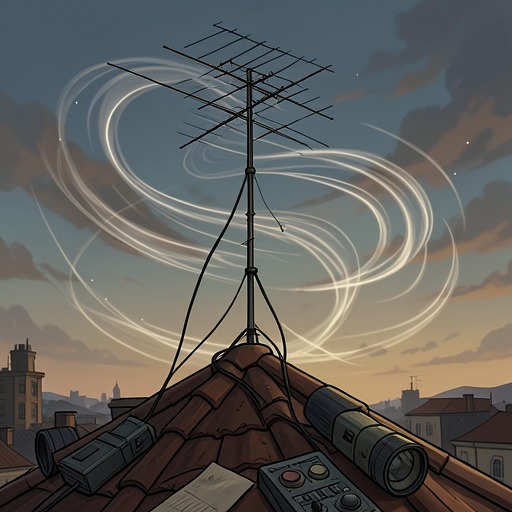
Marie-Laure’s wartime attempt to raise an antenna from the house chimney offers a further contrast. She hopes that someone—a surviving fire brigade, the Resistance, the Americans, the Germans, or Etienne LeBlanc—might be listening, and imagines that even a flicker of hope could reach him. That is a bid to establish contact in the present; the old recording, by contrast, carries speech forward from the past. The two forms of radio connection make voices endure in different ways, without making the recording itself a live transmission.
The Promise to Jutta
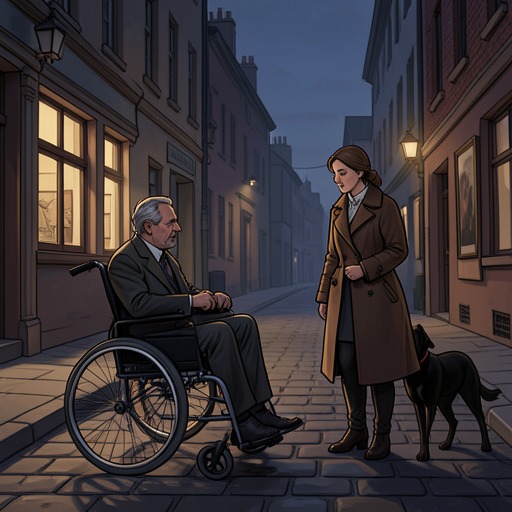
After the war, Jutta says she wants Marie-Laure to have the little model house, believing it will be better with her. Marie-Laure responds not by accepting the exchange in silence but by bringing the old recording into their conversation. She remembers that it was about the moon; Jutta recalls the associated question of light on the other side. Marie-Laure then offers to mail the old record, adding that Max might like it. The offer makes the surviving audio a prospective gift, extending a family artifact into Jutta’s household and toward her son.
Memory Across Generations
The recording’s closing-scene importance lies in its movement between salvage, recollection, and intended sharing. Its survival depends on someone returning to a sold house and rescuing what remained; its meaning is renewed when Marie-Laure remembers its subject with Jutta; and its future use rests on the promise to send it by mail. The episode does not state that the record is ultimately delivered or played. Instead, it ends with the possibility of transmission: a voice preserved from an earlier generation may still enter the life of a child who was not there when it was made.